

On this page
Pick a peepal leaf and look at its end. The broad, roughly heart-shaped blade suddenly narrows into a long, thin tail. Botanists call a tip like this a drip tip, and it is one of the most familiar leaf shapes in tropical rainforests. The research on why it exists is less settled than a one-line textbook answer suggests.
What is a drip tip on a leaf?
A drip tip is a long, narrow, pointed extension at the end of a leaf blade that channels rainwater off the leaf. A 2012 study in Biotropica by Ana Malhado and colleagues calls drip tips a common feature of rainforest leaves whose functional significance "remains contested".
The same team combined leaf-tip records for 2,786 species, taken from floras and herbarium images, with data on 83,868 trees in 130 forest plots across the Amazon. On average, 32% of species and 33% of trees in a plot had drip tips. Drip tips were tied more strongly to how much rain fell in the wettest three months of the year than to total yearly rainfall or the length of the dry season. That suggests the trait follows heavy downpours, not just a wet climate.
Why do rainforest leaves have drip tips?
The most widely accepted idea, as the Malhado paper explains, is that drip tips help the leaf drain and dry, which slows the growth of epiphylls: fungi, lichens, mosses and algae that live on leaf surfaces. Other suggestions: a dry leaf gets more light to its chloroplasts, keeps transpiring, and needs less tissue to carry the weight of water.
Early evidence came from a 1985 study by Lightbody of Piper plants at 18 sites in a cloud forest. As summarised in the Malhado paper, leaves from wetter sites had longer tips, and leaves with experimentally shortened tips shed water more slowly.
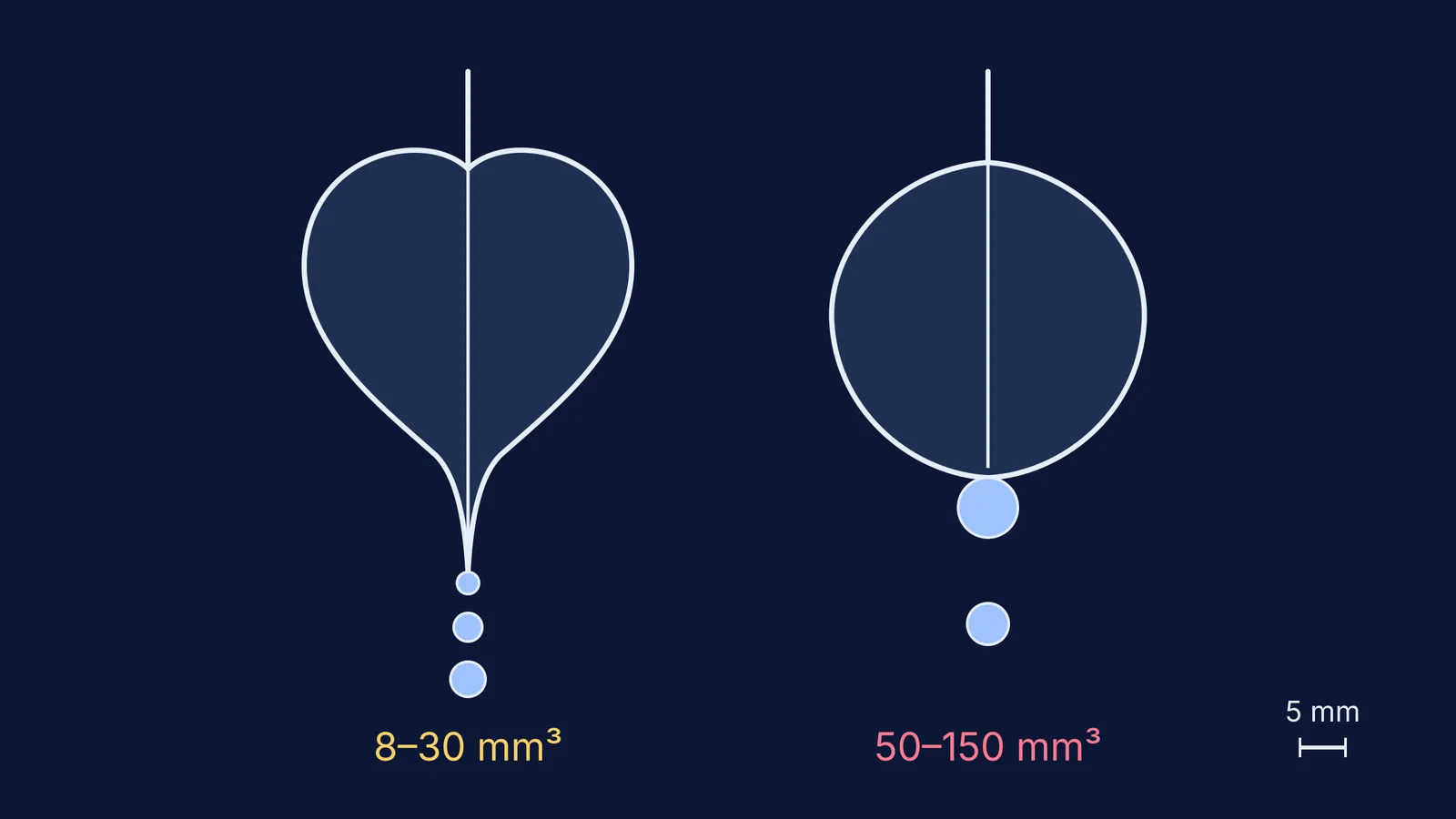
The physics shows up clearly in a 2005 experiment by Lücking and Bernecker-Lücking with artificial leaves in Costa Rica. On leaves with drip tips, water ran off in small, frequent drops of 8 to 30 cubic millimetres. On leaves without them, water pooled near the end and fell in large drops of 50 to 150 cubic millimetres.
Do drip tips really stop fungus growing on leaves?
Here the evidence splits. In a 2001 study, Christopher Ivey and Naamal DeSilva cut back the drip tips on leaves of several species. According to the Malhado summary, fungi turned up about 1.7 times as often on the trimmed leaves, which also held about 2.3 times as much water as the two control groups.
But Martin Burd's 2007 test in Panama removed the tip from one leaf in each of 50 pairs of opposite leaves, on each of two understorey species. After 11 months there was no statistical difference in epiphyll cover. Burd noted that drip tips cost the plant very little, so even a small, hard-to-measure benefit could explain why they evolved.
The Costa Rica team ran their artificial leaves for 38 months and found no difference in lichen cover or species. Leaves without tips collected more debris at the end, and near the apex, lichens actually did better on leaves with drip tips.
How does the peepal leaf fit India's climate?
Peepal, Ficus religiosa, is native to India, Nepal and Pakistan. A botanical description from Hong Kong Baptist University gives its leaf apex as caudate, or tail-like, with the tail about a quarter to half the length of the blade. For its other features, see how to identify peepal, banyan and other Ficus trees.
We found no study testing what the tip does for peepal itself, so use it as an example of the drip-tip shape, not as proof of its purpose. Plants have other ways to deal with water too: the lotus uses a waxy, bumpy surface, which we explain in why water beads on lotus leaves. For where rainforests sit among other climates, see our guide to world biomes by temperature and rainfall.
Try it: a 20-minute drip-tip test
You can copy Lightbody's idea with peepal leaves.
Pick three pairs of peepal leaves of similar size, each pair from the same twig.
Snip the tail off one leaf in each pair. Leave the other whole.
Hang all six leaves tip down from a string, side by side.
Spray each leaf with the same number of squirts from a spray bottle.
For each leaf, count the drops in the first minute and note when the last drop falls.
Compare the trimmed and whole leaf in each pair.
If the studies above hold, whole leaves should give more, smaller drops and finish dripping sooner. The test says nothing about fungi; say so in your write-up.
If the water side of this is shaky, such as why drops gather at the lowest point and when they let go, the Fermi Concept Library has a lesson for each concept in physics, chemistry, biology and mathematics. Next time you pass a peepal tree after rain, watch the tips: that is the experiment, running for free.


