

On this page
The *Ficus* genus, part of the mulberry family (Moraceae), contains approximately 850 accepted species of woody plants (Wikipedia). From the sacred peepal to the sprawling banyan, these plants are central to both ecology and culture. But how do you recognize a *Ficus*, and how do you tell its most famous species apart?
What features do all Ficus trees share?
Despite their varied appearances, all members of the *Ficus* genus share a set of unique identifying traits.
First, all *Ficus* species produce a white to yellowish latex, or sap, when their leaves or stems are broken (Wikipedia). This latex is often so abundant that it gave the rubber fig (*Ficus elastica*) its common name. They also feature paired stipules—small leaf-like structures—that protect their young buds, and their leaves typically have lateral veins at the base that form a tight angle with the midrib.
Their reproductive structure is even more unusual. The "fruit" of a *Ficus* is actually a syconium, which is an urn-shaped receptacle containing numerous tiny flowers on its inner surface. Because the flowers are hidden inside, figs rely on highly specialized wasps that enter through a tiny opening called an ostiole to pollinate them. This mutualism is a classic example of co-evolution: most fig species are pollinated by only one or a few specific wasp species, and without their wasp, the tree cannot produce seeds (Wikipedia).
Ecologically, *Ficus* trees act as keystone species in tropical forests because their syconia provide a critical, year-round food resource for birds, bats, and monkeys.
How do you identify a banyan (*Ficus benghalensis*)?
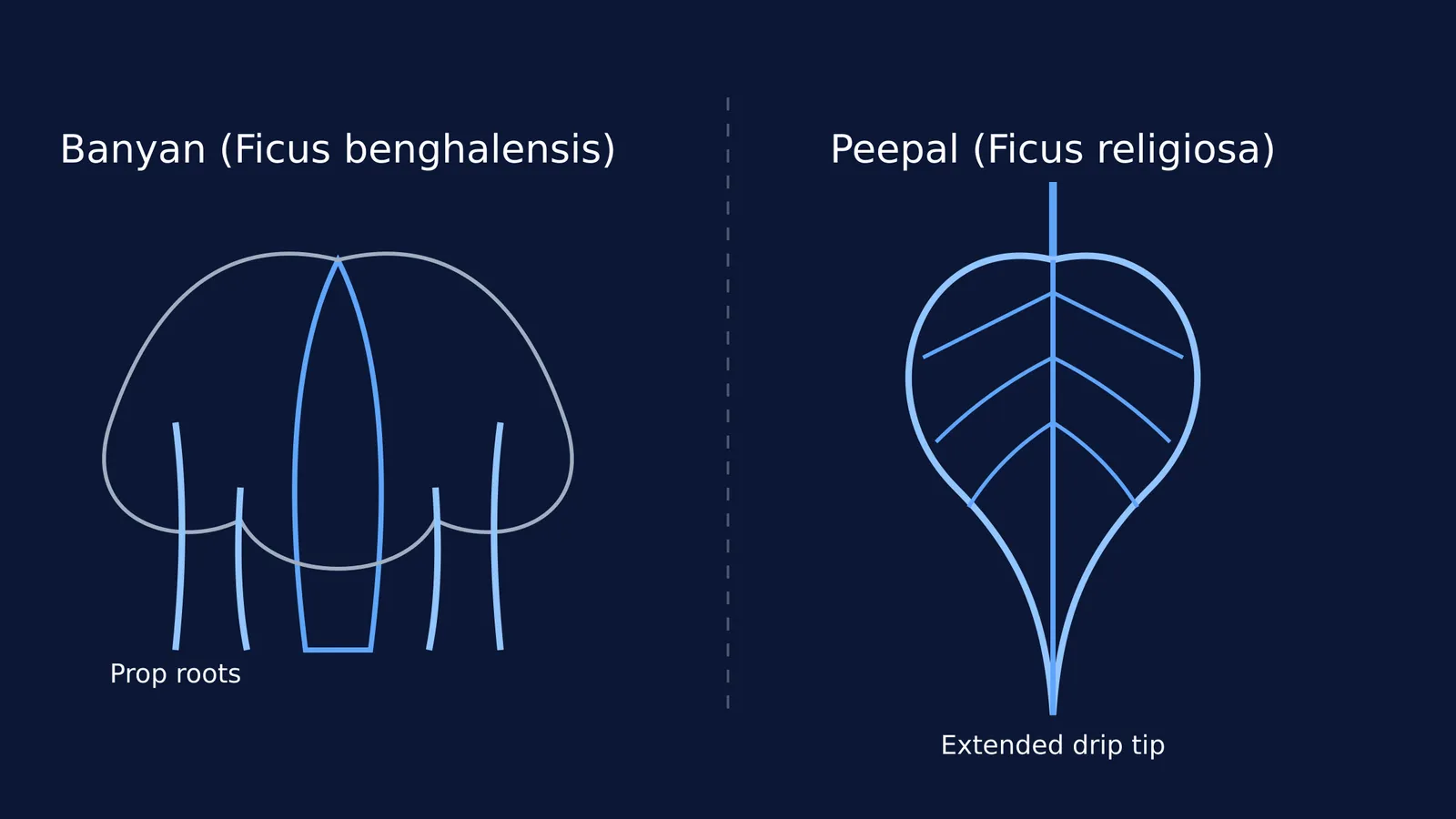
The Indian banyan (*Ficus benghalensis*) is recognized by its massive, spreading canopy and its distinctive root system (Wikipedia).
Unlike most trees, the banyan develops extensive propagating aerial roots. These prop roots grow downwards from horizontal branches until they reach the ground, where they take root and thicken into sturdy woody trunks. This structural support allows a single banyan tree to spread outward almost indefinitely. For example, the largest known specimen, Thimmamma Marrimanu in Andhra Pradesh, covers over 19,000 square meters (Wikipedia). Its leaves are large, leathery, and evergreen, making it a permanent source of dense shade.
Many *Ficus* species, including the banyan, can grow as "strangler figs." They begin life as seeds dropped by birds in the canopy of a host tree, sending down roots that eventually envelop the host trunk, sometimes killing the host as they compete for sunlight and space.
What is the function of the peepal leaf's drip tip?
The peepal or sacred fig (*Ficus religiosa*) looks entirely different from the banyan and is famous as the tree under which Gautama Buddha attained enlightenment (Wikipedia).
Its most striking feature is its foliage. The peepal leaf is cordate (heart-shaped) and ends in a distinctive, extended drip tip. This extended tip is an evolutionary adaptation to wet habitats; it facilitates the rapid shedding of rainwater from the leaf surface (Wikipedia). By keeping the leaf surface dry, the drip tip helps maintain high rates of transpiration. Furthermore, preventing water from pooling deters the growth of epiphylls such as algae, fungi, and lichens that could otherwise block sunlight. Unlike the evergreen banyan, the peepal is semi-evergreen or deciduous, shedding its leaves during the dry season.
Why learn plant morphology?
When studying plant biology, you will need to classify plant structures and understand adaptations like the prop roots of the banyan, or how plants respond to light and gravity through tropic movements in plants. Understanding these differences goes beyond simple identification. Recognizing a syconium helps you classify the Moraceae family, and identifying a drip tip helps you infer the plant's native climate. Learning to connect structure to function transforms rote memorization into active understanding.
If you are trying to picture how different root modifications work, the Fermi Concept Library can break down the terminology. Fermi's AI tutor can also walk you through the morphology of flowering plants, asking questions to check your understanding as you go. You can further explore the anatomy of flowering plants and the morphology of flowering plants to see how stems, roots, and leaves vary across different plant families.


