

On this page
You can test the laws of reflection for sound with things found in any school lab: two tubes, a ticking clock, a hard flat surface and your own ear. The experiment is simple, but it is easy to get a muddled result, and examiners like to ask why the setup is built the way it is. Here are the laws, the setup step by step, a sample record, and the one surface choice that ruins everything.
What are the laws of reflection of sound?
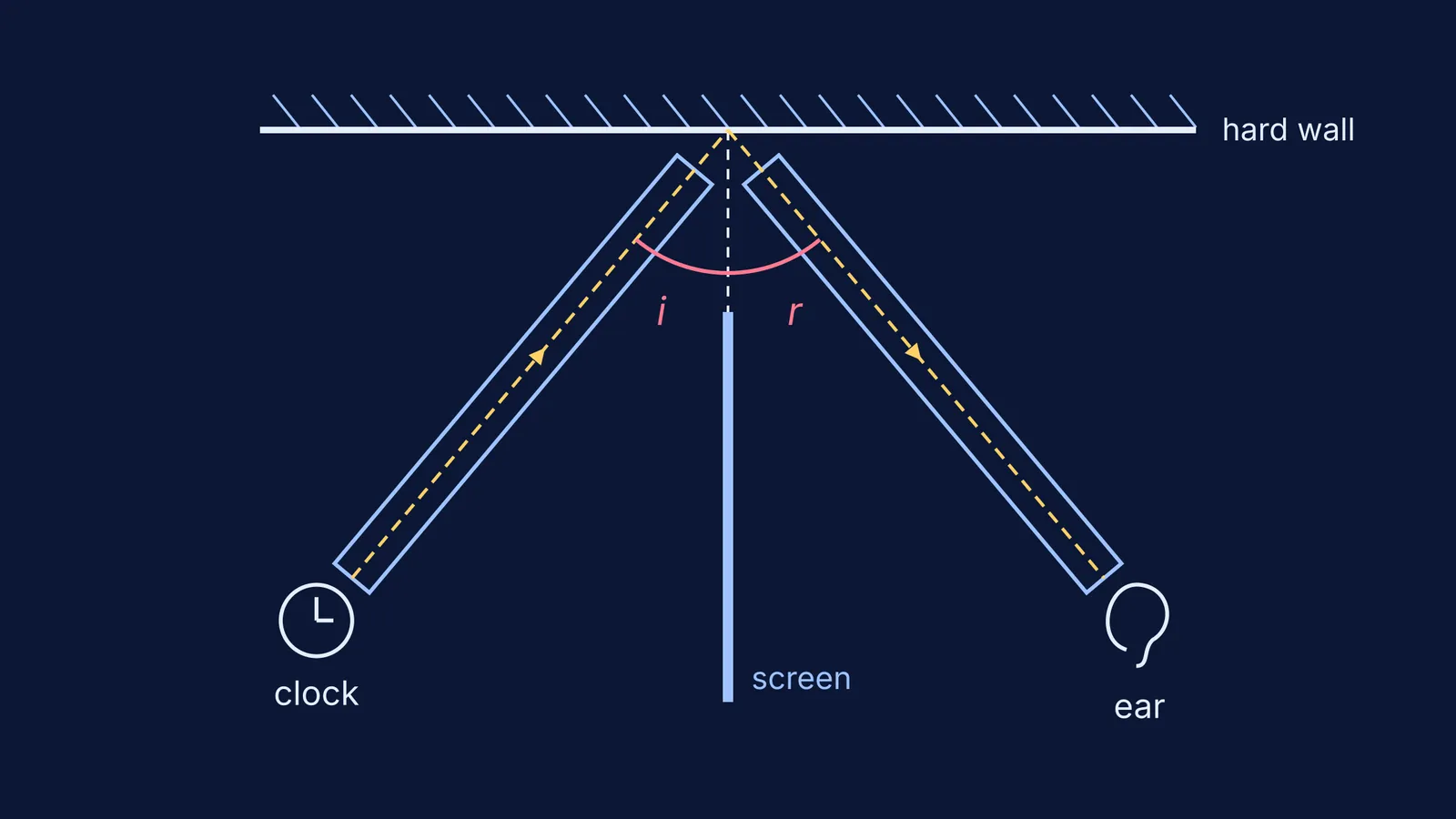
NCERT's Grade 9 science textbook, Exploration, says that sound follows the same laws of reflection as light (NCERT, Chapter 10, Sound Waves: Characteristics and Applications, section 10.7). As two laws:
The angle of incidence equals the angle of reflection, both measured from the normal to the surface at the point of incidence.
The incident sound, the reflected sound and the normal all lie in the same plane.
The same section gives the echo as one of the most common examples. For the numerical side, see our guide to measuring the speed of sound using an echo.
How do you verify the laws of reflection of sound with two tubes?
You need two identical tubes (cardboard, PVC or metal), a watch with a clear tick, a smooth hard surface such as a wall, board or metal plate, drawing paper, a protractor and stiff cardboard for a screen.
Fix the paper flat on the table against the hard surface. Draw the surface's edge, mark a point P on it, and draw the normal at P.
Stand the cardboard screen upright along the normal. It stops sound going straight from the clock to your ear, so anything you hear has bounced off the surface.
Lay the first tube on the paper, aimed at P, at a chosen angle to the normal, say 30 degrees. Put the clock at its far end.
Lay the second tube on the other side of the normal, also aimed at P, and put your ear to its far end.
Swing the second tube slowly and stop where the tick sounds loudest. Draw along it and measure its angle from the normal. That is the angle of reflection.
Repeat for two more angles, such as 45 and 60 degrees.
Both tubes and the normal lie flat on the same sheet of paper, so the incident sound, the reflected sound and the normal share one plane, as the second law describes.
What does a sample observation record look like?
These are made-up example readings to show the format, not measured data:
Incidence 30 degrees, loudest at 31 degrees
Incidence 45 degrees, loudest at 44 degrees
Incidence 60 degrees, loudest at 60 degrees
Your ear judges loudest over a small range, so readings within a few degrees count as equal. Note that as a source of error rather than nudging numbers to match. For more on honest records, see how to keep a lab notebook as a science student.
Why does a soft cloth surface spoil the result?
NCERT says echoes are stronger from hard, smooth surfaces, that soft surfaces like curtains tend to absorb sound, and that rough surfaces scatter it in different directions (NCERT Grade 9, section 10.7.1). With a cloth surface, the reflected tick can be so faint that there is no clear loudest position to find. With a rough one, the loudest position turns fuzzy.
The absorption coefficient is the fraction of sound energy a surface absorbs, a number between 0 and 1 that usually changes with frequency (Handbook for Acoustic Ecology, Simon Fraser University). That handbook's table, after Olson's Music, Physics and Engineering, lists unpainted concrete at 0.016 and velour drapery hung straight against a wall at 0.35, both at 512 Hz (SFU handbook). At that frequency, the heavy cloth absorbs more than 20 times the fraction that bare concrete does.
What questions come up in the practical viva?
Practise answering each in a sentence or two:
Why the screen? To block direct sound, so you hear only the reflected sound.
Why tubes? They narrow the sound into a beam whose direction you can measure.
Why a hard surface? It reflects most of the sound; soft surfaces absorb it and rough ones scatter it.
Why no echo in a small room? NCERT says two sounds must arrive at least 0.1 s apart to be heard separately, which at 340 m/s puts the reflecting surface at least 17 m away (NCERT Grade 9, section 10.7.1).
If echo numericals trip you up, the Fermi Problem Library has worked problems with a step-by-step solver that explains the reasoning rather than printing an answer. Then try finding distances from echoes between two cliffs. If the normal or the angle of incidence still feels shaky, the Fermi Concept Library gives each physics concept its own lesson.


