

On this page
When you perform an experiment in school or college, you often work from a printed lab manual and later write up a neat "practical file" to be graded. But between those two steps lies the most important tool in experimental science: the lab notebook.
Unlike a textbook or a final report, a lab notebook is a messy, chronological record of what actually happened at the bench. It contains raw data, unexpected colour changes, instrument errors, and crossed-out mistakes. Learning how to keep one properly is a core skill for any science student preparing for a career in research.
Why do research labs insist on this habit?
In a professional setting, a lab notebook is not a personal diary. It is a legal document owned by the institution. It protects intellectual property, proves who made a discovery first, and ensures that experiments can be reproduced by others.
When scientists fail to keep good records, the consequences are severe. The US Office of Research Integrity (ORI) noted that in misconduct investigations, incomplete or inadequate records accounted for 30% of the problems encountered. Furthermore, research data is fragile if not properly documented. A 2014 study by Vines et al. in *Current Biology* found that the odds of obtaining the raw data for a paper fell by 17% every year after publication, often because notebooks are lost, illegible, or lack crucial context.
To prevent this, modern laboratories, including those funded by the National Institutes of Health, train their researchers to follow the ALCOA+ principles. This framework demands that every entry be Attributable, Legible, Contemporaneous (recorded at the time, not later), Original, and Accurate.
How to write a lab notebook entry?
If you are setting up your first notebook for a science project or preparing organic compounds, start by choosing a bound notebook rather than loose sheets or a spiral pad. Number the pages so none can be secretly removed or added later.
For every experiment, your entry should include:
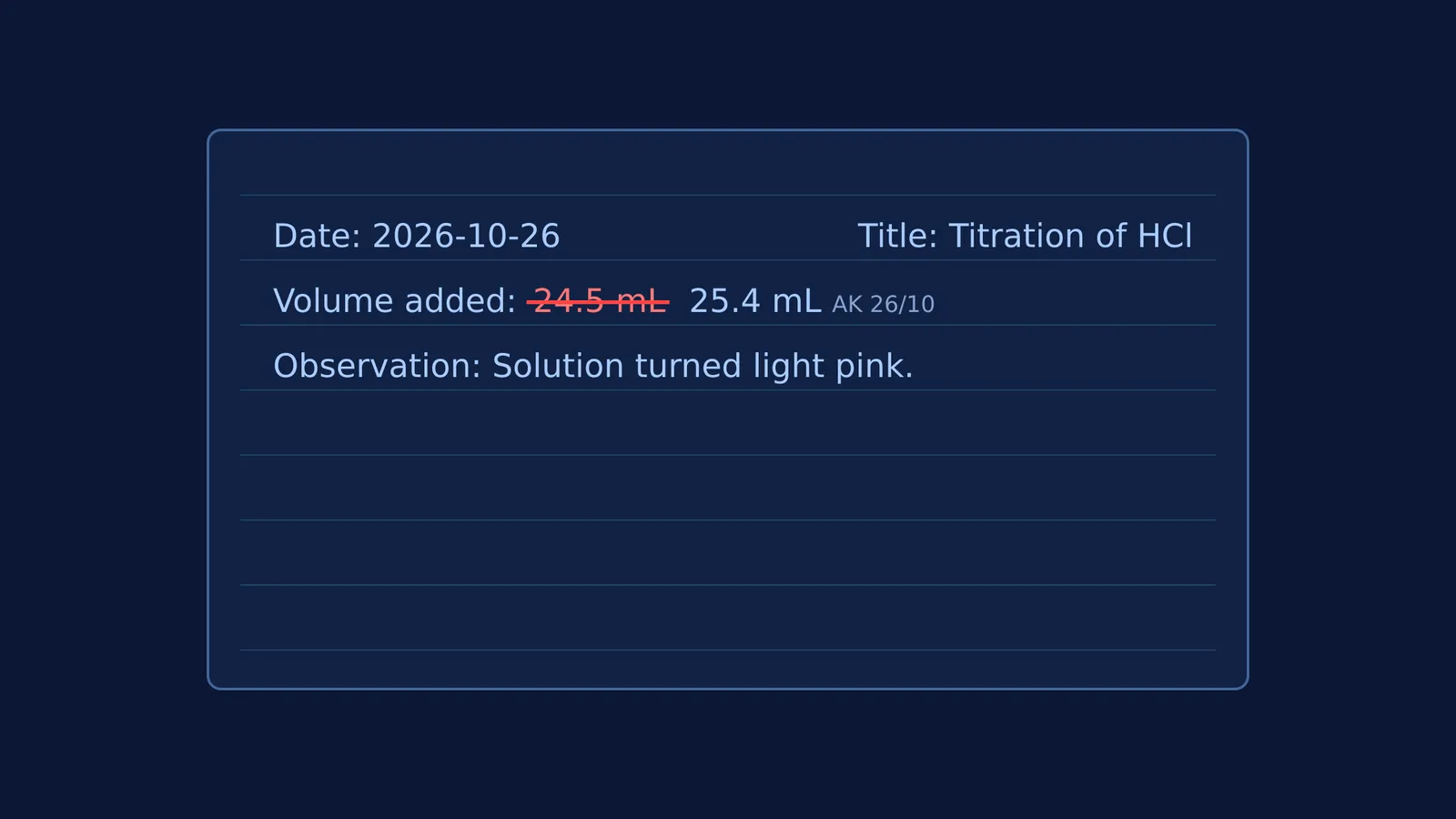
Date and title: Always date your work. In professional labs, entries are often signed by the researcher and sometimes a witness to prove when an idea was first tested.
Objective: A one-sentence goal for the day's work. What are you trying to find out?
Materials and methods: Write down exactly what you used, including concentrations, lot numbers, and equipment settings. If you deviate from the standard protocol—such as heating a flask for 20 minutes instead of 15—record the change immediately.
Raw data: Record numbers directly into the notebook as you read them off the instrument. Never write data on a scrap of paper or your hand to copy over later, as this increases the chance of transcription errors.
What to do when an experiment fails?
Students are often tempted to leave failed runs out of their records, believing that only the "right" answer matters. In reality, a failed experiment is a valid observation. If a solution did not precipitate or a circuit failed to produce the expected current, write it down. Record the ambient temperature, any delays in mixing, or a loose connection. This raw information is how you figure out what went wrong.
If your experimental results do not match the theory and you cannot see why, it usually points to a gap in your understanding of the underlying physics or chemistry. If you are struggling to picture the setup, the Fermi Simulation Lab provides interactive simulations for the ideas that are easier to see than to read. If you do not know where to begin fixing your method, Fermi's AI tutor can work out what you already know and build a plan for the session.
A checklist for science students
Before you leave the bench, check your notebook against these student-friendly ALCOA+ standards:
Did I write today's date and the title of the experiment?
Did I record the data directly into the book as it happened?
Are all my mistakes crossed out with a single line, rather than erased?
Did I note down any accidental spills, delays, or changes to the instructions?
Is the handwriting clear enough that my lab partner could read it and repeat the work tomorrow?
Building this habit now ensures that when you walk into a university laboratory, you are already thinking and recording like a scientist.


