

On this page
Tie an overhand knot in a shoelace and join the two loose ends. No amount of wiggling will untie it now, and proving claims like that is what knot theory is for.
What is knot theory?
Knot theory is the branch of topology that studies mathematical knots: closed loops in three-dimensional space, like a tangled string with its ends glued together (Wikipedia, Knot theory). The simplest is a plain ring, called the unknot. Two knots are the same if you can move one into the shape of the other without cutting the string or passing it through itself.
In the 1860s Lord Kelvin guessed that atoms were knots in the aether, which led Peter Guthrie Tait to publish a table of knots with up to ten crossings in 1885 (Wikipedia, Knot theory). The atom idea died; the tables grew. There is 1 prime knot (one that is not two smaller knots joined together) with three crossings, 2 with five and 1,388,705 with sixteen (OEIS A002863). Jim Hoste, Morwen Thistlethwaite and Jeff Weeks described listing all of them up to sixteen crossings in a 1998 paper, The first 1,701,936 knots.
When are two knots the same?
Mathematicians study knot diagrams: drawings of a knot's shadow, with a break in the line wherever one strand passes under another. One knot can be drawn in endless ways. In 1927 Kurt Reidemeister proved that three local moves connect any two diagrams of the same knot (Reidemeister, 1927); James Alexander and Garland Briggs reached the same result independently (Wikipedia, Reidemeister move).
Twist (type I): add or remove a kink in one strand.
Poke (type II): slide one strand over another, adding or removing two crossings.
Slide (type III): move a strand across a crossing of two others.
So to prove two knots are different, you find a property that none of the three moves can change, called a knot invariant, and show that the knots disagree on it.
How do you prove the trefoil cannot be untied?
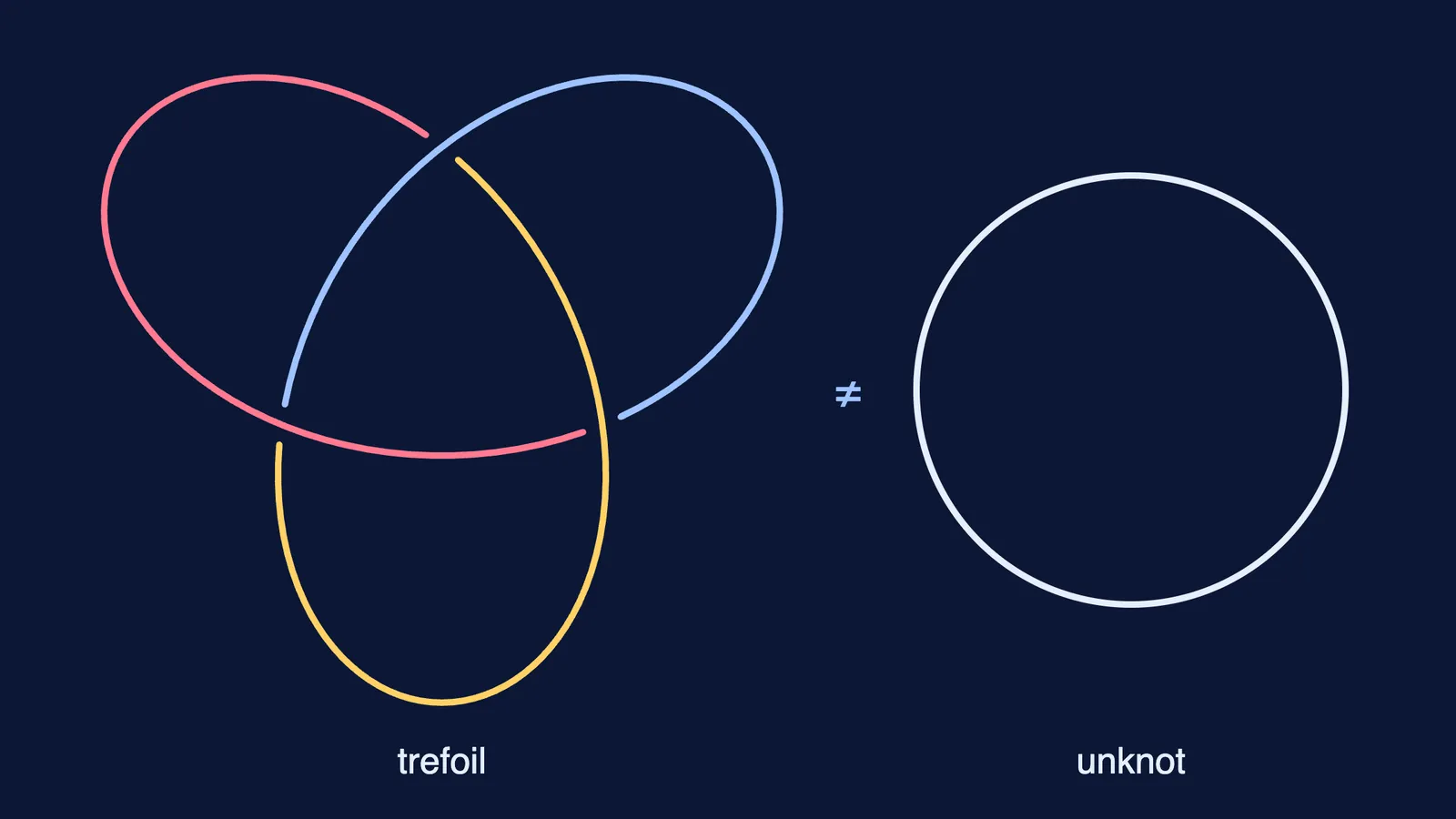
The trefoil is the simplest knot other than the unknot, and the only knot with crossing number three (Wikipedia, Trefoil knot). The easiest invariant that separates it from the unknot is tricolourability (Wikipedia, Tricolorability). Try it with three pens.
Draw the trefoil, leaving a gap wherever a strand goes under.
Count the arcs, the unbroken lines from one gap to the next. There are three.
Learn the rules: use at least two colours, and at each crossing the three arcs that meet must be all the same colour or all different.
Give each arc its own colour. Every crossing shows three different colours, so the trefoil passes.
Try a plain circle. It has one arc, so it gets one colour and fails.
Reidemeister moves never change whether a diagram can be tricoloured (Wikipedia, Tricolorability), so no sequence of moves turns the trefoil into the unknot. The test has limits: the figure-eight knot fails it too, though it is knotted.
For another shape that behaves oddly when you deform it, read about August Möbius and his one-sided strip.
Why do DNA researchers care about knots?
Some DNA molecules are closed loops, and loops can knot and link. Recombination and replication frequently produce knotted or interlinked DNA, and telling these forms apart with gel electrophoresis and electron microscopy lets researchers work out how those reactions proceed (Wasserman and Cozzarelli, Science, 1986).
In DNA from a tailless mutant of the virus bacteriophage P4, 95% of the molecules were knotted; comparing the knot types with simulations showed that the DNA is packed in a non-random, chiral way (Arsuaga and colleagues, PNAS, 2005).
Cells untangle DNA with enzymes called topoisomerases. Type II topoisomerases cut both strands of one segment and pass another double helix through the break, which lets them resolve knots and catenanes, or linked DNA rings (Sutormin and colleagues, Acta Naturae, 2021). In knot theory terms, that cut-and-pass switches a crossing. Our explainer on what helicase and topoisomerase do in DNA replication gives the school-level picture.
How can you start exploring knot theory?
Try this plan, one short session a day, with string, tape, paper and three pens.
Tie a trefoil in string, tape the ends together, and try to untie it without cutting.
Practise each Reidemeister move on a drawn loop.
Tricolour the trefoil, then explain in writing why a circle cannot be tricoloured.
Give a paper strip three half-twists, tape the ends and trace its edge: you get a trefoil (Wikipedia, Trefoil knot).
Explain to a parent how a topoisomerase's cut-and-pass changes one crossing.
If a step does not click, Fermi's AI tutor can draw the figure and check your understanding as it goes, and the Fermi Concept Library has its own lesson for each concept in mathematics and biology you meet on the way.
Start with step 1 tonight; one piece of string is enough.


