

On this page
The CBSE Class 12 chemistry practical for 2026-27 asks you to find the molarity of a KMnO4 solution by titrating it against a standard solution of oxalic acid or ferrous ammonium sulphate (Mohr's salt), and you must prepare that standard solution by weighing it yourself, according to the CBSE 2026-27 chemistry curriculum. The same document gives volumetric analysis 8 of the 30 practical marks. Here is the Mohr's salt version: the chemistry, the calculation and the mistakes that cost those marks.
What happens in the flask during the titration?
Mohr's salt is ferrous ammonium sulphate, Fe(NH4)2(SO4)2·6H2O, with a molar mass of 392.1 g/mol (PubChem). The iron in it is Fe²⁺, and acidified permanganate oxidises it to Fe³⁺.
The NCERT Class 12 textbook writes the reaction as 5Fe²⁺ + MnO4⁻ + 8H⁺ → Mn²⁺ + 4H2O + 5Fe³⁺ (NCERT, The d- and f-Block Elements). Manganese drops from +7 to +2, taking 5 electrons, while each Fe²⁺ gives up only one. So one mole of KMnO4 reacts with five moles of Mohr's salt. That 1:5 ratio is the whole calculation.
The acid in the flask is dilute sulphuric acid. The same NCERT chapter notes that permanganate titrations in hydrochloric acid are unsatisfactory because HCl is oxidised to chlorine. We explain this in more detail in why dilute sulphuric acid is used in KMnO4 titration, not HCl.
Why is no indicator used in KMnO4 titration?
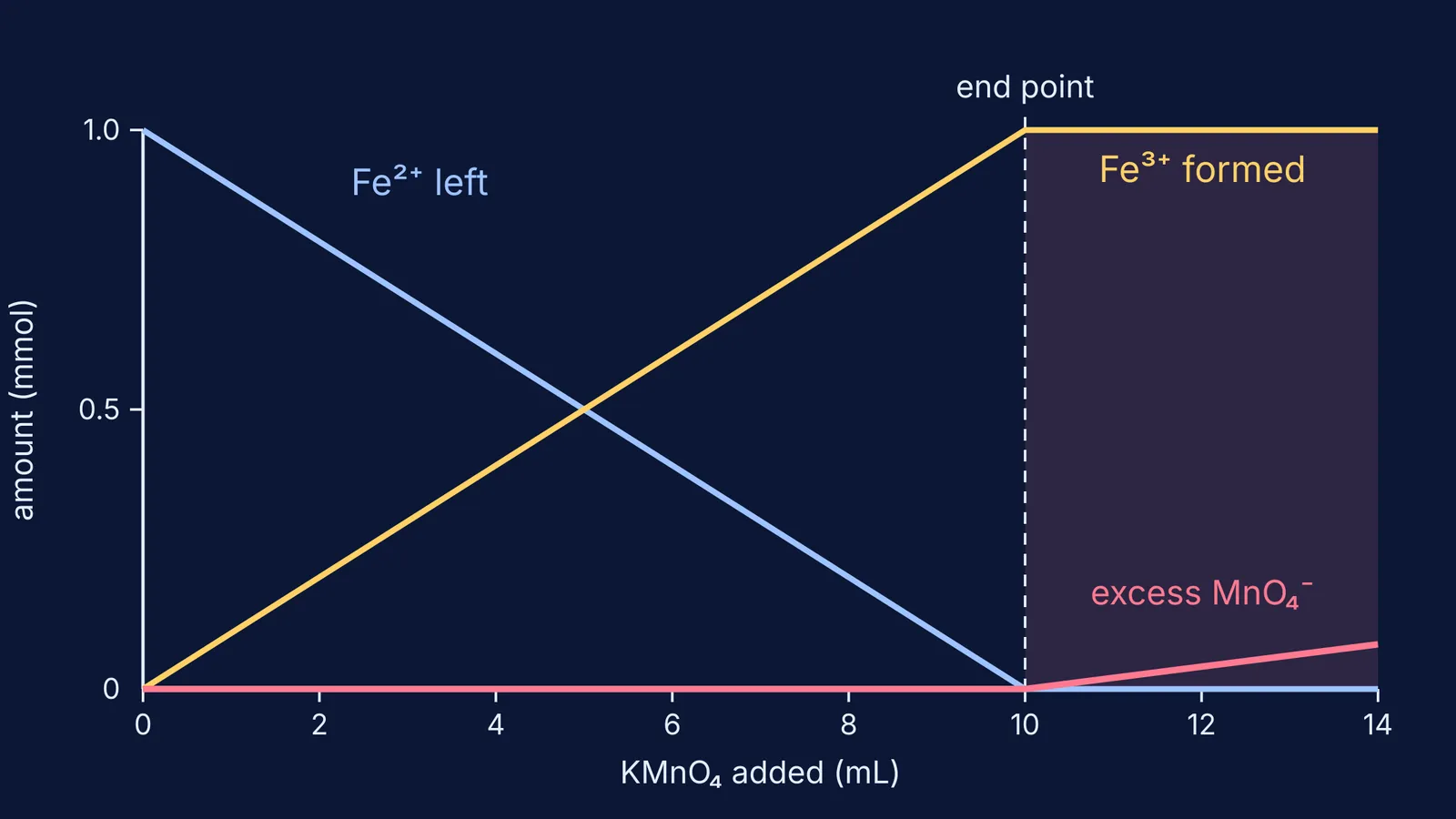
Permanganate is its own indicator: the intensely purple MnO4⁻ ion is reduced to Mn²⁺, which is almost colourless (Harvey, Analytical Chemistry 2.1/09:_Titrimetric_Methods/9.04:_Redox_Titrations)).
While any Fe²⁺ is left in the flask, each drop from the burette is used up and its colour vanishes as you swirl. Once the last Fe²⁺ has been oxidised, the next drop has nothing to react with, so its pink stays. That is why the end point is written as colourless to permanent pale pink (BYJU'S practical write-up).
How do you calculate the molarity of KMnO4 from Mohr's salt?
Use a1M1V1 = a2M2V2, where a is the number of electrons each species gains or loses: 5 for KMnO4 and 1 for Mohr's salt. Here is a full worked example with typical numbers, using the molar masses from PubChem for Mohr's salt (392 g/mol, rounded) and PubChem for KMnO4 (158 g/mol, rounded).
Standard solution: dissolve 4.9 g of Mohr's salt and make it up to 250 mL. Molarity = (4.9 × 1000) ÷ (392 × 250) = 0.05 M.
Pipette 20.0 mL of this solution into a conical flask and add dilute sulphuric acid.
Titrate with KMnO4 from the burette. Readings: 10.1 mL (rough), then 10.0 mL and 10.0 mL. The concordant value is 10.0 mL.
Apply the formula: 5 × M1 × 10.0 = 1 × 0.05 × 20.0, so M1 = 1.0 ÷ 50 = 0.02 M.
Strength = molarity × molar mass = 0.02 × 158 = 3.16 g/L.
For more numericals like this, the Fermi Problem Library has worked problems with a step-by-step solver that explains the reasoning rather than printing an answer, so you can check where your 5 went.
What mistakes cost marks in this practical?
Forgetting the 5. Without it you get 0.1 M, five times too high.
Using 392 for KMnO4 strength. 392 is Mohr's salt; the strength of KMnO4 uses 158.
Reading the wrong meniscus. KMnO4 is too dark to see the bottom of the curve, so read the upper meniscus, as the BYJU'S write-up advises.
Overshooting. A deep pink means you went past the end point. Add dropwise near the end and stop at the first pale pink that lasts.
Copying the oxalic acid method. NCERT writes the oxalate reaction at 333 K, which is why that titration is warmed; the Fe²⁺ equation in the same chapter carries no such condition.
Rinsing the wrong glassware. See why burettes are rinsed with solution and flasks only with water.
The CBSE curriculum gives class record and viva 4 of the 30 practical marks, so practise saying the reasons aloud, not just writing the formula.
What if the question asks for percentage purity instead?
Find the strength in g/L from the titre, then compare it with how much sample you dissolved per litre. Our guide to finding the percentage purity of a sample by titration works through that version.
If the 1:5 ratio still feels like a rule to memorise rather than something you can derive, the redox and oxidation-number lessons in the Fermi Concept Library are a good place to rebuild it from the half-equations.


