

On this page
Titration is a fundamental technique in analytical chemistry used to find the exact concentration or mass of a specific substance in a solution. When a sample is impure—meaning it contains the target chemical mixed with unreactive substances—titration helps you determine exactly how much of the pure chemical is actually present. By comparing this pure mass to the original mass of the sample, you can calculate its percentage purity.
If you are struggling to picture the stoichiometry behind these reactions, the Fermi Concept Library breaks down balancing equations and mole ratios step by step.
How does a titration determine percentage purity?
In any titration, you slowly add a solution of known concentration (the titrant) to a solution containing your impure sample (the analyte) until the chemical reaction between them is perfectly complete. This completion point, often signalled by a colour change from an indicator, allows you to measure the exact volume of titrant used.
As detailed in OpenStax *Chemistry 2e*, the volume and concentration of the titrant tell you precisely how many moles of the standard solution reacted. Because the reaction follows a balanced chemical equation, you can use the stoichiometric ratio to find the exact number of moles of the pure substance in your sample.
Once you know the moles of the pure substance, you multiply by its molar mass to find its actual mass in grams. The impurities in the sample do not react with the titrant, so they do not affect this calculated mass.
What is the formula for percentage purity in titration?
The calculation relies on the standard mass percent formula. Once you have used the titration data to find the mass of the pure substance, you apply this formula:
Percentage Purity = (Mass of pure substance / Total mass of impure sample) × 100
Mass of pure substance: The actual mass you calculate from the titration results.
Total mass of impure sample: The initial mass of the powder or solid you weighed out on the balance before dissolving it for the experiment.
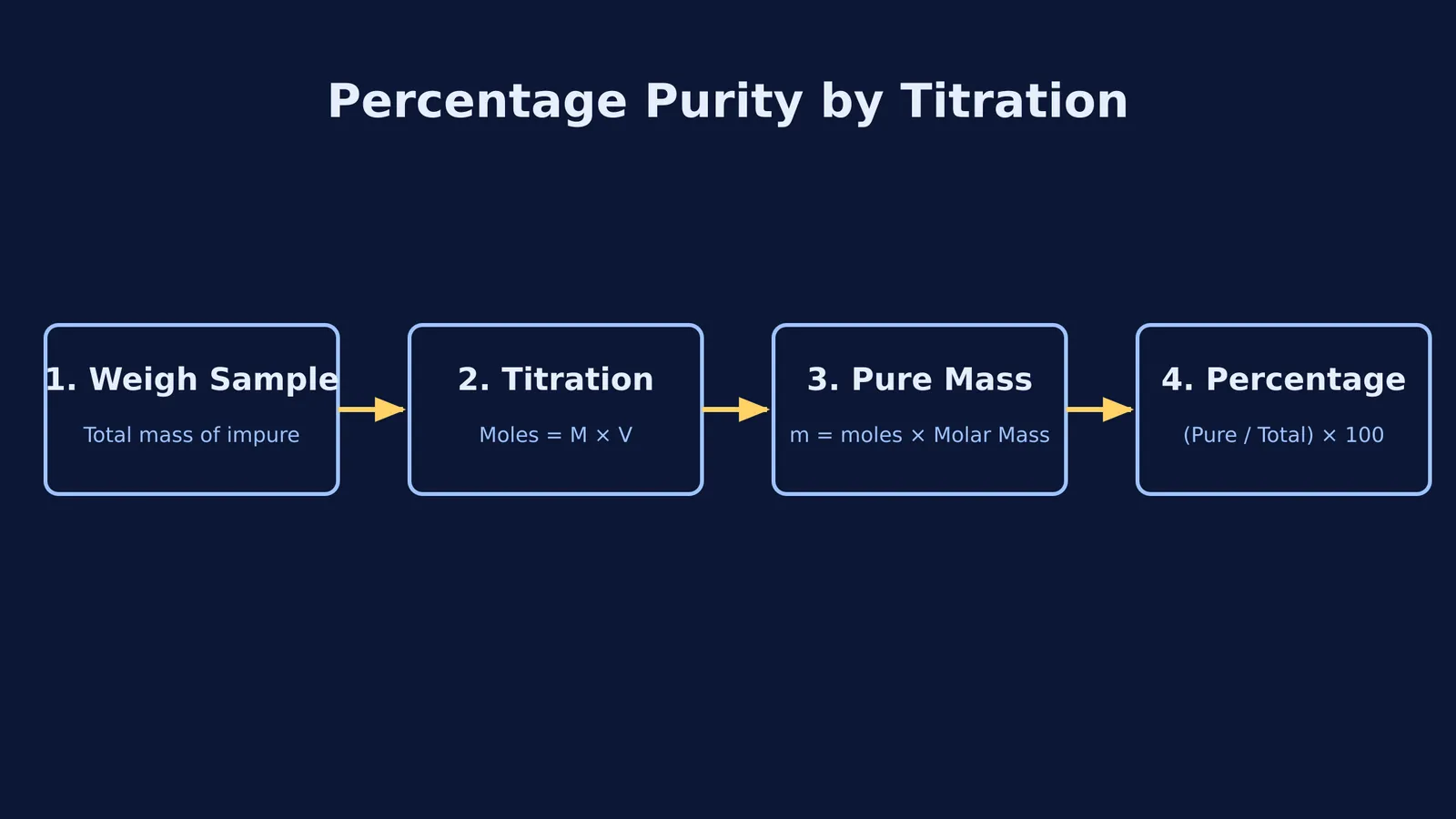
Step-by-step: How to calculate percentage purity by titration?
Here is the standard four-step framework for solving any percentage purity problem in your chemistry practicals or exams, as explained in OpenStax *Chemistry 2e*:
Find the moles of the titrant:
Multiply the molarity (concentration in mol/L) of the titrant by the volume used (in L). Moles of titrant = Molarity × Volume
Use stoichiometry to find the pure analyte:
Look at the balanced chemical equation. If the ratio of titrant to analyte is 1:1, the moles are equal. If the ratio is 2:1 (for example, 2 moles of sodium hydroxide reacting with 1 mole of an acid), divide or multiply accordingly to find the true moles of the pure analyte.
Convert moles to actual mass:
Multiply the calculated moles of the pure analyte by its molar mass (g/mol). Mass of pure substance = Moles × Molar Mass
Calculate the percentage purity:
Divide the pure mass from step 3 by the total mass of the impure sample you weighed at the start, and then multiply by 100.
A practical example of finding purity
To see this in practice, consider a classic titration calculation based on the principles outlined in OpenStax *Chemistry 2e*. Suppose you weigh out 0.500 g of an impure sample of an unknown acid. You dissolve it in water and titrate it with 0.100 M sodium hydroxide (NaOH).
If the titration requires exactly 40.0 mL (0.0400 L) of NaOH to reach the endpoint, you first find the moles of NaOH: Moles of NaOH = 0.100 mol/L × 0.0400 L = 0.00400 moles.
Assuming the balanced equation shows a 1:1 reaction ratio between the acid and the base, then your sample contained exactly 0.00400 moles of the pure acid. If the molar mass of the pure acid is 100 g/mol, the actual mass of the pure acid is: 0.00400 moles × 100 g/mol = 0.400 g.
Finally, you apply the purity formula: Percentage Purity = (0.400 g / 0.500 g) × 100 = 80%.
Your sample is 80% pure.
For situations where the reaction is too slow or the sample is completely insoluble, analytical chemists use a reverse method. You can read more about how this works in our guide to back titration calculations. If you need to prepare the standard solutions yourself before an experiment, mastering mixing and diluting solutions is the next critical lab skill. When these foundational maths skills feel overwhelming, practising with a structured guide like the Fermi Concept Library can help you build confidence before your next exam.


