

On this page
If a question gives you a five-carbon sugar and asks what you get after treating it with HCN, it is testing one idea: the Kiliani-Fischer synthesis. Learn the logic once and you can answer every version of it, including the reverse question that asks which sugar you started from.
What is the Kiliani-Fischer synthesis?
The Kiliani-Fischer synthesis is a method that makes the carbon chain of an aldose one carbon longer by forming a cyanohydrin and turning it into a new aldehyde group. It is named after the German chemists Heinrich Kiliani and Emil Fischer (Wikipedia summary, citing Carey's Organic Chemistry). Kiliani's 1885 paper on the cyanohydrin of fructose (then called laevulose) appeared in the journal Berichte der deutschen chemischen Gesellschaft (Kiliani, 1885).
The reaction runs on the open-chain form of the sugar, because that is the form with a free aldehyde group. If cyanohydrins feel shaky, revise them first with our explainer on how HCN adds to a carbonyl group.
How does HCN add one carbon to a sugar?
The carbon atom of the cyanide ion becomes the new C1. Here is the order of events, as set out in the LibreTexts organic chemistry text/25%3A_Biomolecules-_Carbohydrates/25.06%3A_Reactions_of_Monosaccharides):
Cyanide is a nucleophile, and it attacks the aldehyde carbon (C1). This gives a cyanohydrin: the old C1 now carries an OH, and a C≡N group is attached to it.
The nitrile is reduced to an imine by hydrogen over a palladium catalyst.
The imine is hydrolysed to an aldehyde, giving a new aldose with one more carbon.
The original route took longer. Heating the cyanohydrin in water hydrolysed the nitrile to a carboxylic acid, the acid closed into a lactone, and sodium amalgam reduced the lactone. The Wikipedia article puts the classic yield at around 30% and says that hydrogenation over palladium on barium sulfate gives somewhat higher yields.
Why does the Kiliani-Fischer synthesis give two sugars?
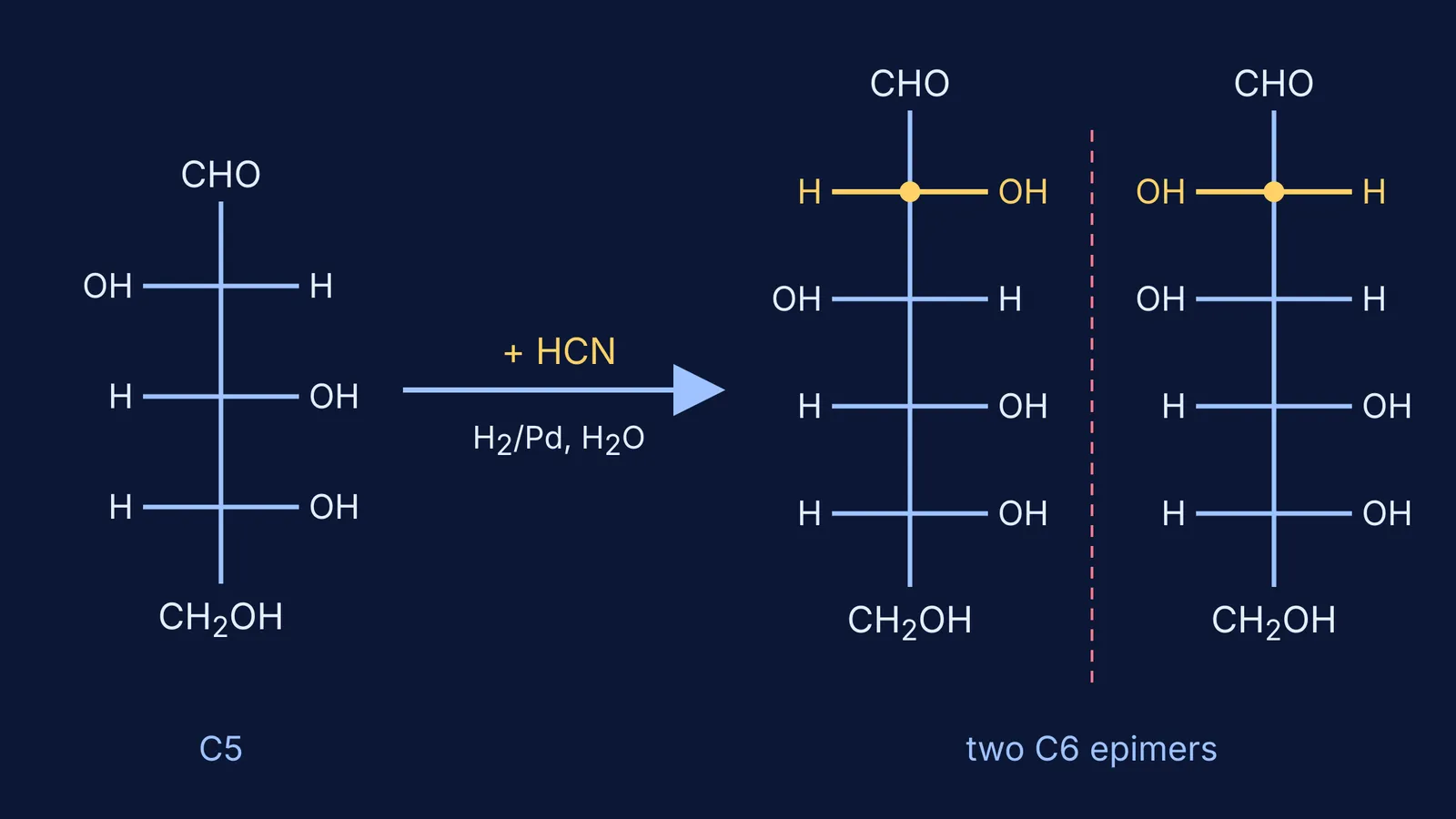
The aldehyde group is flat, so cyanide can attack from either face. That makes the old C1 into a new stereocentre with both possible configurations. The LibreTexts text/25%3A_Biomolecules-_Carbohydrates/25.06%3A_Reactions_of_Monosaccharides) puts it this way: stereochemical control is lost, so you get two cyanohydrins that differ at C2.
The two products are diastereomers that differ at only one stereocentre, so they are epimers. If you mix up epimers and anomers, our post on epimers vs anomers separates the two. Every stereocentre the starting sugar already had keeps its configuration, so both products stay in the same D or L series as the starting sugar.
Worked example: what does D-arabinose give?
According to the Wikipedia article, D-arabinose is converted into a mixture of D-glucose and D-mannose. You can predict this from the Fischer projections without memorising anything.
Write D-arabinose with the CHO at the top. The OH groups run left, right, right at C2, C3 and C4, with CH2OH at the bottom.
Add one new carbon at the top. The old C1 becomes the new C2, the old C2 becomes C3, and so on.
Copy the old OH positions down one row. C3, C4 and C5 now read left, right, right.
Draw the new C2 twice: once with its OH on the right and once on the left.
Name the results. Right, left, right, right is D-glucose. Left, left, right, right is D-mannose.
The same method works for every aldose. Master Organic Chemistry shows D-glyceraldehyde giving D-erythrose and D-threose. LibreTexts shows D-ribose giving D-allose and D-altrose. Following the pairs in the D-aldose family tree on the Wikipedia aldose page, you get:
D-ribose gives D-allose and D-altrose
D-arabinose gives D-glucose and D-mannose
D-xylose gives D-gulose and D-idose
D-lyxose gives D-galactose and D-talose
How do you answer Kiliani-Fischer questions in an exam?
Use this checklist on any chain-lengthening question:
Count the carbons. The product always has exactly one more carbon than the starting sugar.
Expect two products. Unless the question says otherwise, give both C2 epimers.
Shift, don't change. The old stereocentres keep their configuration, but each number goes up by one.
Check the bottom stereocentre. It does not change, so the D or L label stays the same.
Work backwards. Two hexoses from the same pentose must be C2 epimers. Delete C1 and renumber to find the pentose.
Going the other way, one carbon shorter, is covered in our post on how the Ruff degradation shortens a sugar.
If Fischer projections are where you get stuck, the Fermi Concept Library has a lesson for every concept in chemistry, so you can revise stereocentres and D/L notation first. For practice, the Fermi Problem Library has worked problems with a step-by-step solver that explains the reasoning rather than printing an answer.
Next step: draw both products from D-xylose yourself, then check them against the list above.


