

On this page
Every kangaroo starts life as a tiny, hairless newborn that crawls on its own to find milk. That is the reason for the pouch.
Why does a kangaroo have a pouch?
A kangaroo has a pouch because its baby is born long before it could survive in the open. The Australian Museum describes a newborn marsupial as "minute, blond, hairless and with hindlimbs only partially formed". The pouch gives that unfinished baby a protected place to keep growing while it suckles.
The word marsupial comes from the Latin *marsupium*, meaning pouch, though not all marsupials have pouches and in some species the pouch is just a fold, says the same Australian Museum page. There are over 330 species of marsupials, and around two-thirds of them live in Australia; most of the rest live in South America.
How is a joey born, and how does it reach the pouch?
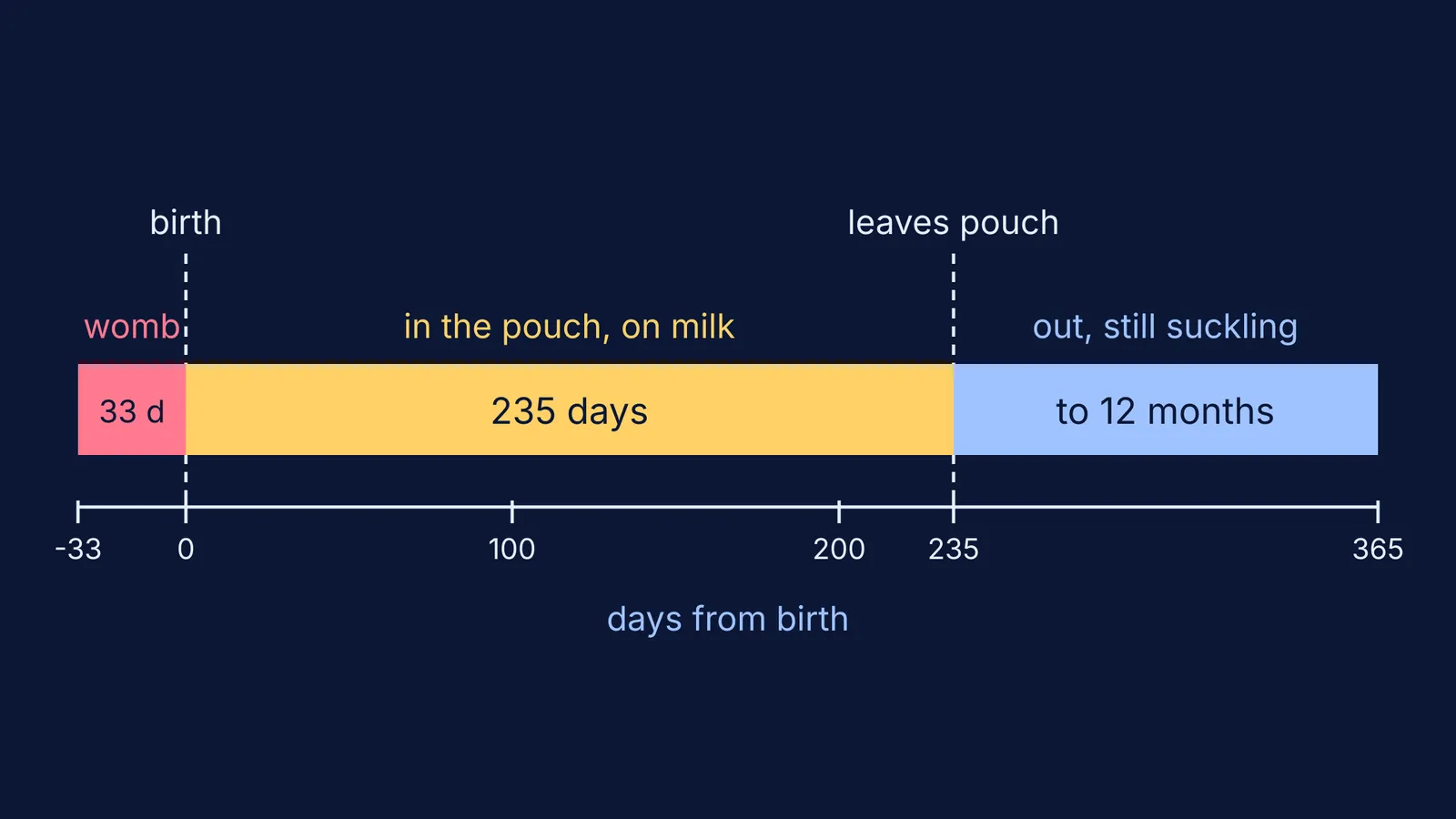
The red kangaroo, the largest living marsupial, has a gestation period of around 33 days, according to the Australian Museum's red kangaroo page. The newborn is the size of a jellybean and climbs straight into its mother's pouch.
It makes that climb without help. In a 2013 ultrasound study of the tammar wallaby, a smaller relative, Drews and colleagues in Scientific Reports saw the fetus making climbing movements with its forelimbs about 3 days before birth, while its hindlimbs were barely formed. Their newborn wallabies weighed 393 mg on average, less than half a gram.
Inside the pouch the joey attaches to a teat and lives on milk. A red kangaroo joey leaves the pouch for good at around 235 days old but keeps suckling until about 12 months of age, the Australian Museum reports. Females can also delay the birth of their next baby until the previous joey has left the pouch, a pause called embryonic diapause.
The milk changes as the joey grows. A 2020 review by Stannard, Miller and Old in PeerJ notes that marsupial milk composition varies at different stages of development.
How do marsupials differ from placental mammals?
Both groups are mammals, and both feed their young on milk. The difference is where the mother puts her effort. The PeerJ review puts it plainly: marsupial mothers invest more energy in milk over a longer period than placental (eutherian) mammals of similar size, while placental mammals invest more in gestation. It also notes that a newborn marsupial has been compared to an eight-week-old human fetus.
Marsupials do have a placenta; it just works for a short time. The Australian Museum says it nourishes the young for just a few days before birth, with the rest of its nutrition coming from the teats in the pouch. In placental mammals such as humans, the placenta and umbilical cord exchange food, oxygen and wastes for the whole pregnancy.
Pregnancy: very short in marsupials (about 33 days in the red kangaroo); long in placental mammals.
Placenta: short-lived in marsupials; supports the fetus throughout pregnancy in placental mammals.
Newborn: embryo-like in marsupials, with strong forelimbs for the climb; far more developed in placental mammals.
Main growing phase: in the pouch on milk for marsupials; in the uterus for placental mammals.
How Australia's marsupials spread into many ways of life is covered in our post on adaptive radiation in Darwin's finches and marsupials. For the egg-laying third group of mammals, see the platypus as a connecting link.
Worked example: how much of a joey's growth happens outside the womb?
Use the red kangaroo figures from the Australian Museum.
Time in the womb: about 33 days.
Time in the pouch: from birth to about 235 days.
Pouch time compared with pregnancy: 235 / 33 = about 7.1, so roughly seven times longer.
Share spent in the womb before leaving the pouch: 33 / (33 + 235) = 33 / 268 = about 0.12, or 12%.
So close to nine-tenths of the time between conception and leaving the pouch is spent outside the womb, growing on milk.
How do you explain it in a biology answer?
When a question asks you to tell a marsupial from a placental mammal, check four things:
Where does most growth happen: in a pouch on milk, or in the uterus?
How long does the placenta work: a few days, or the whole pregnancy?
How developed is the newborn: strong forelimbs but unformed hindlimbs?
Does the young stay fixed to a teat for weeks or months?
A one-line answer you can adapt: "A kangaroo has a pouch because it is a marsupial: its young is born after a very short pregnancy and finishes developing in the pouch, attached to a teat and fed on milk."
If terms like gestation, placenta and lactation blur together, the Fermi Concept Library gives every concept in biology its own lesson and its place in the map, so you can see how each one links to the next.


