

On this page
Adaptive radiation is one of the most powerful engines of evolutionary change. It occurs when a single ancestral species enters a new environment with unoccupied ecological niches and diversifies into a wide variety of forms. When this happens independently in different parts of the world, the resulting animals often end up looking remarkably similar despite having entirely different ancestors. This secondary effect is called convergent evolution.
To understand how species adapt to their surroundings, biologists look at two classic examples: the birds of the Galápagos Islands and the mammals of Australia.
How did adaptive radiation create Darwin's finches?
When Charles Darwin visited the Galápagos Islands in 1835, he collected several birds that he initially thought were blackbirds, grosbeaks and finches. It was only later that scientists realised these birds were closely related. Today, researchers recognize roughly 18 distinct species of Darwin's finches across the islands (Wikipedia, "Darwin's finches"). (They are technically part of the tanager family, not true finches.)
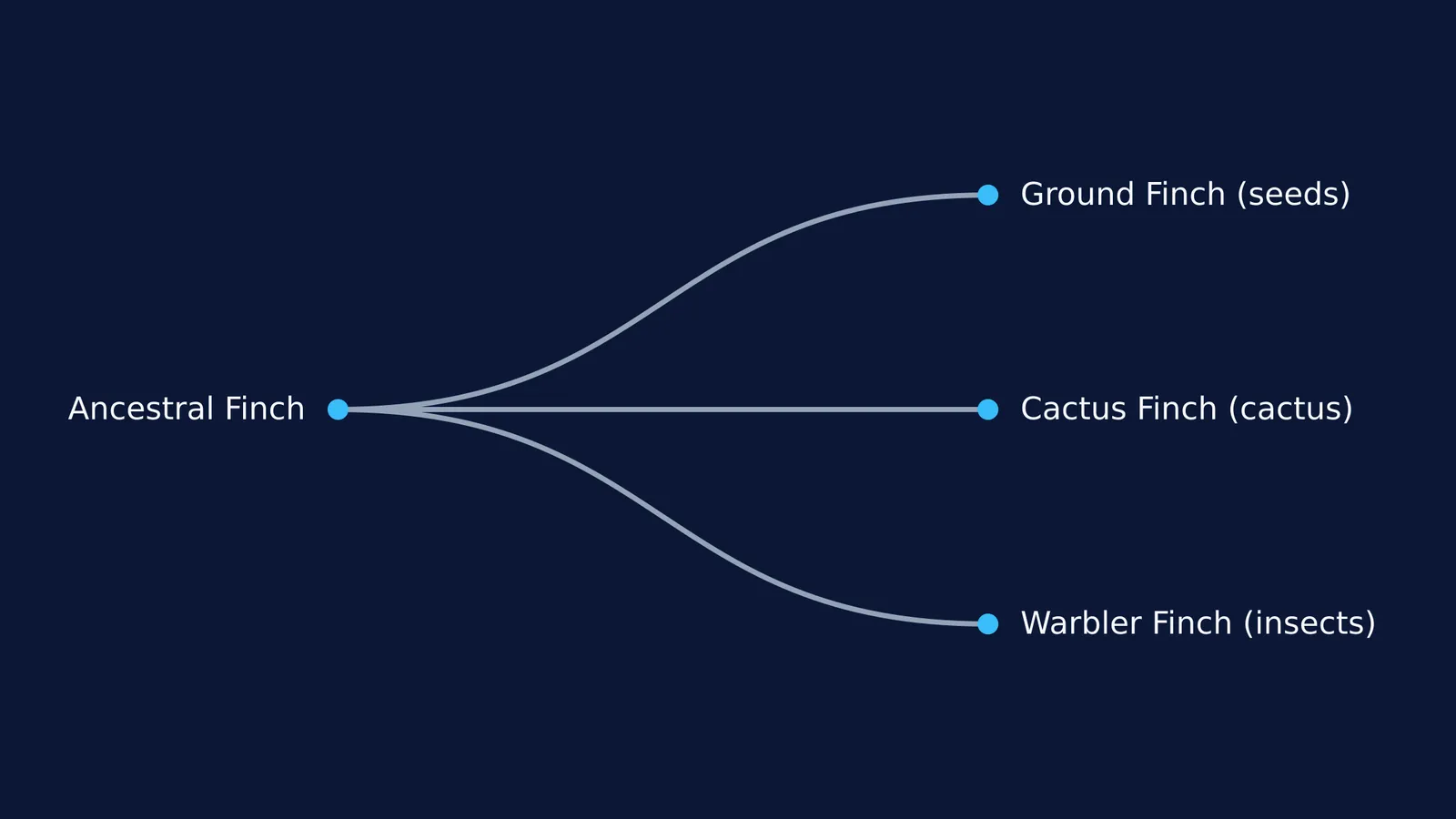
Genetic evidence suggests that all 18 species evolved from a single ancestral flock of seed-eating birds that arrived from the South American mainland more than a million years ago (Wikipedia, "Darwin's finches"). As the birds spread across the archipelago, they encountered different food sources. Natural selection favoured individuals whose beak shapes matched the local diet.
Over time, this single lineage radiated into specialized roles. The large ground finch developed a heavy, crushing beak to crack hard seeds. The warbler finch evolved a thin, probing beak for catching insects, while the cactus finch specialised in feeding on the flowers and pulp of the *Opuntia* cactus. The rapid diversification from one ancestor into many specialized species is the textbook definition of adaptive radiation.
How many marsupial species are in Australia through adaptive radiation?
A similar, much larger-scale radiation took place on the Australian continent. Australia began its final separation from Antarctica approximately 50 million years ago (Wikipedia, "Fauna of Australia"). At that time, placental mammals—which nourish their young internally through a placenta—dominated most of the world. Australia, however, was left with a population of marsupials, which give birth to relatively undeveloped young that finish growing in a pouch.
Without competition from placental mammals, a single ancestral marsupial stock was free to expand into every available habitat. Today, the Australian continent is home to over 200 species of marsupials that have evolved through adaptive radiation (Wikipedia, "Marsupial"). They diversified to fill all the major ecological roles: kangaroos and wallabies became the grazing herbivores of the plains, koalas became the tree-dwelling leaf eaters, and wombats became the heavy burrowers.
For students reviewing these patterns, the Fermi Concept Library contains detailed lessons on every concept in biology, from natural selection to population genetics. If you find it hard to distinguish between homologous and analogous structures, Fermi's AI tutor can walk you through the differences, noticing where you are stuck and checking your understanding as it goes.
Why do Australian marsupials look like placental mammals?
While adaptive radiation explains how marsupials diversified within Australia, it also sets up a striking comparison with the rest of the world. A significant aspect of this history is convergent evolution: unrelated organisms independently evolving similar traits because they adapt to similar environments (Wikipedia, "Convergent evolution").
Because the ecological "jobs" in Australia were similar to the jobs in Europe and the Americas, Australian marsupials evolved physical forms and behaviours that are almost identical to unrelated placental mammals. They faced the same environmental pressures, so natural selection arrived at the same physical solutions.
For example, the marsupial mole and the placental common mole are separated by approximately 160 million years of independent evolution (Wikipedia, "Marsupial"). Yet both have evolved reduced eyes, dense fur, and spade-like front claws perfectly suited for a life spent burrowing underground.
Other pairs show the same remarkable convergence. The sugar glider (a marsupial) and the flying squirrel (a placental mammal) both developed flaps of skin between their legs to glide between trees. The extinct Tasmanian wolf or thylacine (a marsupial carnivore) had the same skull shape, sharp teeth and hunting build as a grey wolf, despite raising its young in a pouch.
If you are preparing for exams and need to tackle questions on these topics, reading about Evolution for NEET: natural selection, Hardy-Weinberg and evidence can help cement the facts. When studying the timeline, you might also review Human evolution for NEET: Dryopithecus to Homo sapiens in order. And for a closer look at the researchers who proved Darwin right in real time, explore the story of Peter and Rosemary Grant: watching evolution in Darwin's finches.


