

On this page
Asked for the aromatic isomers of C7H9N, it is easy to draw the three toluidines and stop. There are five, and the two that get missed, benzylamine and N-methylaniline, are the ones that test whether you can classify an amine.
What are the aromatic isomers of C7H9N?
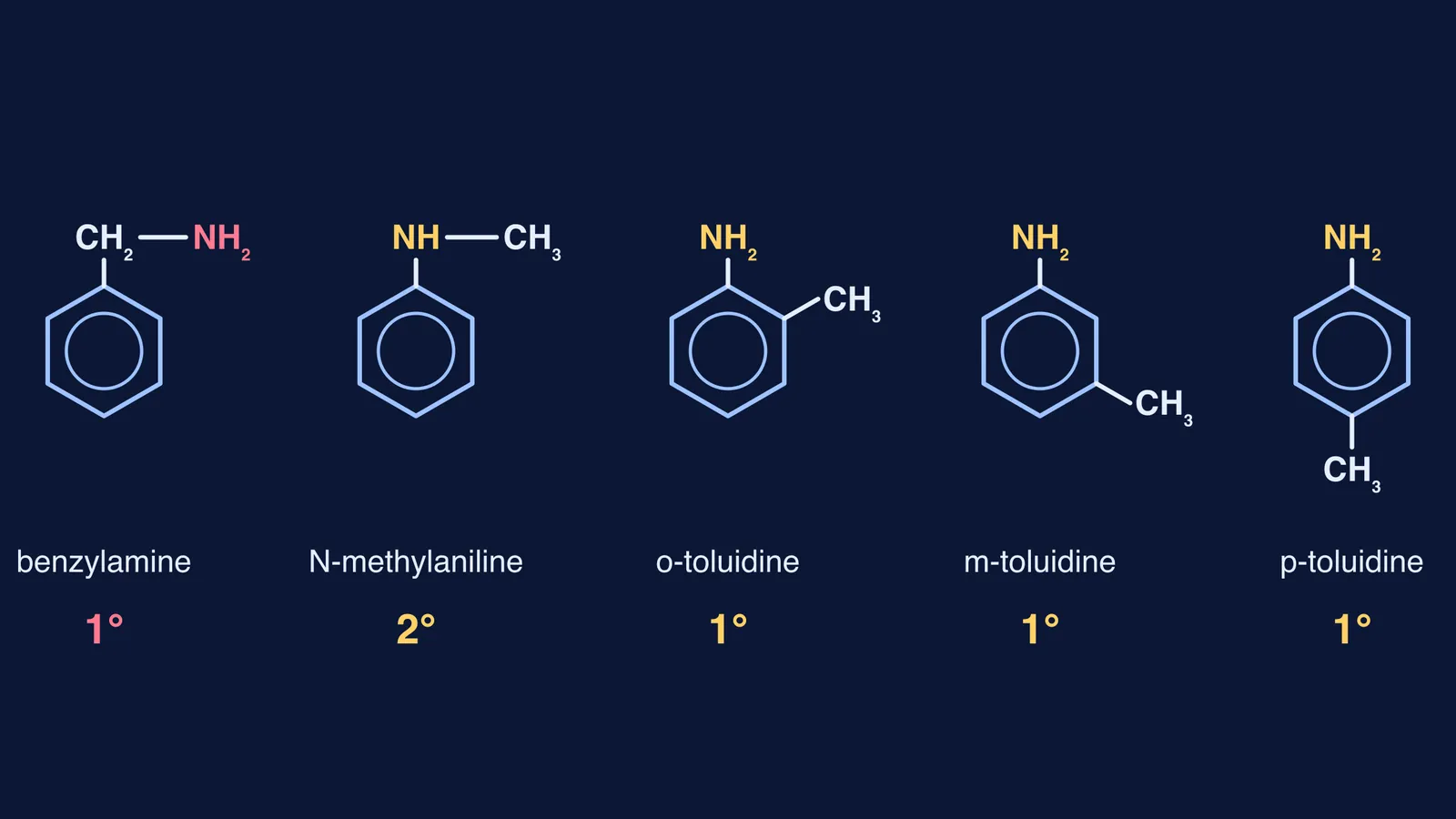
Set aside a benzene ring and you have one carbon and one nitrogen left to place. There are three ways to do it:
Put a CH₂ between the ring and the nitrogen: C₆H₅–CH₂–NH₂, which is benzylamine (PubChem CID 7504).
Put the nitrogen between the ring and the carbon: C₆H₅–NH–CH₃, which is N-methylaniline (PubChem CID 7515).
Put NH₂ and CH₃ straight onto the ring: CH₃–C₆H₄–NH₂, the toluidines. Two groups on a benzene ring can sit 1,2, 1,3 or 1,4 to each other, giving o-toluidine or 2-methylaniline (CID 7242), m-toluidine or 3-methylaniline (CID 7934) and p-toluidine or 4-methylaniline (CID 7813).
PubChem lists all five with the formula C7H9N and a molar mass of 107.15 g/mol. The same counting works for C7H7Cl, with chlorine in place of nitrogen, which gives benzyl chloride and the three chlorotoluenes.
C7H9N also fits pyridines such as 2,6-dimethylpyridine (PubChem CID 7937). Their nitrogen sits inside the ring, so they are heterocycles, outside the usual count of five.
Which are primary, secondary or ring-substituted?
A primary amine has one alkyl or aryl group on nitrogen, and a secondary amine has two, according to the standard definitions summarised on Wikipedia's amine page. An aromatic amine is one with an aromatic ring attached to the amine nitrogen (Wikipedia: Aromatic amine). So for each isomer, ask two questions: how many carbons touch the nitrogen, and is one of them a ring carbon?
Benzylamine: one carbon on nitrogen (the CH₂), so it is primary. That carbon is not in the ring, so its amine group behaves like an alkylamine.
N-methylaniline: two carbons on nitrogen (one ring carbon, one methyl), so it is secondary. It is an aromatic amine.
o-, m- and p-toluidine: one ring carbon on nitrogen, so all three are primary aromatic amines. The methyl sits on the ring, so these are the ring-substituted isomers. Only its position changes, so they are position isomers of one another.
Why does it matter where the nitrogen sits?
When nitrogen is bonded straight to the ring, its lone pair spreads into the ring and is less free to pick up a proton. That makes aromatic amines weaker bases (Wikipedia: Amine). In benzylamine, the CH₂ group keeps the lone pair away from the ring.
The numbers show the gap. PubChem gives a conjugate-acid pKa of 9.33 at 25 °C for benzylamine, 5.10 for p-toluidine and 4.85 for N-methylaniline. A difference of 4.2 to 4.5 pKa units means the acid constants differ by more than ten thousand times. Our explainer on why benzylamine is more basic than aniline draws out the resonance step by step.
How do you tell the five apart in the lab?
Run the tests in this order; each splits off a group.
Carbylamine test (chloroform and alcoholic KOH, warmed). It works only for primary amines, which give a foul-smelling isocyanide; secondary and tertiary amines do not react (Wikipedia: Carbylamine reaction). Benzylamine and the three toluidines give the smell. N-methylaniline does not.
Hinsberg test (benzenesulfonyl chloride in aqueous alkali) to confirm. A secondary amine forms a sulfonamide that will not dissolve in the alkali, while a primary amine's sulfonamide dissolves (Wikipedia: Hinsberg reaction). Our guide to Hinsberg's reagent for 1°, 2° and 3° amines covers what you see in the tube.
Nitrous acid in the cold, then alkaline 2-naphthol. Aromatic diazonium salts are made at 0–5 °C and couple with 2-naphthol to give an intense orange-red azo dye, while primary alkyl diazonium ions quickly lose nitrogen gas (Wikipedia: Diazonium compound; Chemguide on amines and nitrous acid). Benzylamine fizzes and gives no dye. The toluidines give the dye.
Separating o-, m- and p-toluidine. These behave alike in every test above, so use physical data. PubChem gives p-toluidine a melting point of 43.6 °C (CID 7813), so it is a solid at room temperature. The melting points it lists for o-toluidine (CID 7242) and m-toluidine (CID 7934) are well below 0 °C, so both are liquids.
If you keep putting the tests in the wrong order in practice questions, the Fermi Problem Library has worked problems with a step-by-step solver that explains the reasoning rather than printing an answer.
What should you check before writing the answer?
A one-minute check:
Have you drawn five structures, each with a benzene ring?
For each one, did you count the carbons bonded to nitrogen to get 1° or 2°?
Did you mark which nitrogen is on the ring and which is on a side chain?
Did you give IUPAC names where asked: phenylmethanamine, N-methylaniline, and 2-, 3- and 4-methylaniline?
Did you leave out the pyridines unless the question asks for every isomer?
If the line between primary and secondary still feels shaky, the Fermi Concept Library covers every concept in chemistry, each with its own lesson and its place in the map.


