

On this page
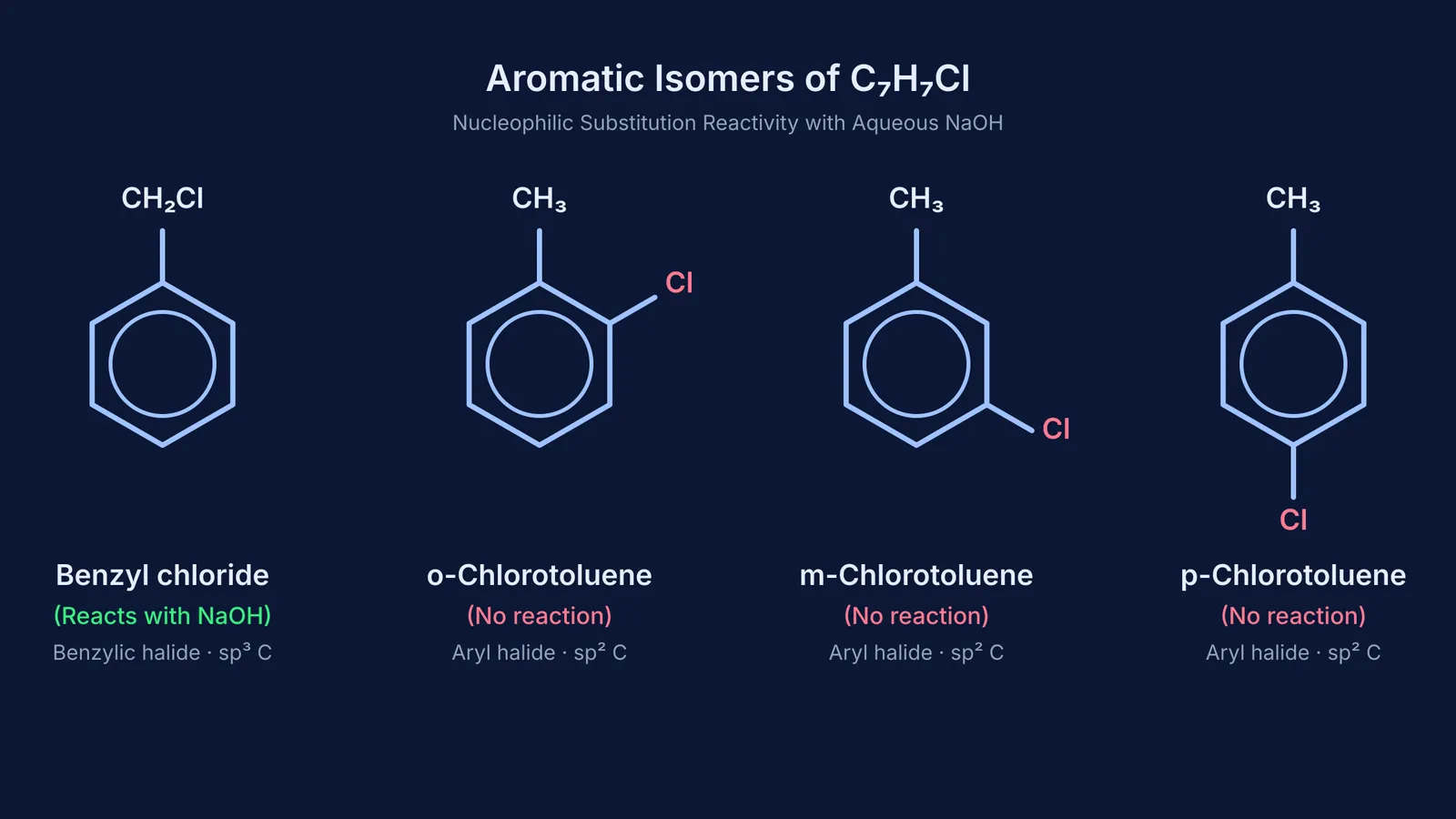
When you are asked to draw the aromatic isomers of C7H7Cl, there are four distinct compounds to consider: benzyl chloride, and the three positional isomers of chlorotoluene (*ortho*, *meta*, and *para*). A recurring question in organic chemistry asks which of these isomers undergoes nucleophilic substitution readily upon warming with aqueous sodium hydroxide.
The short answer is that only benzyl chloride reacts under standard conditions. The pronounced contrast between benzylic halides and aryl halides explains why benzyl chloride hydrolyses smoothly to benzyl alcohol, while the chlorotoluenes remain unreactive without extreme conditions.
What are the aromatic isomers of C7H7Cl?
An aromatic isomer of C7H7Cl must contain an intact benzene ring, accounting for six carbon atoms and four degrees of unsaturation. The remaining carbon, seven hydrogen atoms, and one chlorine atom can be arranged in two distinct ways:
Side-chain halogenation (benzyl chloride): The chlorine atom is attached to the methyl carbon rather than the ring, forming a chloromethyl group (-CH₂Cl) bonded to a phenyl ring. This compound is benzyl chloride (chloromethylbenzene), an alkyl (specifically benzylic) halide.
Ring halogenation (the chlorotoluenes): The chlorine atom and methyl group are bonded directly to separate carbon atoms on the benzene ring, creating three positional isomers:
***o*-Chlorotoluene** (1-chloro-2-methylbenzene), with substituents at adjacent (1,2) positions.
***m*-Chlorotoluene** (1-chloro-3-methylbenzene), with a 1,3-relationship.
***p*-Chlorotoluene** (1-chloro-4-methylbenzene), with substituents on opposite (1,4) ring carbons.
In benzyl chloride, the chlorine is bound to an sp³-hybridised benzylic carbon. In the three chlorotoluenes, the chlorine is attached directly to an sp²-hybridised ring carbon as an aryl halide. This structural difference dictates their reactivity.
Why does benzyl chloride react easily with aqueous NaOH?
When benzyl chloride is warmed with aqueous sodium hydroxide (NaOH), it undergoes nucleophilic substitution to yield benzyl alcohol (C₆H₅CH₂OH) and sodium chloride. The hydroxide ion (OH⁻) displaces the chloride ion:
C₆H₅CH₂Cl + NaOH(aq) → C₆H₅CH₂OH + NaCl(aq)
This displacement occurs readily because benzyl chloride reacts via both unimolecular and bimolecular substitution pathways. In polar media, the benzylic carbon-chlorine bond ionises to produce a benzyl carbocation (C₆H₅CH₂⁺). Although formally a primary carbocation, it is stabilised by resonance because the vacant p-orbital overlaps with the aromatic π-system, delocalising positive charge across the ring's *ortho* and *para* positions.
Simultaneously, the primary benzylic carbon offers minimal steric hindrance, allowing direct backside displacement by hydroxide ions. To see how resonance stabilisation guides related reaction pathways, explore why allylic and benzylic halides react fast by the SN1 route.
Why are chlorotoluenes unreactive to nucleophilic substitution?
Boiling *o-*, *m-*, or *p*-chlorotoluene with aqueous sodium hydroxide produces no reaction. Aryl halides are inert toward nucleophilic substitution under standard conditions for several structural reasons:
Resonance and partial double-bond character: The unshared electron pairs on chlorine conjugate with the π-electrons of the benzene ring. This delocalisation gives the carbon-chlorine bond partial double-bond character, making it shorter and stronger than an alkyl C-Cl bond.
Hybridisation: The chlorine atom in chlorotoluene is bonded to an sp²-hybridised carbon, which has 33% s-character compared to 25% in the sp³ carbon of benzyl chloride. The sp² carbon is more electronegative, holding the bonding pair more tightly.
Instability of the aryl cation: Loss of chloride would generate a tolyl cation whose positive charge resides in an sp² orbital perpendicular to the π-system, preventing resonance stabilisation.
Electronic repulsion: The electron-rich π-cloud of the ring repels approaching nucleophiles like OH⁻, while planar geometry blocks backside attack.
Aromatic electron density strongly governs reactivity, as seen in the bromination of phenol and coupling in Wurtz-Fittig and Fittig reactions.
How can you distinguish these isomers experimentally?
In a laboratory setting, you can distinguish benzyl chloride from chlorotoluenes using qualitative silver nitrate tests:
Ethanolic silver nitrate test: Add the unknown compound to a solution of silver nitrate in ethanol and warm gently. Benzyl chloride rapidly forms a white precipitate of silver chloride (AgCl), which dissolves in aqueous ammonia. The chlorotoluenes show no change because their aryl C-Cl bonds do not ionise under these conditions.
Alkaline hydrolysis followed by silver nitrate: Boil the compound with aqueous sodium hydroxide, cool the mixture, and acidify with dilute nitric acid (HNO₃) to neutralise remaining base. Adding silver nitrate solution produces a white precipitate with benzyl chloride, whereas chlorotoluenes yield a clear solution.
When practising mechanism questions, the Fermi Problem Library offers worked problems with a step-by-step solver that explains the reasoning rather than just printing an answer. To see where aromatic halides fit into the broader subject, the Fermi Concept Library covers every concept in chemistry with its own lesson and its place in the map.


