

On this page
Isomer-counting questions look like memory tests, but they are really sorting tests. The usual slips are two habits: missing a whole family (often the enols or the rings) and drawing the same molecule twice in a different pose.
How do you count the isomers of C3H6O?
Start with the degree of unsaturation, IHD = C + 1 + N/2 − H/2 − X/2, as set out on Wikipedia's degree of unsaturation page. Oxygen does not appear in the formula, so C3H6O gives 3 + 1 − 3 = 1. One degree means exactly one ring or one double bond, and that double bond can be C=O or C=C.
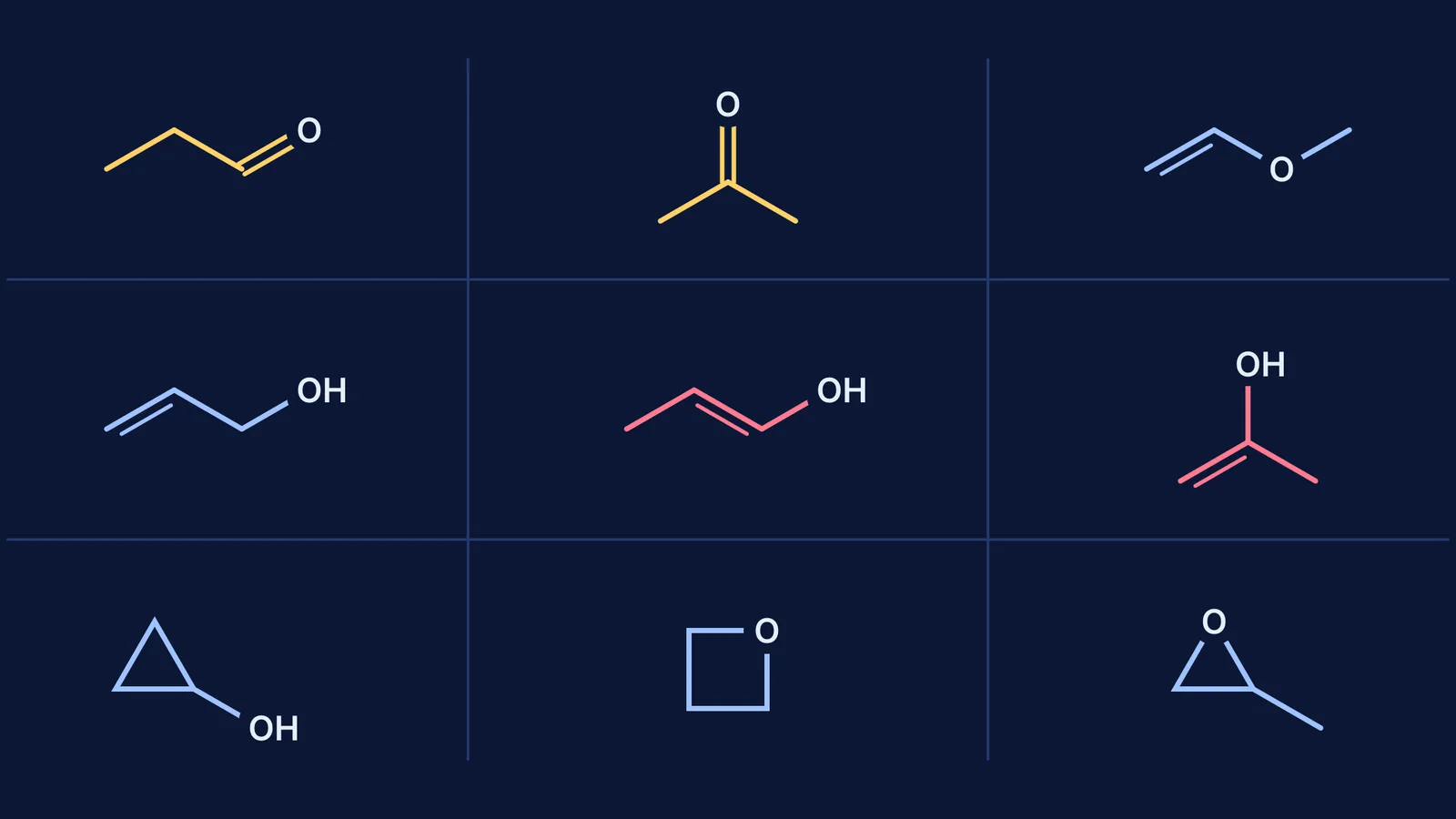
Now place the oxygen in each possible role. Doc Brown's C3H6O isomer page lists 9 constitutional isomers:
C=O: propanal (aldehyde) and propanone (ketone)
C=C with OH on a saturated carbon: prop-2-en-1-ol (allyl alcohol)
C=C with OH on the double bond (enols): prop-1-en-1-ol and prop-1-en-2-ol
C=C with O between carbons: methoxyethene (methyl vinyl ether)
A carbon ring: cyclopropanol
An oxygen ring: oxetane and methyloxirane
The same page counts 11 distinct isomers once you add the E and Z forms of prop-1-en-1-ol and the R and S forms of methyloxirane.
For acetone, the equilibrium constant [enol]/[keto] is about 5.12 × 10⁻⁷, according to Wikipedia's keto–enol tautomerism article. Our explainer on the difference between resonance and tautomerism sorts the two out.
What are all 26 isomers of C4H8O?
C4H8O also has one degree of unsaturation. Doc Brown's C4H8O isomer page identifies 26 constitutional isomers:
Aldehydes and ketones (3): butanal, 2-methylpropanal, butan-2-one
Unsaturated alcohols that are not enols (4): but-3-en-1-ol, but-3-en-2-ol, but-2-en-1-ol (crotyl alcohol), 2-methylprop-2-en-1-ol
Enols (4): but-1-en-1-ol, but-1-en-2-ol, but-2-en-2-ol, 2-methylprop-1-en-1-ol
Unsaturated ethers (4): 1-methoxyprop-1-ene, 2-methoxyprop-1-ene, 3-methoxyprop-1-ene, ethoxyethene
Carbon rings (5): cyclobutanol, cyclopropylmethanol, 1-methylcyclopropan-1-ol, 2-methylcyclopropan-1-ol, methoxycyclopropane
Oxygen rings (6): oxolane (tetrahydrofuran), 2-methyloxetane, 3-methyloxetane, 2-ethyloxirane, 2,2-dimethyloxirane, 2,3-dimethyloxirane
Stereoisomers push the total higher. Doc Brown's page puts it at "at least 35 distinct isomers", adding one extra form for each structure that shows stereoisomerism. Four structures have E and Z forms: but-1-en-1-ol, but-2-en-1-ol, but-2-en-2-ol and 1-methoxyprop-1-ene. Three have a single chiral carbon: but-3-en-2-ol, 2-methyloxetane and 2-ethyloxirane. Two need extra care. 2-Methylcyclopropan-1-ol has cis and trans forms, and each of those is chiral, so it has four stereoisomers. 2,3-Dimethyloxirane has three stereoisomers, a meso form and a pair of enantiomers, according to Wikipedia's 2,3-epoxybutane article. Add those up and you reach 38, so check whether a question wants structures or every stereoisomer.
If you only need the carbonyl compounds, the next formula up works the same way: see the aldehyde and ketone isomers of C5H10O. For the ring and double-bond skeletons without oxygen, the C4H8 butenes and cycloalkanes use the same method.
Which isomers do students draw twice?
These are the pairs that look different on paper but are the same molecule:
Butan-2-one and "butan-3-one". You number from the end nearer the C=O, so a ketone on the third carbon is the same compound.
A straight chain and a bent chain. CH3CH2CH2CHO drawn with a kink is still butanal. Only 2-methylpropanal has a real branch.
CH3CH=C(OH)CH3 and CH3C(OH)=CHCH3. Both are but-2-en-2-ol, written from opposite ends.
CH2=CHCH2OCH3 and CH3OCH2CH=CH2. Both are 3-methoxyprop-1-ene.
"4-Methyloxetane" and 2-methyloxetane. The ring oxygen is position 1, so the methyl next to it is always at 2.
Methyloxirane with the methyl on the left carbon and on the right carbon. Flip the ring and they match.
The opposite trap costs marks too. Cyclopropylmethanol (OH on a CH2 outside the ring) and 1-methylcyclopropan-1-ol (OH on a ring carbon) look alike, but they are different isomers. So are 2-methyloxetane and 3-methyloxetane.
How do you avoid drawing duplicates?
Use this five-step method on any CxHyO question:
Work out the degree of unsaturation. For these formulas it is 1.
Choose where the unsaturation goes: C=O, C=C or a ring.
Choose the oxygen's role: OH, an O between two carbons, the C=O itself, or an atom in the ring.
For each combination, try every carbon skeleton: the straight chain first, then the branches.
Give every structure its full IUPAC name. If two names match, cross one out.
Step 5 is the one people skip, and it catches every duplicate above. Try it on C3H6O first: you should finish with exactly the nine names on Doc Brown's C3H6O list.
If you want to compare your working with a full solution, the Fermi Problem Library has worked problems with a step-by-step solver that explains the reasoning rather than printing an answer. If the naming rules are the weak spot, the Fermi Concept Library gives each chemistry concept its own lesson, so you can fix the numbering habit before you count again.
Draw the nine C3H6O structures from memory tonight, name each one, and check them against the list.


