

On this page
"How many isomers does C3H5Cl have, including geometrical isomers?" is a common practice question in Class 11 organic chemistry. The usual slips are forgetting that one alkene splits into cis and trans, or splitting one that cannot. Here is the count one step at a time, so you can reuse the method on any formula.
How many isomers does C3H5Cl have?
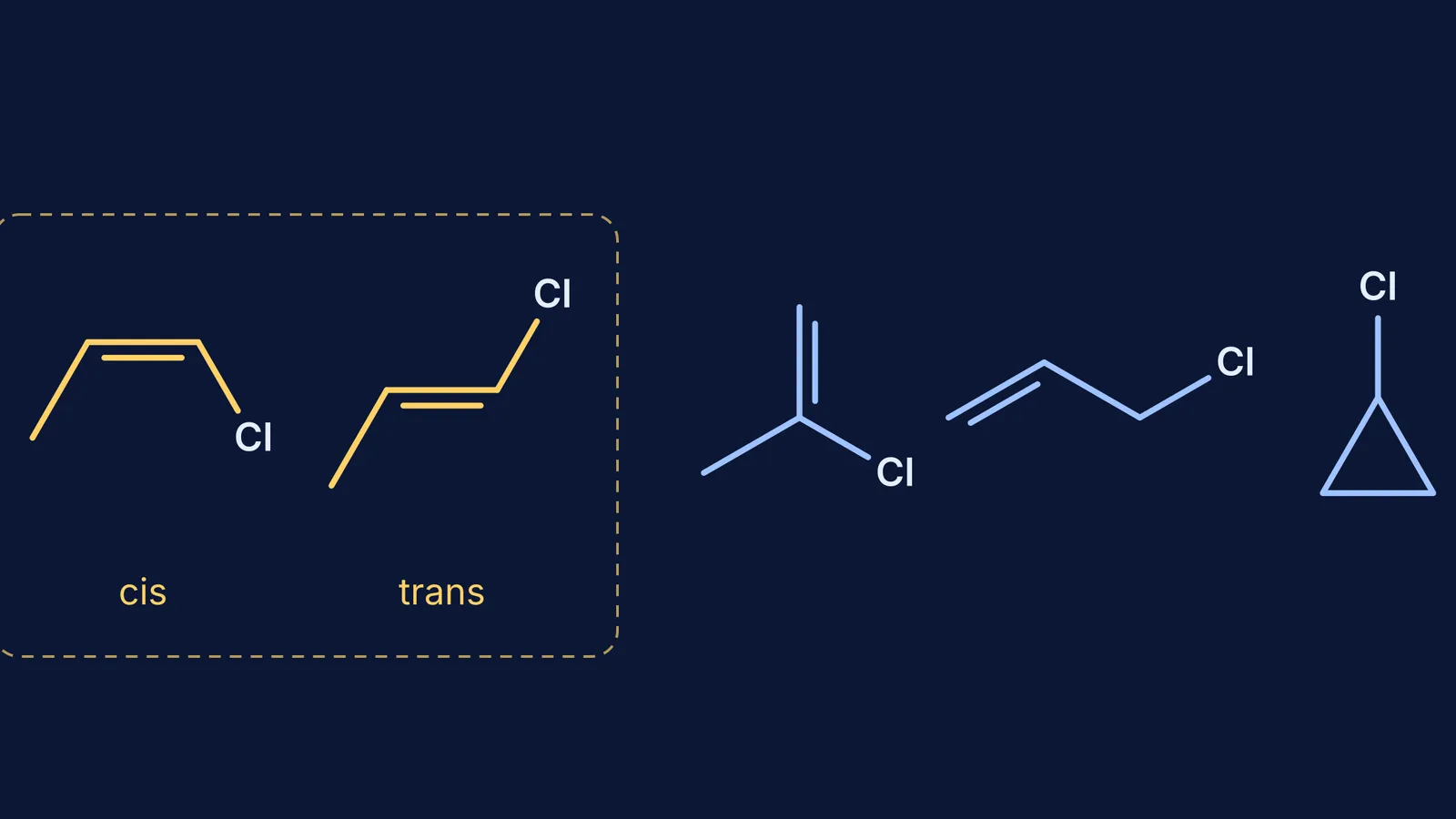
The answer is five: four structural isomers, plus one extra because 1-chloropropene exists in two geometrical forms. The PubChem chemistry database gives each of the five its own entry with the formula C3H5Cl:
(Z)-1-chloroprop-1-ene, the cis form (PubChem CID 5326315)
(E)-1-chloroprop-1-ene, the trans form (PubChem CID 5284364)
2-chloroprop-1-ene (PubChem CID 11203)
3-chloroprop-1-ene, also called allyl chloride (PubChem CID 7850)
chlorocyclopropane (PubChem CID 81879)
Only the 1-chloropropene names carry a (Z) or (E) label, which marks the compound with geometrical isomers.
Step 1: what does the formula allow?
Start with the degree of unsaturation. Treat the chlorine as if it were a hydrogen, so C3H5Cl behaves like C3H6. Then the degree of unsaturation is (2 × 3 + 2 − 6) ÷ 2 = 1. If that formula is new to you, our explainer on working out the degree of unsaturation walks through it.
One degree of unsaturation means the molecule has either one C=C double bond or one ring. A triple bond would need two degrees of unsaturation, so those are your only two options. Count each one separately.
Step 2: where can the chlorine go?
Option A, a ring. Three carbons make cyclopropane. All three ring carbons are identical, so putting Cl on any of them gives the same molecule: chlorocyclopropane. That gives one structure.
Option B, a double bond. Three carbons with one C=C make propene, CH2=CH–CH3. Its three carbons are all different, so there are three places for the chlorine:
On C1, the end carbon of the double bond: CHCl=CH–CH3, 1-chloropropene.
On C2, the middle carbon: CH2=CCl–CH3, 2-chloropropene.
On C3, the CH3 end: CH2=CH–CH2Cl, 3-chloropropene.
That gives four structural isomers. In passing: 1- and 2-chloropropene are vinylic halides (Cl on a double-bond carbon), while 3-chloropropene is allylic, which changes how it reacts. See our guide to vinylic, allylic and benzylic halides.
Which C3H5Cl isomers show geometrical isomerism?
Rotation about a carbon-carbon double bond is restricted, as NCERT's Class 11 chemistry textbook explains in its section on pi bonds (NCERT Chemistry Part 2, Unit 8, section 8.2.2). That restricted rotation is what makes geometrical (cis-trans) isomers possible. It is not enough on its own, though. Each carbon of the double bond must also carry two different groups. If either carbon has two identical groups, swapping sides gives back the same molecule.
Test each isomer:
1-Chloropropene, CHCl=CH–CH3. C1 has H and Cl; C2 has H and CH3. Both ends are different, so there are two forms. In cis (Z), Cl and CH3 are on the same side. In trans (E), they are on opposite sides. That counts as 2.
2-Chloropropene, CH2=CCl–CH3. C1 has two hydrogens. No geometrical isomers. That counts as 1.
3-Chloropropene, CH2=CH–CH2Cl. C1 again has two hydrogens. No geometrical isomers. That counts as 1.
Chlorocyclopropane. A ring can show cis-trans isomerism, but only when two ring carbons carry substituents. Here there is only one. That counts as 1.
Total: 2 + 1 + 1 + 1 = 5. For more practice with the "two different groups on each end" test, see our post on counting geometrical isomers.
Are any C3H5Cl isomers optically active?
No. An optical isomer needs a carbon with four different groups. The CH2Cl carbon of 3-chloropropene has two hydrogens, and in chlorocyclopropane the Cl-bearing carbon has two identical ring CH2 groups. Double-bond carbons cannot be chiral centres. The answer stays at five.
A checklist for any "count the isomers" question
Find the degree of unsaturation, treating each halogen as a hydrogen.
List every skeleton it allows: chains, branched chains, rings.
On each skeleton, place the substituent on every carbon that is genuinely different. Symmetry removes repeats.
For every C=C, check both ends for two different groups. Count cis and trans only if both ends pass.
Look for any carbon with four different groups, and count optical isomers.
Write your answer as "structural + stereo = total" so the examiner can see your reasoning.
If you keep losing marks on a step rather than a fact, it helps to see where your reasoning slipped. The Fermi Problem Library has worked problems with a step-by-step solver that explains the reasoning rather than printing an answer. If the idea of restricted rotation itself still feels shaky, the Fermi Concept Library gives each chemistry concept its own lesson.
Try the same six steps on C4H7Cl next, and check whether your count of cis-trans pairs holds up.


