On this page
The question comes straight from the textbook. Exercise 1.1, Question 6 of the NCERT Class 10 Real Numbers chapter asks you to "Explain why 7 × 11 × 13 + 13 and 7 × 6 × 5 × 4 × 3 × 2 × 1 + 5 are composite numbers." You don't need to multiply it out: the way the sum is written already gives you the answer.
What does composite mean here?
A composite number is a natural number greater than 1 that has at least one factor other than 1 and itself. A prime has exactly two factors: 1 and itself. And 1 is neither prime nor composite, which we explain in why 1 is not a prime number.
So to prove a number is composite, you need just one factor that is not 1 and not the number itself.
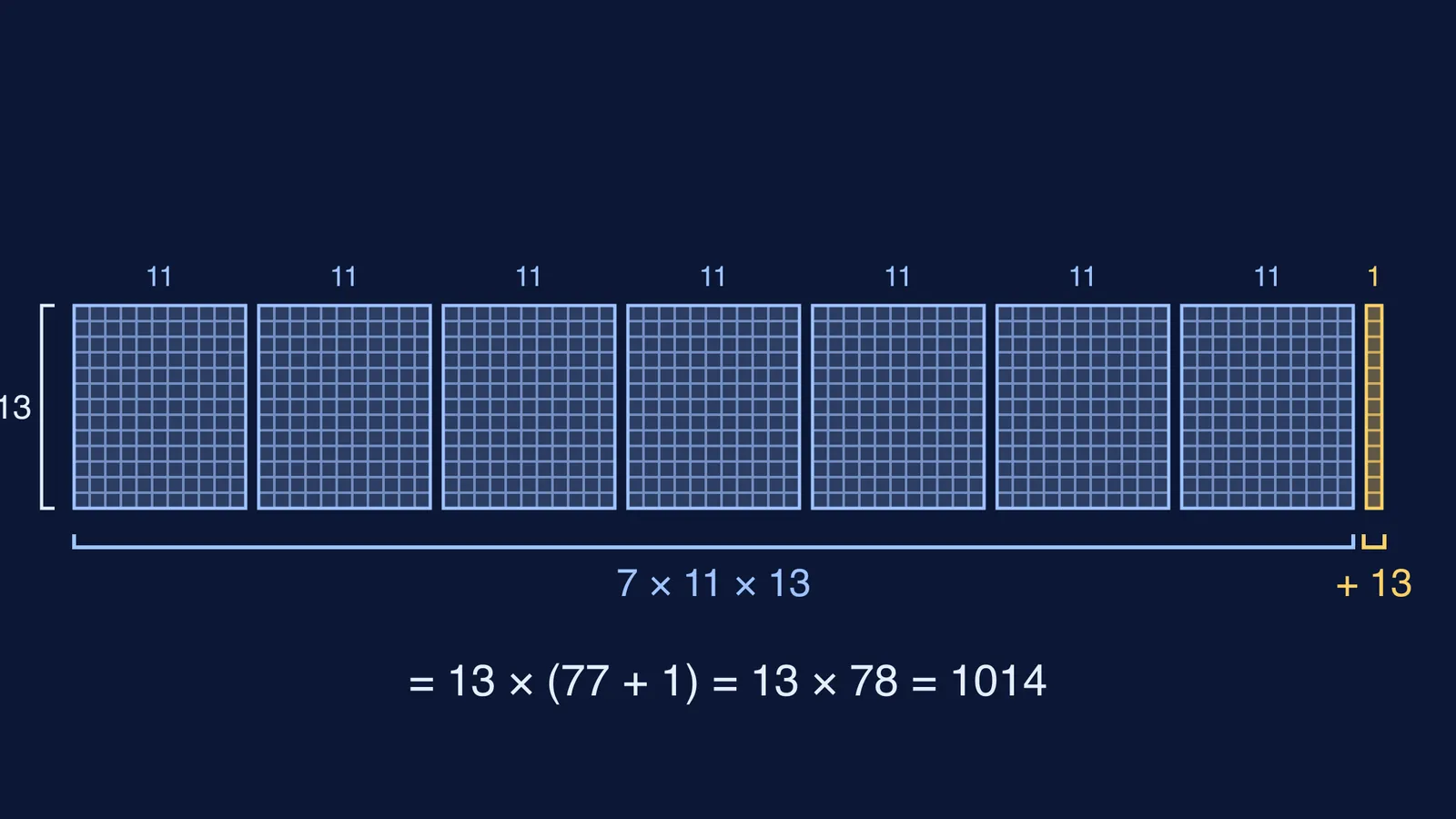
Why is 7 × 11 × 13 + 13 a composite number?
Look at the two terms being added. The first term, 7 × 11 × 13, has 13 as a factor. The second term is 13 itself, which is 13 × 1. When both terms share a factor, you can take it out, exactly as you would in algebra with 7ab + b = b(7a + 1).
Write the second term as 13 × 1: 7 × 11 × 13 + 13 × 1.
Take 13 out as a common factor: 13 × (7 × 11 + 1).
Simplify the bracket: 13 × (77 + 1) = 13 × 78.
Conclude: the number is 13 times a whole number bigger than 1, so 13 is a factor other than 1 and itself. The number is composite.
That is the whole argument. If you want to go further, 78 = 2 × 3 × 13, so the number is 2 × 3 × 13 × 13. By the Fundamental Theorem of Arithmetic, stated as Theorem 1.1 in the same NCERT chapter, every composite number can be written as a product of primes, and that factorisation is unique apart from the order of the primes. Our post on using the Fundamental Theorem of Arithmetic in Class 10 shows where else that idea comes up.
What about 7 × 6 × 5 × 4 × 3 × 2 × 1 + 5?
The second half of the question works the same way. The long product contains 5, and the added term is 5, so 5 comes out:
7 × 6 × 5 × 4 × 3 × 2 × 1 + 5 = 5 × (7 × 6 × 4 × 3 × 2 × 1 + 1)
= 5 × (1008 + 1) = 5 × 1009
The number is 5 times something bigger than 1, so it is composite. You never needed to know whether 1009 is prime.
How do you spot the trick in a new question?
Use this three-step check whenever an exam gives you "product + number" and asks whether the result is prime or composite.
Look for a number that appears in every term. Rewrite a lone term like 13 as 13 × 1 so you can see it.
Take that number out and simplify the bracket.
Check that both the common factor and the bracket are greater than 1, then write the sentence: it has a factor other than 1 and itself, so it is composite.
Three more board-style expressions to try
Cover the answers and try each one before reading on.
2 × 3 × 5 × 7 + 7. Every term contains 7, so it equals 7 × (2 × 3 × 5 + 1) = 7 × 31 = 217. Composite.
3 × 5 × 7 × 11 + 11 × 13. Both terms contain 11, so it equals 11 × (105 + 13) = 11 × 118 = 1298. Composite.
9 × 8 × 7 × 6 × 5 × 4 × 3 × 2 × 1 + 3. The product contains 3, so it equals 3 × (120960 + 1) = 3 × 120961. Composite, and you did not need the full value of 362883.
Now a trap, so you know where the trick stops. In 2 × 3 × 5 + 1, the added term is 1, so there is no common factor greater than 1 to take out. The answer is 31, which is prime. But 2 × 3 × 5 × 7 × 11 × 13 + 1 = 30031 = 59 × 509, which is composite. So "product of primes plus 1" can go either way, and the common-factor method cannot decide it. That same "product plus 1" idea is the heart of Euclid's proof that there are infinitely many primes.
If you got one of the practice sums wrong because you took out the wrong factor, the Fermi Problem Library has worked problems with a step-by-step solver that explains the reasoning rather than printing an answer, so you can see which step went off track.