

On this page
For centuries, farmers in India raised water from wells with ropes, wheels and levers. Today many pipe it straight to the roots, a drop at a time.
What are the traditional methods of irrigation?
The NCERT Class 8 Science textbook, Chapter 1 (Crop Production and Management) defines irrigation as the supply of water to crops at regular intervals. It names four traditional ways of lifting water from wells, lakes and canals: moat (pulley system), chain pump, dhekli and rahat. These use cattle or human labour, so NCERT calls them cheaper but less efficient.
Moat: a rope over a pulley above a well hauls up a container of water, which is tipped into a channel to the field.
Chain pump: discs on an endless chain run through a tube, lifting the water trapped between them (chain pump).
Dhekli: a pole on a pivot with a bucket at one end and a weight at the other, the same lever as the shadoof.
Rahat: a wheel of pots turned by bullocks, like the Persian wheel or sakia.
NCERT adds that pumps, run on diesel, biogas, electricity or solar energy, are now commonly used to lift water.
How do sprinkler and drip irrigation work?
In a sprinkler system, NCERT explains, upright pipes with rotating nozzles join a main pipeline, and pumped water sprays out as if it were raining. It is useful on uneven land where water is short, and for lawns and coffee. The FAO chapter on sprinklers adds that spray is easily blown about by even a gentle breeze.
In a drip system, water falls drop by drop directly near the roots. NCERT recommends it for fruit plants, gardens and trees and calls it a boon where water is scarce. The FAO chapter on drip irrigation says emitters release water at 2 to 20 litres per hour and wet only part of the soil where the roots grow.
Why does drip irrigation save water in dry regions?
When you flood a field, water spreads over all of it. Some runs off, some sinks below the roots, and some evaporates from wet soil. The FAO drip chapter says drip's water savings are exactly these: less deep percolation, less surface runoff and less evaporation from the soil. FAO's guide to choosing a method adds that sprinkler and drip generally give higher application efficiency than surface irrigation, and are preferred when water is in short supply.
A Press Information Bureau release of 30 June 2026 says that since its inception the Per Drop More Crop scheme has brought 110.92 lakh hectares under micro-irrigation, about 7.98% of India's net sown area. Under the scheme, small and marginal farmers get 55% financial assistance for micro-irrigation systems and other farmers 45%. This matters most where wells are running low, as our explainer on why groundwater levels are falling in India shows.
How much water does drip save compared with flooding?
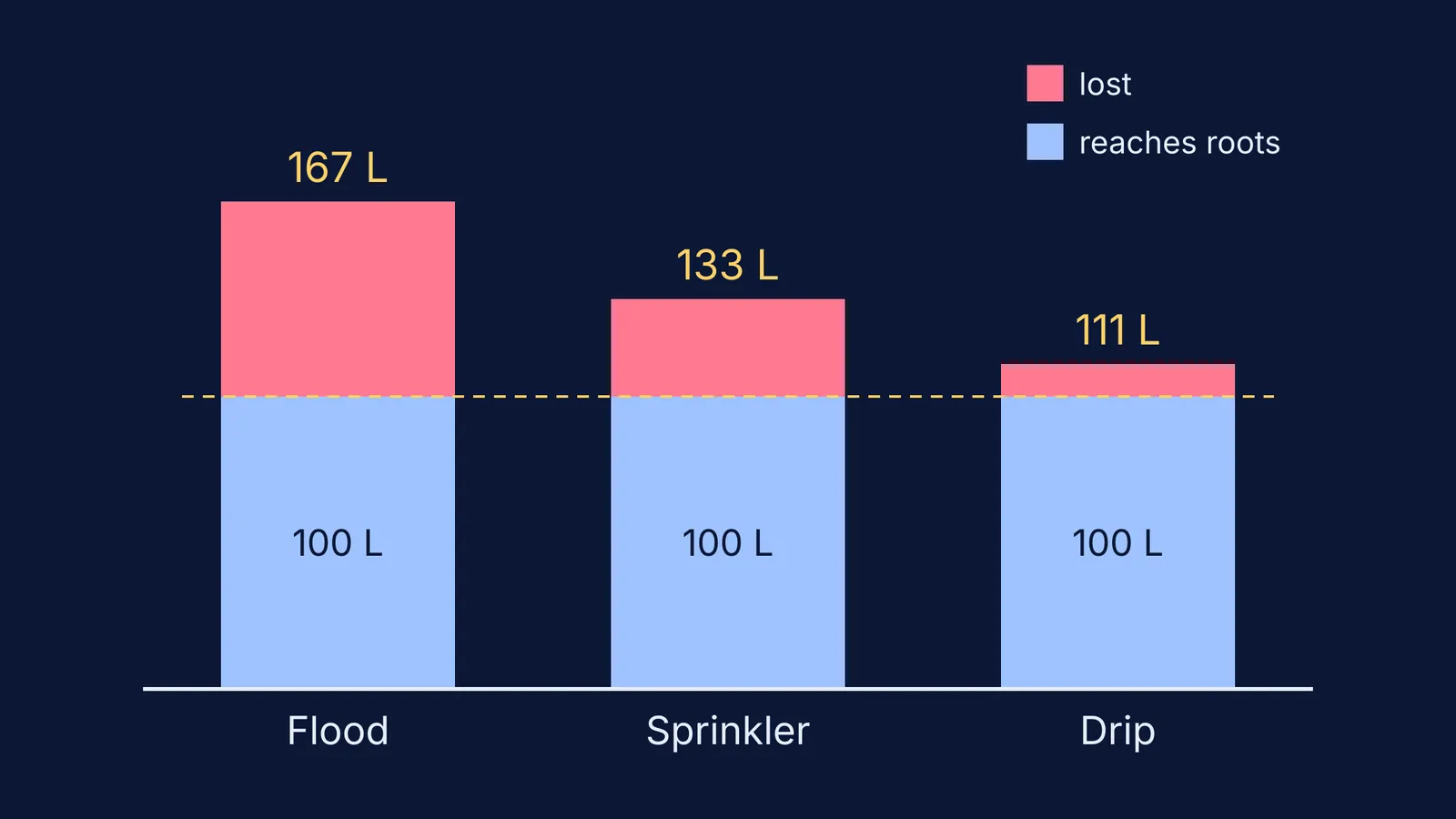
FAO's table of indicative irrigation efficiencies gives field application efficiency as 60% for surface irrigation, 75% for sprinkler and 90% for drip. Field application efficiency describes how much of the water you apply ends up in the root zone, where the crop can use it.
Say a one-hectare field needs 40 mm of water in the root zone. One millimetre over a hectare is 10,000 litres, so the crop needs 400,000 litres. Water you must supply = water needed ÷ efficiency.
Flood: 400,000 ÷ 0.60 = about 666,700 litres.
Sprinkler: 400,000 ÷ 0.75 = about 533,300 litres.
Drip: 400,000 ÷ 0.90 = about 444,400 litres.
Drip needs about 222,000 litres less than flooding for one watering, a third less. FAO says these values are indicative and can be lower when systems are run carelessly. If dividing by an efficiency still feels shaky, the Fermi Problem Library has worked problems with a step-by-step solver that explains the reasoning rather than printing an answer.
How do you write the NCERT answer on water-saving irrigation?
NCERT asks you to define irrigation and describe two methods that conserve water. A plan that covers the marks:
Define irrigation in one line: the supply of water to crops at regular intervals.
Sprinkler: pipes with rotating nozzles, water under pressure, sprays like rain; useful on uneven land, lawns and coffee.
Drip: water drop by drop near the roots; fruit plants, gardens and trees; a boon where water is scarce.
Add one line on why: less runoff, less deep seepage, less evaporation.
For one-mark questions, pair each traditional method with its machine: moat and pulley, dhekli and lever, rahat and bullock-turned wheel, chain pump and discs. If levers or pulleys are the weak link, the Fermi Concept Library gives every physics and biology concept its own lesson.
NCERT also suggests watering seeds by drip to see if it saves water. Try two pots, one watered by cup and one by a pierced bottle. Pair it with our guide to testing soil water holding capacity at home, then see where irrigation fits in crop production in Class 8, from sowing to storage.


