

On this page
Index numbers get one short chapter in your Class 11 Statistics for Economics book: Chapter 7 of the NCERT textbook. Each formula is a few lines of arithmetic, and marks go when q0 and q1 swap places.
What is an index number in Class 11 statistics?
NCERT defines an index number as "a statistical device for measuring changes in the magnitude of a group of related variables" (NCERT, Chapter 7).
The period you compare against is the base period, and its value is set to 100. So an index of 250 means the value is two and a half times what it was in the base period, as the same chapter explains.
What are the simple and weighted methods?
The NCERT chapter gives two ways to build an index, the aggregative method and the method of averaging relatives. Each comes in a simple and a weighted form:
Simple aggregative: P01 = Σp1 / Σp0 × 100
Simple average of price relatives: P01 = (1/n) × Σ(p1/p0) × 100
Weighted aggregative: prices multiplied by quantities, as in Laspeyres and Paasche below
Weighted average of price relatives: P01 = ΣW(p1/p0 × 100) / ΣW, where W is usually each item's share of base-period spending
The simple versions treat a matchbox and a sack of rice as equally important. NCERT's own example shows why weights matter: for the same four items, the unweighted average of relatives is 149 and the weighted one is 156, because the item carrying 40% of the weight doubled in price.
Laspeyres vs Paasche: what is the difference?
Both are weighted aggregative indices. The only difference is whose quantities you use.
Laspeyres uses base-period quantities: Σp1q0 / Σp0q0 × 100. It asks what the old basket costs now.
Paasche uses current-period quantities: Σp1q1 / Σp0q1 × 100. It asks what today's basket would have cost in the base period.
In NCERT's Example 2, the same prices give a Laspeyres index of 135.3 and a Paasche index of 132.1 (NCERT, Chapter 7). Neither is wrong. They price different baskets.
A worked example: one student's monthly basket
Say you spend on three things each month. In the base period, samosas cost Rs 15 and you buy 20; notebooks cost Rs 40 and you buy 5; a bus trip costs Rs 10 and you take 40. In the current period, samosas cost Rs 20 and you buy 15; notebooks cost Rs 50 and you buy 6; a bus trip costs Rs 12 and you still take 40.
Simple aggregative: (20 + 50 + 12) / (15 + 40 + 10) × 100 = 82/65 × 100 = 126.2
Simple average of relatives: the relatives are 133.3, 125 and 120, so the mean is 126.1
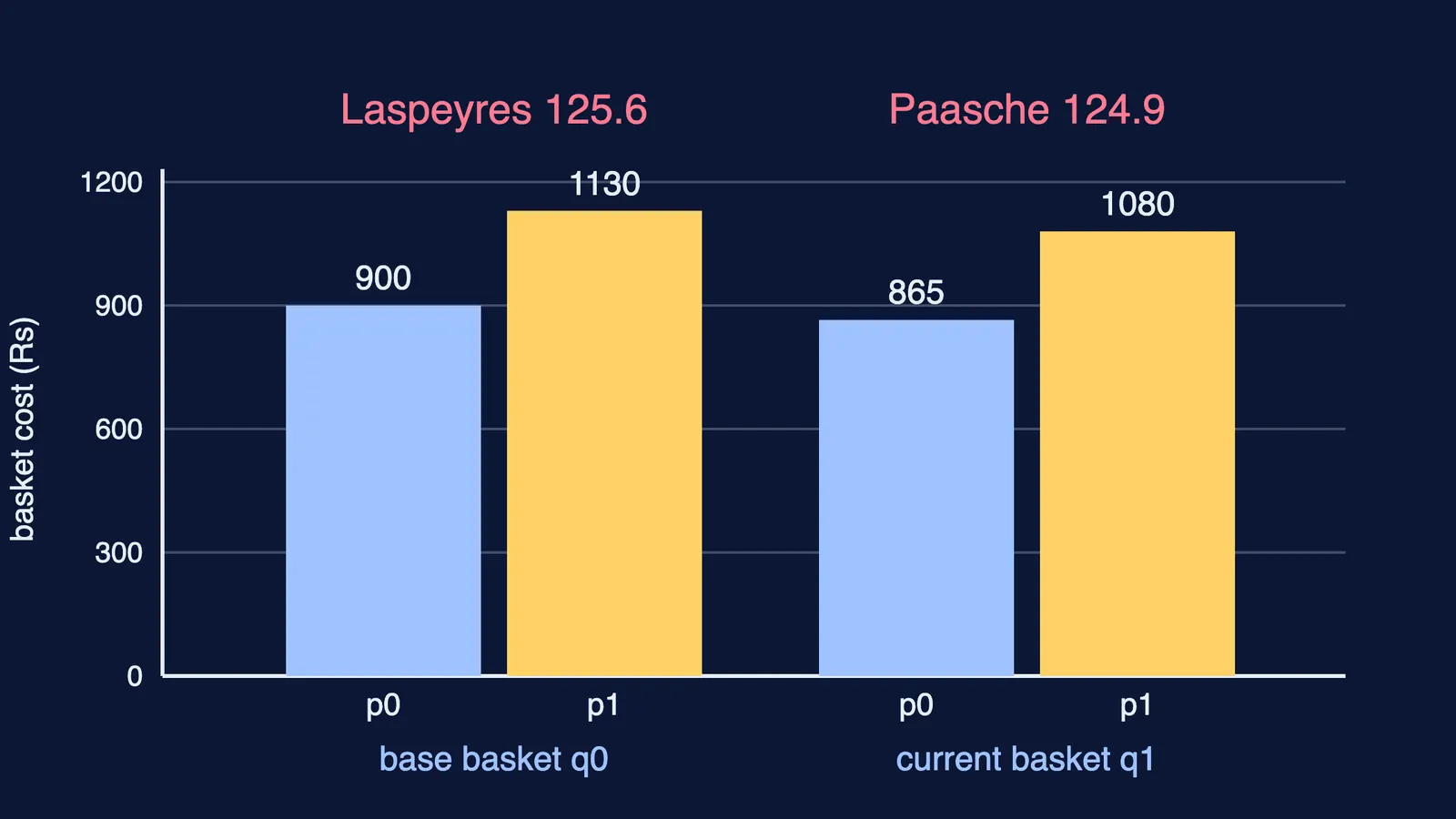
Laspeyres: Σp1q0 = 400 + 250 + 480 = 1,130 and Σp0q0 = 300 + 200 + 400 = 900, so the index is 125.6
Paasche: Σp1q1 = 300 + 300 + 480 = 1,080 and Σp0q1 = 225 + 240 + 400 = 865, so the index is 124.9
Weighted relatives, with base-period spending (300, 200, 400) as weights: (300 × 133.3 + 200 × 125 + 400 × 120) / 900 = 125.6
Step 5 matches Laspeyres exactly, because weighting price relatives by base-period spending is the same calculation written another way, so you can use one to check the other. Paasche comes out lower because you bought fewer samosas, the item whose price rose most.
If you keep mixing up q0 and q1 in steps 3 and 4, the Fermi Problem Library has a step-by-step solver that explains the reasoning, so you can see where your method went off.
How is the consumer price index calculated?
The consumer price index, also called the cost of living index, measures the average change in retail prices (NCERT, Chapter 7). Your textbook builds it as a weighted average of price relatives, CPI = ΣWR / ΣW. It reads an index of 150 as meaning salaries must rise by 50% to buy the same basket.
The textbook describes India's All-India CPI with base 2012 = 100, in which food and beverages carry a weight of 45.86 out of 100. That series has since been replaced. On 12 February 2026, the Ministry of Statistics and Programme Implementation released a new CPI with 2024 as the base year and weights from the Household Consumption Expenditure Survey 2023-24, according to ThePrint's report on the new series. The same report says the basket now tracks 308 goods and 50 services, up from 259 and 40, and that January 2026 retail inflation on the new series was 2.75%.
In the exam, use the base year and weights your textbook uses unless a question asks about current data.
Where to go next
For a gentler start, try building a samosa price index. For contrast, see how HDI is calculated. If averages still feel shaky, start with statistics through cricket scores.


