

On this page
“The ratio of incomes of two persons is 9 : 7 and the ratio of their expenditures is 4 : 3.” That line opens NCERT's Example 8. If a line like that makes you freeze, you are not alone. The arithmetic is easy. The hard part is turning two ratios and a savings figure into equations. Once you see that each person gives you one equation, it becomes a routine pair of linear equations.
How do you turn income and expenditure ratios into equations?
Everything rests on one line you already know from home: income minus expenditure equals savings. The second idea is the one students miss. Each ratio needs its own multiplier.
NCERT's Class 10 chapter Pair of Linear Equations in Two Variables (reprint 2026-27) does exactly this in Example 8. It writes the incomes as ₹9x and ₹7x and the expenditures as ₹4y and ₹3y, then solves the pair by elimination.
Why two letters? The ratio 9 : 7 says the incomes are 9 parts and 7 parts of some unknown size x. The ratio 4 : 3 is about different amounts, so its parts have a different size, y. Using x for both quietly assumes the parts are the same size, and nothing in the question says so.
How did NCERT solve the 9 : 7 and 4 : 3 problem?
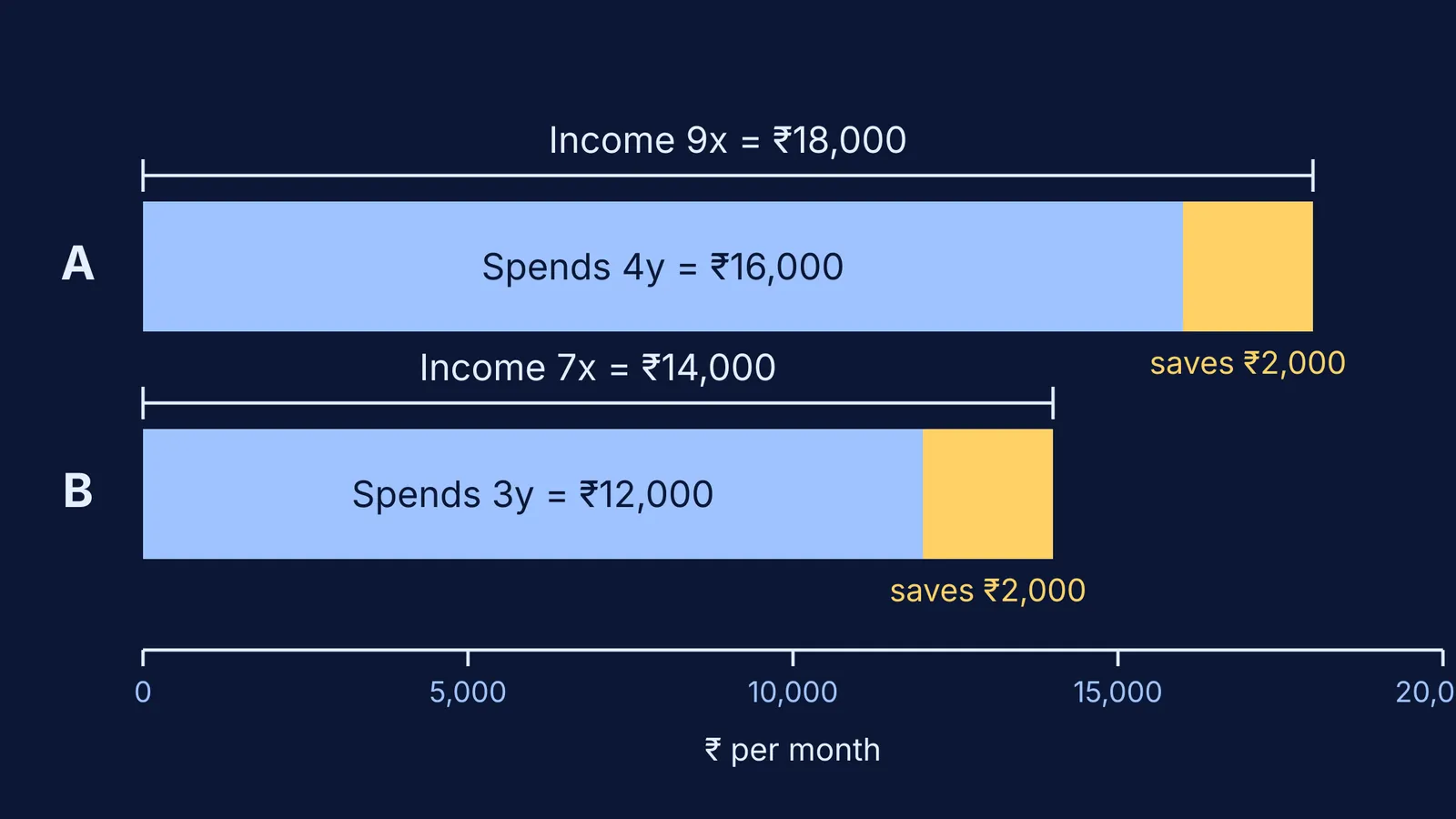
In the NCERT example, each person saves ₹2,000 a month. Writing income minus expenditure for each person:
Person A: 9x − 4y = 2000
Person B: 7x − 3y = 2000
Multiply the first by 3 and the second by 4: 27x − 12y = 6000 and 28x − 12y = 8000.
Subtract: x = 2000. Put it back into the first equation: 18000 − 4y = 2000, so y = 4000.
Incomes are 9x = ₹18,000 and 7x = ₹14,000.
NCERT then checks the answer: 18,000 : 14,000 = 9 : 7, and expenditures of ₹16,000 and ₹12,000 are in the ratio 4 : 3. Make that check a habit. It is quick, and it catches setup errors before they cost you marks.
Can you try one with new numbers?
Here is a fresh problem. The incomes of Riya and Kabir are in the ratio 5 : 4, their expenditures are in the ratio 7 : 5, and each saves ₹3,000 a month. Find their incomes.
Let the incomes be 5x and 4x, and the expenditures 7y and 5y.
Riya: 5x − 7y = 3000. Kabir: 4x − 5y = 3000.
Multiply Riya's equation by 5 and Kabir's by 7: 25x − 35y = 15000 and 28x − 35y = 21000.
Subtract: 3x = 6000, so x = 2000. Then 10000 − 7y = 3000, so y = 1000.
Incomes: ₹10,000 and ₹8,000. Expenditures: ₹7,000 and ₹5,000.
Check: 10,000 : 8,000 = 5 : 4, 7,000 : 5,000 = 7 : 5, and both save ₹3,000.
The savings do not have to be equal. Suppose incomes are 5 : 3, expenditures are 9 : 5, and the two people save ₹2,000 and ₹3,000. The equations are 5x − 9y = 2000 and 3x − 5y = 3000, which give x = 8500 and y = 4500, so the incomes are ₹42,500 and ₹25,500. Only the right-hand sides change.
What mistakes cost marks in these problems?
One letter for both ratios. Use x for incomes and y for expenditures.
Savings the wrong way round. It is income minus expenditure.
Stopping at x. The question asks for incomes, so multiply back.
Mixing up the people. Keep A's income and A's expenditure in the same equation. A small table with one row per person prevents this.
Skipping the check. Put your answer back into both ratios and both savings figures.
If ratios still feel shaky, start with how ratio parts work as fractions of a whole. For the general habit, see how to set up linear equations from word problems, and for the whole chapter, our guide to linear equations in two variables for Class 10.
How should you practise income and expenditure problems?
A short plan for one week:
Day 1: redo NCERT Example 8 without looking, then solve it again by substitution.
Days 2 and 3: invent three problems. Pick two incomes and two expenditures, work out the ratios and savings, then swap with a friend.
Day 4: try one problem with unequal savings.
Day 5: time yourself on five mixed problems and check every answer against the ratios.
If you get stuck on a step, the Fermi Problem Library has worked problems with a step-by-step solver that explains the reasoning rather than printing an answer, which helps when you can't see which equation went wrong. If ratios or linear equations need a refresher first, each concept has its own lesson in the Fermi Concept Library.
Start with the table, give each ratio its own letter, and check your answer every time.


