On this page
If a recipe calls for a 3 to 5 ratio of water to syrup, how much of the final drink is water? It is a question that catches many students (and adults) off guard. The instinct is to look at the numbers and assume that water makes up 3/5 of the mixture.
But a ratio is not always a fraction. When you are comparing two separate pieces, you need one extra step to find the whole before you can write it as a fraction.
What fraction is each part in a 3 to 5 ratio?
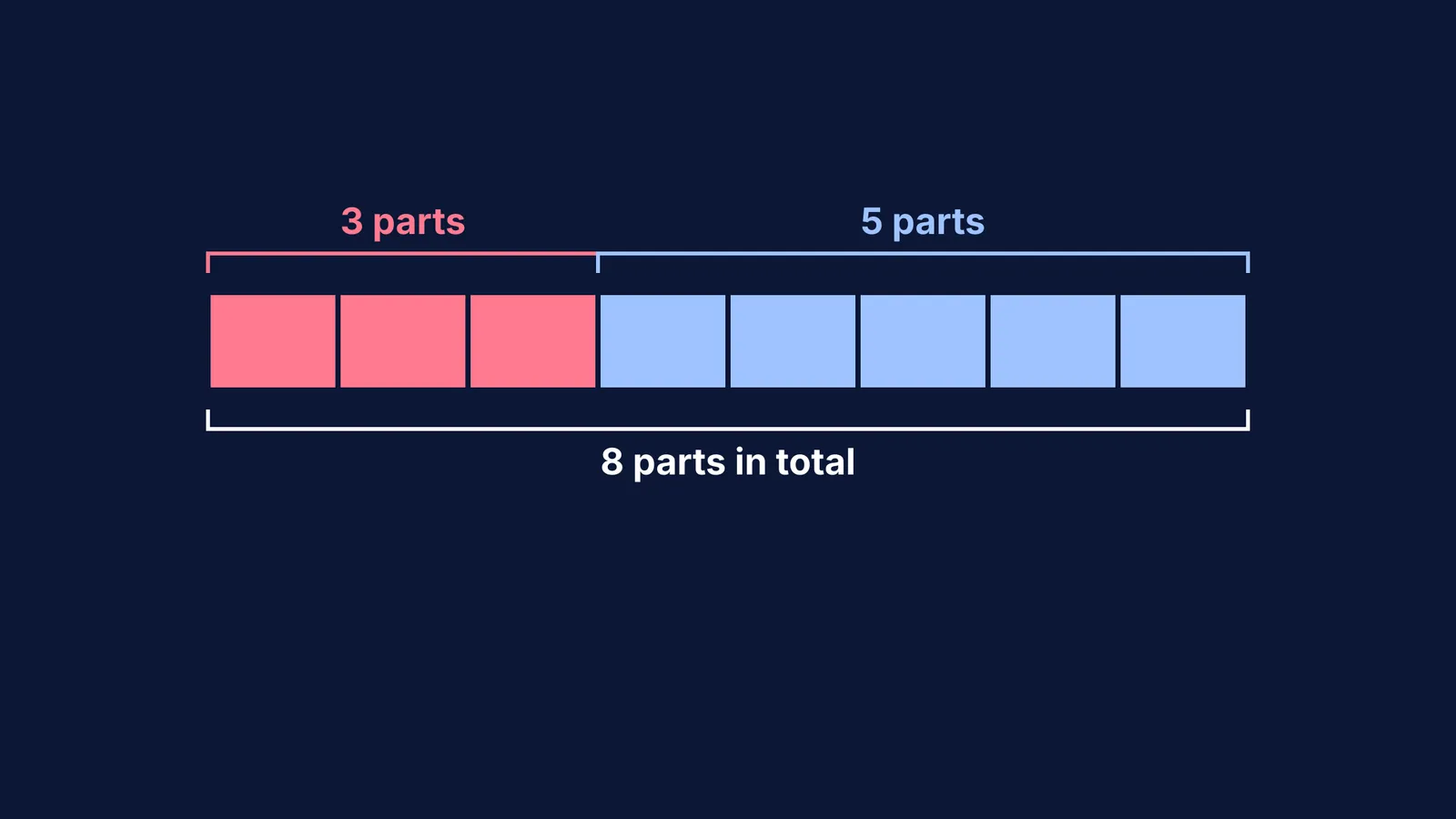
In a 3 to 5 ratio, the first part is 3/8 of the whole and the second part is 5/8 of the whole.
You find this by adding the separate parts together to get the total number of parts. If you have 3 parts of one thing and 5 parts of another, the total is 3 + 5 = 8 parts. Every time you look at a ratio written as A to B (or A:B), the total number of parts is A + B. This total sum becomes the denominator for your fractions. The numerator is simply the original number from your ratio.
Why do so many students get ratio fractions wrong?
More than 50% of U.S. eighth-graders answer proportion problems incorrectly on national assessments (National Assessment of Educational Progress data via I, Martinez & Dougherty, 2018).
The study identifies "confusion about the whole" as a frequent misconception where students treat a part-to-part ratio as a part-to-whole fraction. When asked to convert a 3:5 ratio, a student making this mistake will write 3/5 instead of 3/8. They focus entirely on the numbers in front of them and fail to realise that the "whole" is actually the sum of the parts combined.
This often happens because schools teach students early on that a ratio a:b can be written as a fraction a/b. That mathematical rule works perfectly when you are comparing one part directly to another part, but it fails completely when you need to know how much of the total mixture that part represents.
The power of visualising the whole
One of the easiest ways to correct this misconception is to draw a tape diagram. A tape diagram is a visual model that looks like a segmented bar. If you draw a bar and divide it into 8 equal blocks, you can colour 3 blocks pink to represent the first part, and 5 blocks blue to represent the second part.
Seeing the parts laid out side by side makes it immediately obvious that the entire bar consists of 8 blocks. It physically prevents you from using 5 as the denominator because you can see that the 3 pink blocks are a fraction of the 8 total blocks, not a fraction of the 5 blue blocks.
How to avoid the part-to-part trap
You can stop yourself from making this common mistake by following a simple three-step method every time you see a ratio in a test or a recipe.
Label the parts. Write it out in words to ground the maths in reality: "3 parts water, 5 parts syrup."
Add to find the total. Combine the numbers: 3 + 5 = 8 total parts.
Write the fraction. Now you know water is 3 out of 8 parts, or 3/8 of the final mixture.
Practice with an AI tutor
If you often mix up parts and wholes in maths or physics problems, the Fermi Problem Library has worked problems with a step-by-step solver that explains the reasoning rather than printing an answer.
Fermi's AI tutor holds a line of reasoning across a session, notices where you are stuck, and decides whether to explain, ask or show you the next step. If you just need to brush up on foundational ideas like proportional division, you can read through the Fermi Concept Library before tackling your homework.
A worked example: splitting money
Suppose you need to split ₹400 between two people in a 3 to 5 ratio. Here is how you apply the rule to find the exact amounts without guessing.
First, find the total parts by adding the ratio numbers: 3 + 5 = 8 parts in total. Next, find the monetary value of a single part by dividing the total amount by the total number of parts: ₹400 ÷ 8 = ₹50 per part. Finally, multiply this value by the number of parts for each person: the first person gets 3 × ₹50 = ₹150, and the second person gets 5 × ₹50 = ₹250.
You can always check your work by adding the final amounts together: ₹150 + ₹250 = ₹400. You can apply this exact same proportional division method to solve physics problems step by step when mixing chemical solutions or balancing forces across different sections of a beam. Mixing your problem types in an interleaved practice plan can also help you spot these ratio traps faster before they cost you marks on an exam.