On this page
This classic solid-state question rewards one idea: a crystal has to stay electrically neutral. Once you see how strontium keeps the charge balanced, the number falls out in three lines.
What happens when SrCl2 is added to NaCl?
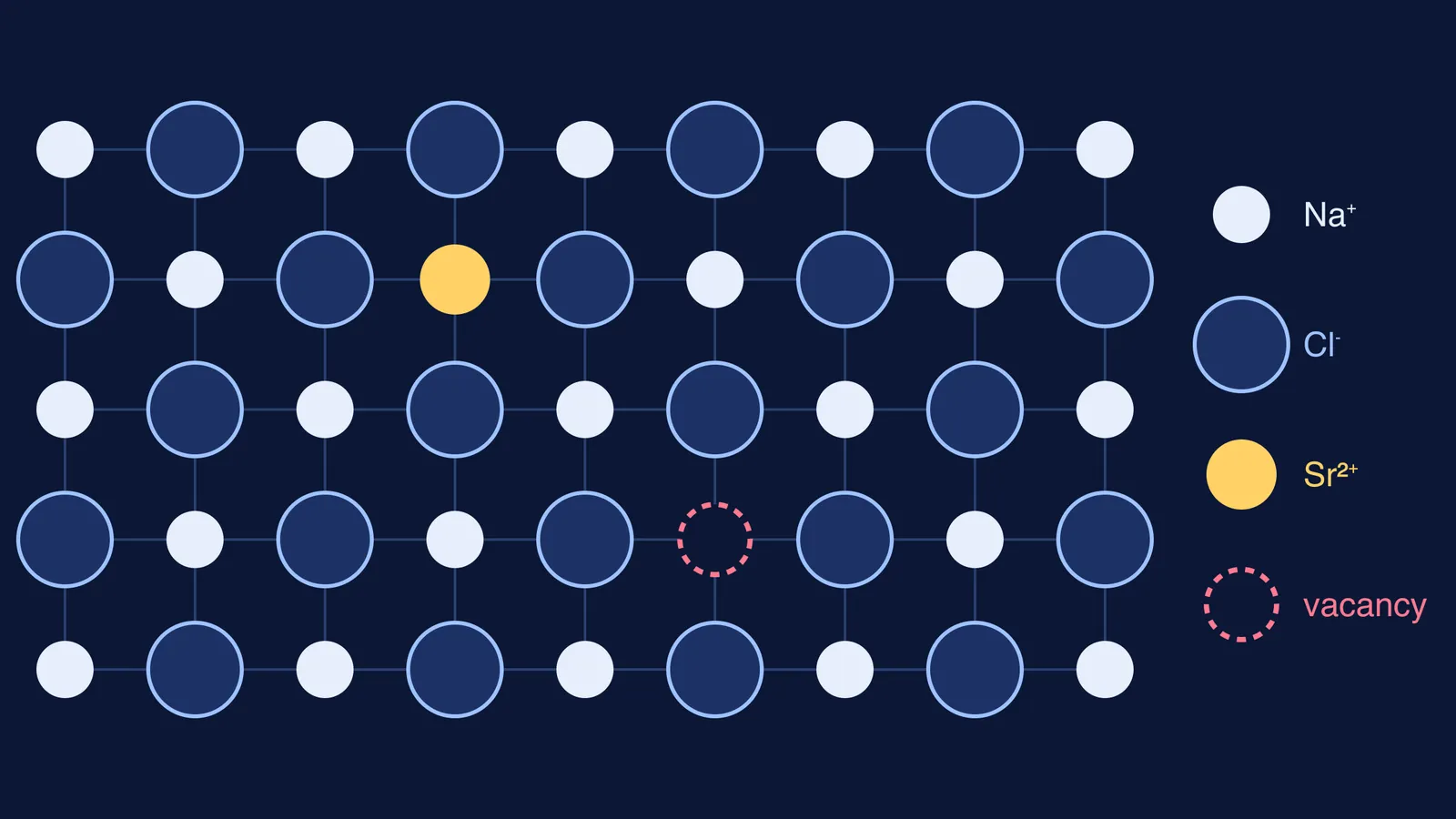
Sodium chloride is built from Na⁺ and Cl⁻ ions in strict alternation, one positive charge for every negative one. Strontium chloride brings in Sr²⁺, an ion with a charge of +2 where the Na⁺ it replaces has +1.
An impurity ion with a different charge from the ion it substitutes is called an aliovalent impurity, and it forces charge-compensating point defects into the crystal, as MIT's materials science lecture notes on defects in ionic crystals put it. The same notes describe the "extrinsic regime", where the impurity concentration controls how many point defects there are. In NaCl doped with SrCl2, the compensating defect is an empty cation site.
Why does one Sr²⁺ create exactly one cation vacancy?
Count charges, then count sites. One formula unit of SrCl2 brings one Sr²⁺ and two Cl⁻. The two Cl⁻ ions go into two anion sites, so the crystal also needs two cation sites to keep the rock-salt pattern.
Two cation sites would normally hold two Na⁺, a total charge of +2.
One Sr²⁺ already supplies +2 on its own.
So Sr²⁺ fills one of the two sites and the other is left empty.
That empty site is the cation vacancy. One Sr²⁺ in, one vacancy created, every time.
The rule tells you how to handle variants too. A 2+ ion in any 1+ cation site makes one vacancy; a 3+ ion in a 1+ site would carry two extra units of charge and so leave two sites empty.
How many cation vacancies does 10⁻³ mol% SrCl2 create?
The answer, 6.02 × 10¹⁸ vacancies per mole of NaCl, matches the worked solution in the SATHEE solid-state problem set from IIT Kanpur, and the Avogadro constant is exactly 6.022 140 76 × 10²³ mol⁻¹ according to NIST's CODATA value.
Turn mol% into a fraction: 10⁻³ mol% = 10⁻³ ÷ 100 = 10⁻⁵ mol of SrCl2 per mole of NaCl.
Each SrCl2 gives one Sr²⁺, so there are 10⁻⁵ mol of Sr²⁺ per mole of NaCl.
Each Sr²⁺ creates one cation vacancy, so there are 10⁻⁵ mol of vacancies per mole of NaCl.
Convert moles to a number: 10⁻⁵ × 6.022 × 10²³ = 6.022 × 10¹⁸.
Write the answer with its unit: 6.02 × 10¹⁸ cation vacancies per mole of NaCl (written 6.02 × 10¹⁸ mol⁻¹).
Strictly, 10⁻³ mol% means 10⁻⁵ mol of SrCl2 in one mole of the mixture, not per mole of NaCl. At this dilution the difference is one part in a hundred thousand, far too small to change the answer, which is why standard solutions such as SATHEE's work per mole of NaCl.
If you want to test yourself, change the numbers. At 2 × 10⁻³ mol% the vacancies double to about 1.20 × 10¹⁹ per mole. At 10⁻² mol% they rise tenfold to about 6.02 × 10¹⁹. If your answers move the same way, you have the logic and not just the memory of one number.
The Fermi Problem Library has worked problems with a step-by-step solver that explains the reasoning rather than printing an answer, which helps when you got a number but cannot say why it is right.
Where do students lose marks on this question?
Most wrong answers come from four slips. Run this check before you move on:
Forgetting the 100 in mol%. The SATHEE solution divides by 100 first. Writing 10⁻³ mol instead of 10⁻⁵ mol makes the answer a hundred times too large: 6.02 × 10²⁰.
Counting two vacancies. SrCl2 has two Cl⁻, but those fill anion sites. Only the cation side has a gap, and it has one.
Calling it a Schottky or Frenkel defect. Those are intrinsic defects of a pure crystal. A vacancy caused by a foreign ion is an impurity defect.
Dropping the unit. "6.02 × 10¹⁸" alone is incomplete; say "per mole of NaCl".
Solid-state chapters have moved in recent syllabus revisions: Unit 1 of the current NCERT Class 12 Chemistry book is now Solutions. Check the current book and your exam's official syllabus before deciding how much time to give this topic. The reasoning carries over to any question about charge balance in ionic solids.
If ionic crystals or point defects still feel shaky, the Fermi Concept Library covers every concept in chemistry, each with its own lesson and its place in the map, so you can fill the gap before the next problem set.