

On this page
The short answer: not in the way the nickname suggests. Turritopsis dohrnii is the only animal known to do this again and again after reproducing: an adult jellyfish can turn back into the young, rooted stage of its life and start again. But "immortal" here is a biologist's word about ageing, not a promise that any one jellyfish lives forever.
What is the normal life cycle of this jellyfish?
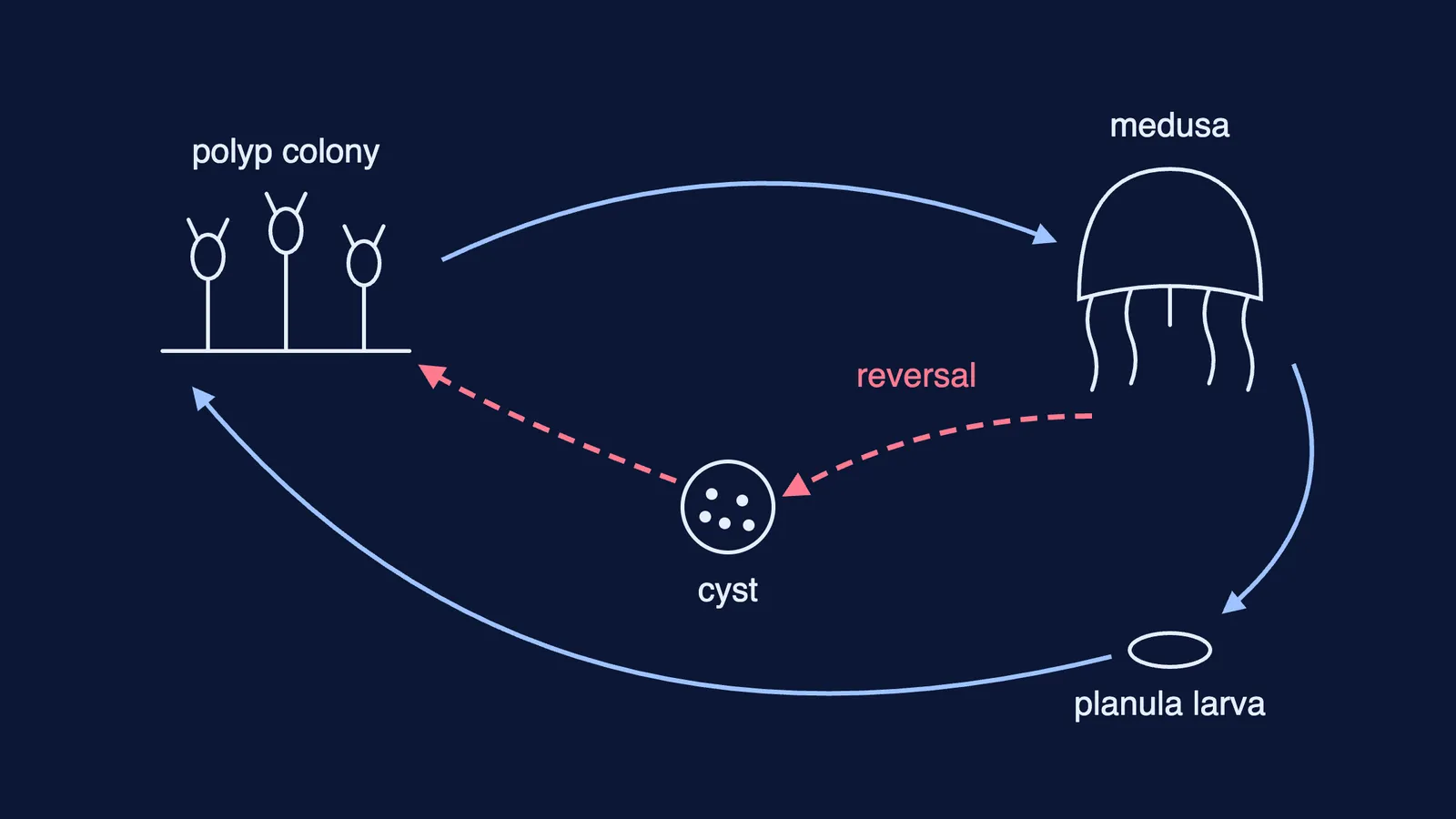
Turritopsis is a hydrozoan, part of the phylum Cnidaria, and its life has two very different forms. As Matsumoto, Piraino and Miglietta (2019) describe it, free-swimming medusae release eggs and sperm into the water, the fertilised egg becomes a short-lived planula larva, and the planula settles on the sea floor and grows into a colony of polyps that buds off new medusae. In a typical hydrozoan the cycle only runs forward: going back to an earlier stage is possible in a few species, but it does not usually happen once an animal has started to reproduce.
How does the immortal jellyfish turn back into a polyp?
The reversal was first described in 1996 by Piraino, Boero, Aeschbach and Schmid, who studied the jellyfish under the name Turritopsis nutricula. They reported that medusae at every stage, from newly released to fully mature, could transform back into colonial polyps, either directly or after a resting period. They called it the first many-celled animal known to revert to a colonial, juvenile form after reaching sexual maturity as a single medusa. When they cut away parts of the medusa, the change happened only if differentiated cells of the outer bell's skin layer and part of the gut system were still there.
The 2019 study fills in the steps. A medusa that is ageing, damaged or under bad conditions shrinks, stops swimming, settles, and becomes a cyst: a small ball of cells in a thin chitin coat that looks like neither medusa nor polyp. In the following 24 to 36 hours the cyst grows a polyp's root-like stolon, from which new polyps rise (Matsumoto et al., 2019). In that lab work, newly released medusae were starved to turn them into cysts, which took 24 to 48 hours.
What is transdifferentiation?
Transdifferentiation is the reprogramming of a fully specialised body cell into a different cell type, either directly or after first becoming less specialised (Matsumoto et al., 2019). The same paper notes that dedifferentiation, a cell simply returning to a less specialised state, cannot be ruled out and may happen alongside it in Turritopsis.
So the jellyfish is not playing a video backwards: cells from the bell take on new jobs and build a body plan that was not there a day earlier.
If these terms blur together, the Fermi Concept Library gives each biology concept its own lesson and its place in the map, so you can see how related ideas connect. For another kind of regrowth, read how axolotls regrow limbs and how Hydra and Planaria differ.
Is the immortal jellyfish really immortal?
A 2022 genome study in PNAS by Pascual-Torner and colleagues calls T. dohrnii the only animal able to rejuvenate repeatedly after its medusae reproduce. Some other cnidarians can reverse their development, they note, but usually lose the ability once sexually mature; two other Turritopsis species reported to rejuvenate after reproducing see that ability drop sharply. The authors call T. dohrnii immortal because the chance that a sexually mature medusa rejuvenates goes up to 100%, with no apparent limit to the number of cycles (PNAS, 2022). Comparing it with its relative Turritopsis rubra, which has no published record of rejuvenating after reproduction, they found differences in genes linked to DNA repair, telomere maintenance and stem cells.
Read those words carefully, because each sets a limit:
Biologically immortal means escaping death from ageing, not escaping death. A medusa that is eaten has no body left to rebuild.
No apparent limit means none has been seen, which is not proof of endless cycles.
Rejuvenate means returning to the polyp stage. The medusa does not stay a medusa; its body is rebuilt into a polyp colony.
Genes linked to repair are clues, not a full explanation, and nothing here is a treatment for human ageing.
Your own body works differently: it replaces worn-out cells rather than rebuilding them into a younger form, as in why red blood cells have a fixed lifespan.
How do you answer "is it immortal?" in an exam or viva?
Use four sentences, one idea each:
Turritopsis dohrnii can turn an adult medusa back into a polyp colony through a cyst stage.
This works by transdifferentiation: specialised cells are reprogrammed into new cell types.
Biologists call it biologically immortal because it can repeat this after reproducing, with no limit yet observed.
It can still be eaten or destroyed; immortal here means escaping death from ageing.
Then say them aloud without notes. If you want someone to push back, Fermi's AI tutor checks understanding as it goes and decides whether to explain, ask or show, so a shaky definition gets caught early.
If cnidarians have caught your interest, see how Hydra's nerve net works with no brain.


