

On this page
What is hypnosis, according to scientists?
The American Psychological Association's hypnosis division defines hypnosis as a state of consciousness involving focused attention and reduced peripheral awareness, with an enhanced capacity to respond to suggestion (APA Division 30).
Hypnotizability, the same page says, is a person's ability to experience suggested changes in sensations, emotions, thoughts or behaviour. It varies between people, and as the studies below show, it strongly shapes how much someone responds.
What do brain scans show during hypnosis?
Pain that bothers you less, at the same strength. Pierre Rainville's team in Montreal used hypnotic suggestion to change how unpleasant a painful heat stimulus felt without changing how intense it felt. PET scans showed changes in the anterior cingulate cortex, while the primary somatosensory cortex was unaltered (Science, 1997).
An automatic habit switched off. In the Stroop task you name the ink colour of a word such as RED printed in blue, and reading gets in the way. Amir Raz and colleagues tested 16 highly suggestible and 16 less suggestible people. A posthypnotic suggestion to attend only to the ink and not read the words removed the interference in the highly suggestible group, but not in the others (Archives of General Psychiatry, 2002).
Brain networks working differently. A Stanford team screened 545 healthy adults and scanned the 57 with very high or very low hypnotizability. During hypnosis, activity fell in the dorsal anterior cingulate cortex, and a prefrontal control area linked more strongly with the insula and more weakly with the mind-wandering default mode network (Cerebral Cortex, 2017).
Does hypnosis work for pain and medical problems?
A meta-analysis pooled 85 controlled trials with 3,632 healthy volunteers given lab-induced pain, comparing hypnosis with no intervention (Neuroscience and Biobehavioral Reviews, 2019). With direct pain-relief suggestions, pain fell by 42% in highly suggestible people and 29% in medium responders, reductions the authors call clinically meaningful; low responders gained little. The authors say high-quality clinical data are still needed for long-term pain.
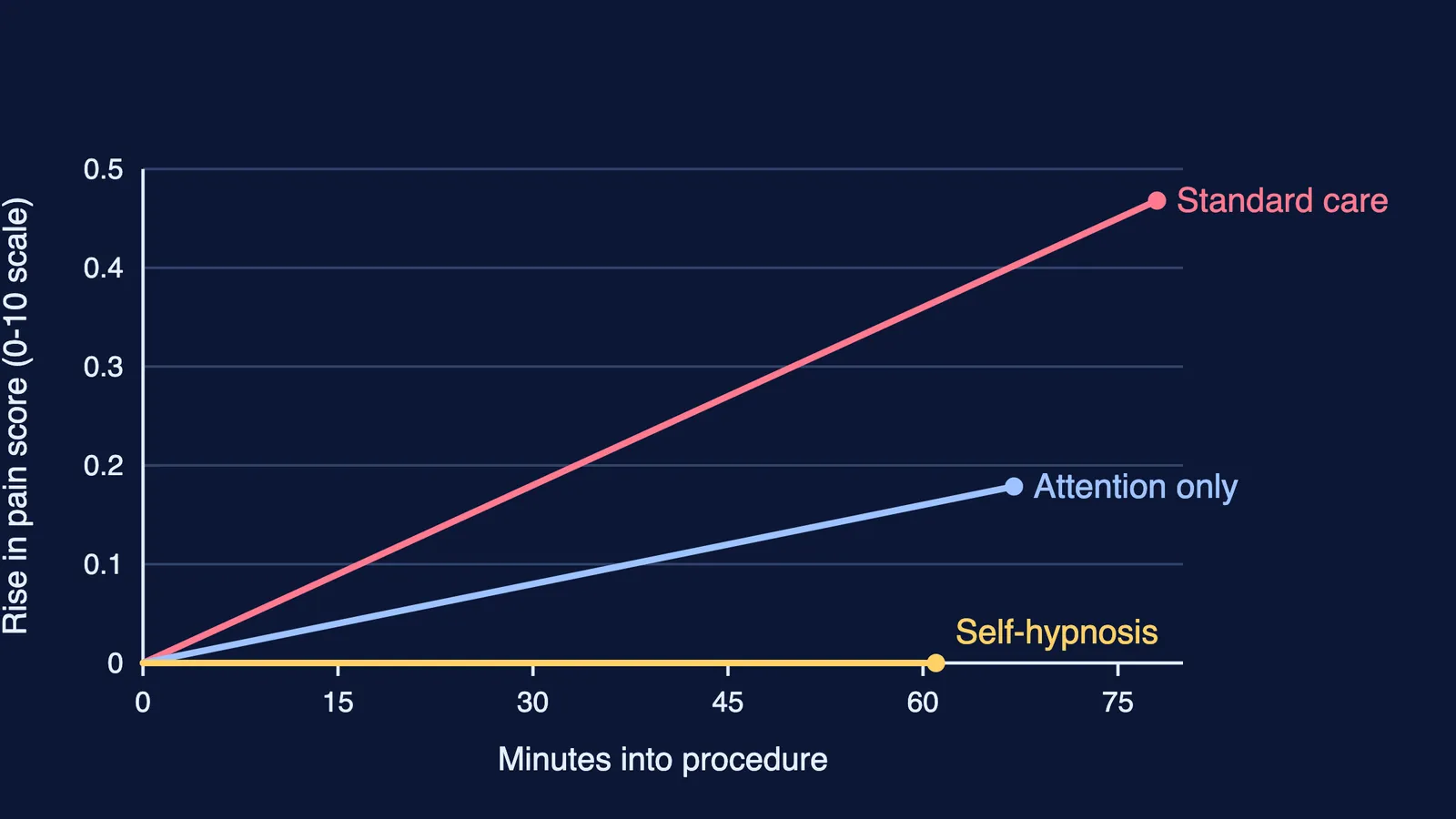
In hospital, a trial randomised 241 patients having vascular and kidney procedures to standard care, structured attention or self-hypnotic relaxation (The Lancet, 200002162-0)). Pain rose steadily with time under standard care but stayed flat with hypnosis. The standard group used 1.9 units of pain and sedation drugs against 0.9 in the hypnosis group, and their procedures took 78 minutes against 61.
For irritable bowel syndrome (IBS), a 2025 review of 67 randomised trials with 7,441 adults found gut-directed hypnotherapy beat waiting-list controls, alongside several other behavioural therapies such as forms of CBT (Lancet Gastroenterology and Hepatology, 202500238-9)). The authors rated the certainty of the evidence low or very low, so hypnosis sits beside other therapies, not above them.
What do stage shows exaggerate?
That it works on everyone. The research keeps finding that response depends on hypnotizability. If a show tests the audience and invites only the most responsive people on stage, you see the top of that range, not a typical person.
That it digs up hidden memories. In a classic experiment, people spent a week trying to recall 60 pictures; when hypnotised and pushed to remember more, most of the newly recalled material was wrong, especially for highly hypnotizable people (Science, 1983).
That you are asleep or controlled. Scientists describe focused attention, not sleep. The studies here measured volunteers who agreed to take part; none shows a hypnotist overriding what someone wants.
Expectation also plays a part, as our explainer on how the placebo effect works shows.
How can you judge a hypnosis claim?
Run any advert, video or recording through these five questions.
Who was tested: lab volunteers, patients, or a stage audience?
Compared with what: a waiting list, an attention control, usual care, or nothing?
How big was the effect, and for whom: high or low responders?
Who is offering it? In India, ask whether they are a doctor or a licensed clinical psychologist; our guide to the RCI licence route for clinical psychologists explains what that licence means.
Does it promise recovered memories, guaranteed results, or a replacement for medicine? If so, walk away.
Worked example. A video says: listen to this track every night and your board marks will jump. Question 1: no one says who was tested. Question 2: no comparison group. Question 3: no effect size. It fails three questions before the fourth, so treat it as an advert, not evidence. Relaxing before sleep is fine; expecting a recording to replace revision is not.
If the biology here, such as the cingulate cortex or how pain signals travel, is new to you, the Fermi Concept Library covers every concept in biology, physics, chemistry, mathematics and computing, each with its own lesson. For calmer study sessions, see what trials found about mindfulness for students.
If pain, stress or a health condition is troubling you or your child, talk to a doctor or qualified mental-health professional, or call India's free Tele MANAS helpline on 14416 (Ministry of Health, PIB).


