

On this page
If a question asks you to rank HCl, HBr and HI by how fast they add to an alkene, the answer is HI > HBr > HCl. The reason fits in one line: the H–X bond gets weaker as the halogen gets bigger, and a weaker bond lets go of its hydrogen more easily. This post shows you the numbers behind that line, where it sits in the mechanism, and how to write it in an exam answer.
What happens when HX adds to an alkene?
Adding HX to an alkene is an electrophilic addition: the alkene's pi electrons attack the hydrogen of HX, and one carbon becomes a carbocation, as LibreTexts' chapter on electrophilic addition/07:_Alkenes-_Structure_and_Reactivity/7.08:_Electrophilic_Addition_Reactions_of_Alkenes) describes it.
In the second step, the halide ion (Cl⁻, Br⁻ or I⁻) attacks the carbocation and you get the alkyl halide.
The first step is the rate-determining step, because its activation energy is much larger than that of the second step (LibreTexts/07:_Alkenes-_Structure_and_Reactivity/7.08:_Electrophilic_Addition_Reactions_of_Alkenes)). The H–X bond breaks in this slow step, so anything that makes it easier to break speeds up the whole reaction.
Why does HI react fastest with alkenes?
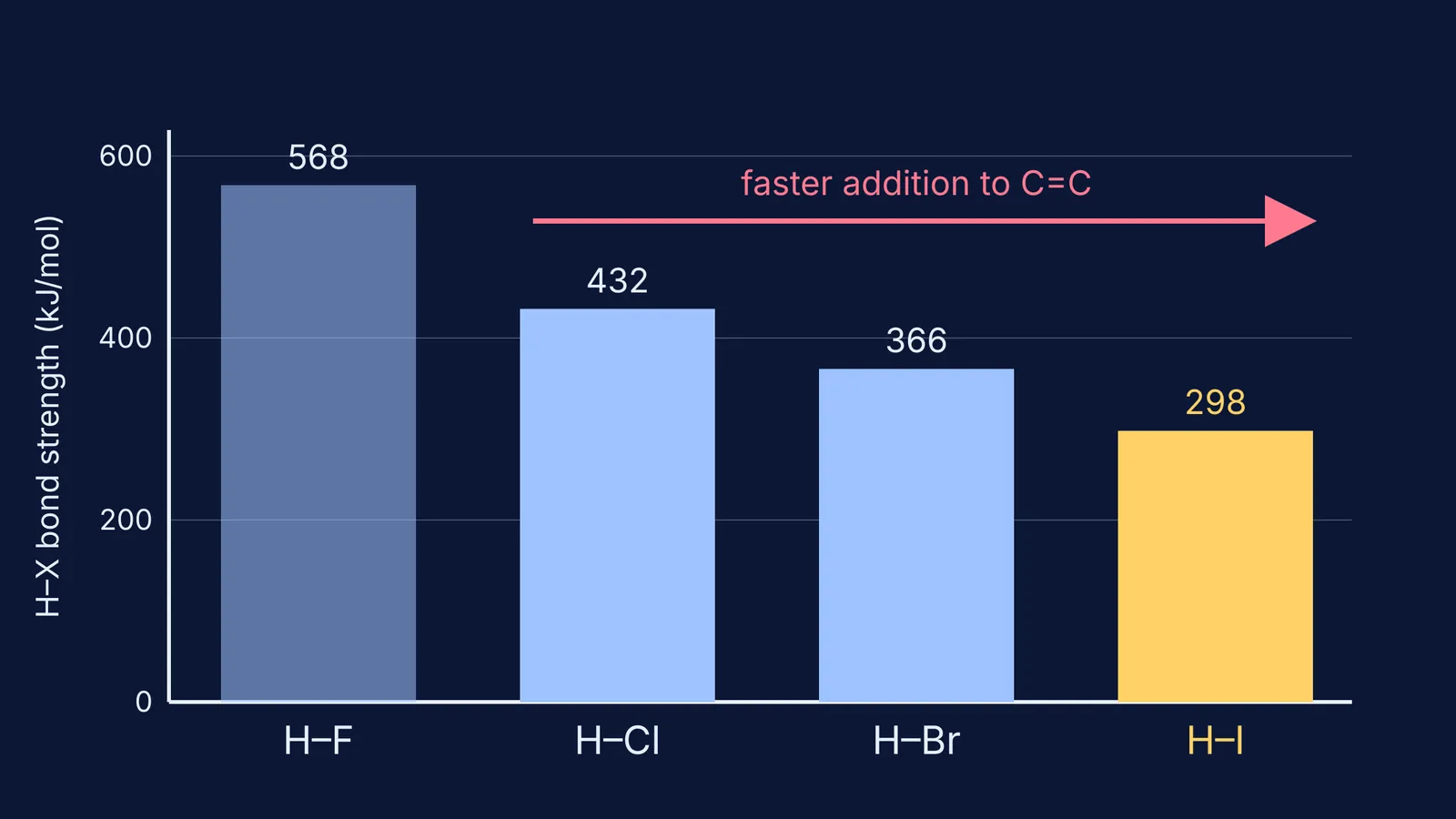
Because the H–X bond gets weaker from HF down to HI. Chemguide gives these bond strengths:
H–F: 568 kJ/mol
H–Cl: 432 kJ/mol
H–Br: 366 kJ/mol
H–I: 298 kJ/mol
The same page states the consequence: in the first step of the mechanism the hydrogen–halogen bond breaks, and a weaker bond breaks more readily, so the rate rises from HF to HCl to HBr to HI (Chemguide).
Why does the bond weaken? As Chemguide puts it, the halogen atoms get bigger going down the group, and the hydrogen–halogen bond strength falls. A bigger atom holds the shared electrons further from hydrogen, so the bond is longer and weaker. Our post on why the C–I bond is the weakest carbon–halogen bond walks through the same size effect for carbon.
The same weak bond is why HI is the strongest acid of the four in water. Our post on why HF is a weak acid but HI is a strong acid shows the same trend in a new setting.
What about HF?
HF has the strongest bond by far. LibreTexts notes that hydrogen fluoride reacts much more slowly than the other three and is normally left out of these discussions (LibreTexts/07:_Alkenes-_Structure_and_Reactivity/7.08:_Electrophilic_Addition_Reactions_of_Alkenes)). That is why many textbook orders stop at HCl.
Worked example: ranking propene + HX
Question. Arrange HCl, HBr and HI in increasing order of rate of reaction with propene. Give a reason.
Step 1. Name the slow step. The alkene's pi electrons take the proton from HX to form a carbocation. The H–X bond breaks here.
Step 2. Compare the bond that breaks. Using Chemguide's values, H–Cl is 432 kJ/mol and H–I is 298 kJ/mol. Breaking H–I takes 134 kJ/mol less energy than breaking H–Cl.
Step 3. Conclude. The weaker the bond, the faster the proton transfer, so HCl < HBr < HI.
Step 4. Add the product if asked. The proton goes to the CH₂ end, giving the more stable secondary carbocation (Markovnikov's rule), so propene + HI gives 2-iodopropane. The same pattern holds for HCl, and for HBr when no peroxides are present.
A strong answer uses three key terms: bond strength, rate-determining step and carbocation.
How do you check you have really got it?
Run through this quick checklist before you move on:
Can you write the two-step mechanism for ethene + HBr from memory, with curly arrows?
Can you say which step is slow, and why?
Can you rank HCl, HBr and HI and give the bond-strength reason in one sentence?
Can you explain why HF is usually left out?
Can you predict the product with propene, and say which carbocation forms?
If point 5 is shaky, our guide to Markovnikov's rule and the peroxide effect covers where the halogen ends up. If you are unsure about bond strength or carbocation stability themselves, the Fermi Concept Library has a lesson for each concept in chemistry and shows where it sits in the map.
For practice, try a few ranking and product questions in the Fermi Problem Library, where the step-by-step solver explains the reasoning rather than printing an answer, so you can check whether your reason, not only your order, is right.


