

On this page
Your stomach growls halfway through a mock test, or you can't face dinner the night before a board exam. Both come from one system: hormones that report on your body's energy, and a small brain region that reads them.
What causes hunger hormones to rise and fall?
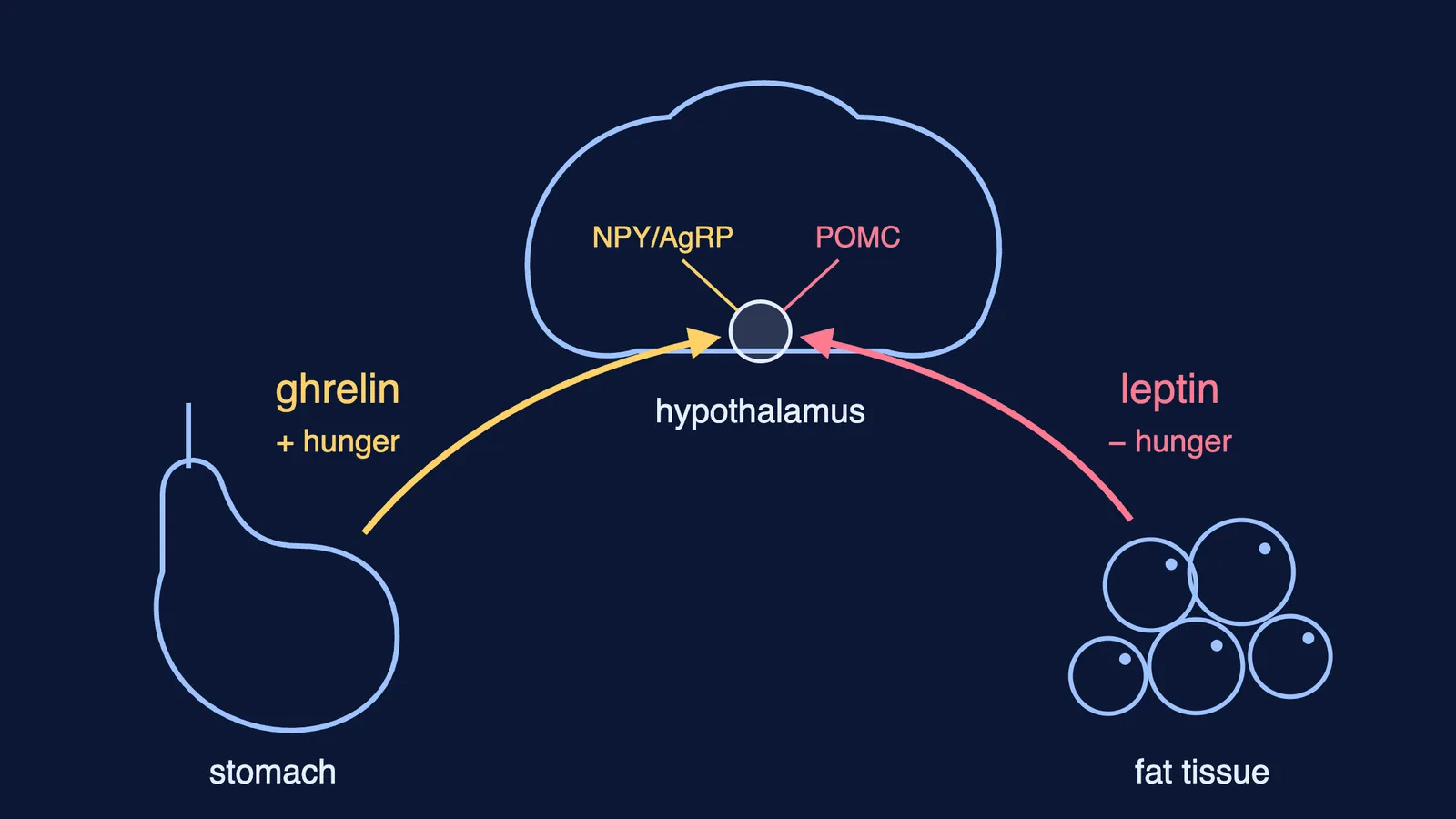
Ghrelin is the "time to eat" signal. A Japanese team first purified it from rat stomach in 1999 (Kojima et al., Nature). Most ghrelin is produced in the stomach, and a dose of it reliably brings on hunger and increases food intake (Müller et al., Molecular Metabolism, 2015).
The main trigger is time since your last meal. In a study of 10 healthy adults eating on a fixed schedule, blood ghrelin rose nearly twofold just before each meal and fell back to its low point within an hour of eating (Cummings et al., Diabetes, 2001).
Leptin is the slower "we have enough stored" signal; the mouse gene behind it was identified in 1994 (Zhang et al., Nature). Leptin is secreted by fat tissue in proportion to the body's fat stores (Thon, Hosoi and Ozawa, Frontiers in Endocrinology, 2016). So ghrelin tracks the next few hours, while leptin reports on the long-term reserve.
What does the hypothalamus do with these signals?
The hypothalamus, at the base of the brain, is the principal site where leptin and insulin act to keep the body's energy in balance (Thon et al., 2016). Inside it, two groups of neurons pull against each other: NPY/AgRP neurons push you to eat, and POMC neurons push you to stop. Leptin, together with insulin, quiets the NPY/AgRP neurons and stimulates the POMC neurons.
Ghrelin does roughly the reverse: it increases the activity of NPY and AgRP neurons and inhibits POMC neurons, and the arcuate nucleus of the hypothalamus is an important site of its action (Müller et al., 2015). One accelerator, one brake, and the brain adds up the inputs.
If the endocrine chapter feels like a list of names, the Fermi Concept Library gives every concept in biology its own lesson and its place in the map, so you can see how each idea connects to the rest.
Why does exam stress change your appetite?
Stress pushes different people in different directions. In a questionnaire study of 212 students, 73% said stress increased their snacking; dieters were more likely to report eating more overall, and non-dieters eating less (Oliver and Wardle, Physiology and Behavior, 1999).
A review by Tanja Adam and Elissa Epel suggests part of the why. In the short term, insulin and leptin counter the stress hormone cortisol, but under chronic stress that balance is disrupted, which may contribute to eating more (Adam and Epel, Physiology and Behavior, 2007). Their proposed model gives cortisol and the brain's reward circuitry a central role in the pull towards calorie-dense food.
Does lack of sleep make you hungrier?
Cutting sleep shifts the same two hormones. In a study of 12 healthy young men, two days of restricted sleep, compared with two days of extended sleep, lowered leptin by 18%, raised ghrelin by 28% and increased hunger by 24% (Spiegel et al., Annals of Internal Medicine, 2004). Appetite for calorie-dense, high-carbohydrate foods rose by 33% to 45%.
It was a small study of men only, so treat it as a clue rather than a rule. Sleep matters for memory too: see whether sleep helps you remember what you studied.
How can you eat steadily through exam week?
You can't switch these hormones off, but you can give them steady inputs. A worked example for a day with a 10 a.m. paper:
6:30 a.m. Wake at your usual time, not two hours early to cram.
7:30 a.m. A breakfast you know sits well, such as poha, idli or paratha with curd. Here is what breakfast trials found about school performance.
9:15 a.m. Water, and a small familiar snack if your stomach feels tight.
1:30 p.m. Lunch at the normal time, even if you are not very hungry.
4:30 p.m. One planned snack, eaten away from the desk.
8:00 p.m. Dinner, then a fixed lights-out time.
Then read your own signals:
No appetite before a paper: eat something small and plain, then a proper meal afterwards.
Late-night cravings: often a sign the night is running too long, so move lights-out earlier.
For parents, a calm line works better than pressure: "There's dal-rice kept for you. Eat when you're ready, and tell me if you want something lighter." If your child lives alone in a coaching city, this meal plan for aspirants who order food daily can help.
If exam week feels overwhelming because you don't know where to start, Fermi's AI tutor can work out what you already know and build a plan for the session, so you sit down to a clear next step.


