

On this page
Chapter 3 of NCERT's Class 12 Fundamentals of Human Geography is short and rests on three ideas: the four pillars, the four approaches and how the Human Development Index ranks countries, with India's figures from the 2025 report.
What does human development mean in Class 12 geography?
The NCERT chapter, Human Development (Class 12 geography), first separates growth from development. Growth is quantitative and value neutral. Development is a qualitative change that is always value positive.
The concept of human development was introduced by Dr Mahbub-ul-Haq, who described it as development that enlarges people's choices and improves their lives. Prof Amartya Sen saw an increase in freedom, or a decrease in unfreedom, as the main objective of development. The chapter names three key areas: health, education and access to resources.
What are the four pillars of human development?
The NCERT chapter compares human development to a building held up by four pillars:
Equity: equal access to opportunities for everybody, irrespective of gender, race, income and, in India, caste.
Sustainability: continuity in opportunities, so each generation has the same chances.
Productivity: human labour productivity, enriched by building people's knowledge and health.
Empowerment: the power to make choices, which comes from increasing freedom and capability.
For a case-based question, ask what the problem takes away. Girls dropping out of school removes equal access (equity) and narrows the next generation's choices (sustainability), so one case can illustrate two pillars.
What are the four approaches to human development?
Table 3.1 of the same chapter lists four approaches:
Income approach: one of the oldest; a higher income is taken to mean more freedom and higher human development.
Welfare approach: the government raises human development by spending more on education, health and amenities; people are passive recipients.
Basic needs approach: first proposed by the International Labour Organisation, with six needs (health, education, food, water supply, sanitation and housing); human choice is ignored.
Capability approach: associated with Amartya Sen; building capabilities in health, education and access to resources is the key.
To tell them apart, ask who acts. In the welfare and basic needs approaches the government provides and people receive; in the capability approach people are built up to choose for themselves.
How is the HDI calculated?
UNDP defines the HDI as a summary measure of average achievement in key dimensions: a long and healthy life, being knowledgeable and a decent standard of living (UNDP, Human Development Index).
Your textbook uses adult literacy and gross enrolment for education and weights each dimension one third. UNDP now uses life expectancy at birth, expected and mean years of schooling, and gross national income per capita (2021 PPP dollars), turns each into a 0-to-1 index with fixed goalposts, and takes the geometric mean of the three dimension indices (HDR 2025 technical notes).
Where does India rank on the HDI?
India's 2023 figures, from Table 1 of the HDR 2025 statistical annex, with the goalposts from the technical notes:
Health index: life expectancy 72.0 years, so (72.0 - 20) / (85 - 20) = 0.800.
Education index: expected schooling 13.0 years gives 13.0 / 18 = 0.722; mean schooling 6.9 years gives 6.9 / 15 = 0.460; their average is 0.591.
Income index: GNI per capita of $9,047 (2021 PPP), so [ln(9,047) - ln(100)] / [ln(75,000) - ln(100)] = 0.681.
HDI: the cube root of (0.800 x 0.591 x 0.681) = 0.685.
That matches the published figure: India ranked 130 of 193 countries, level with Bangladesh and up from 133 in 2022. A simple average would give 0.691; the geometric mean is lower because it penalises a weak dimension, and India's weakest is education.
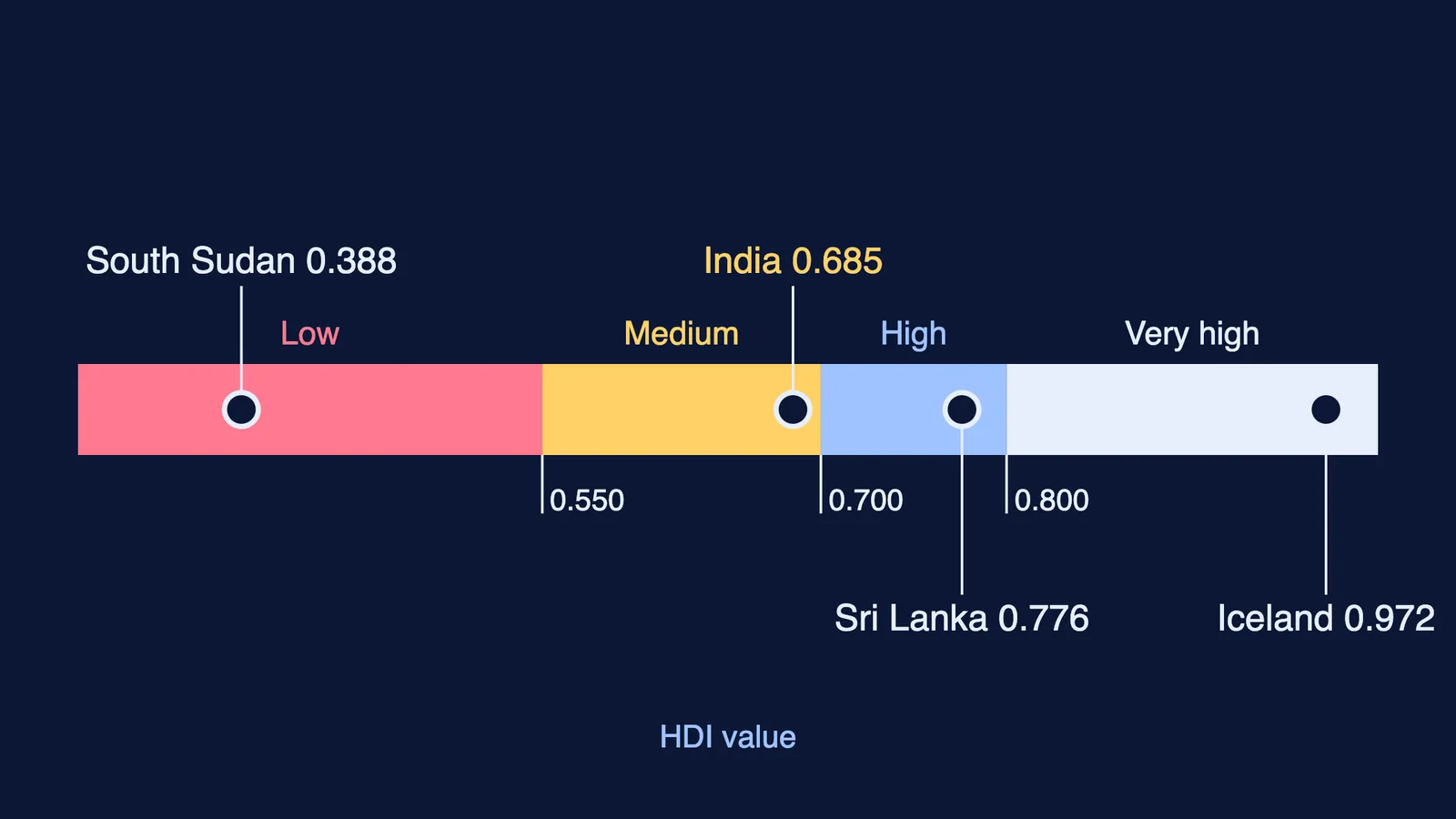
UNDP's cut-offs, the same as the textbook's Table 3.2, are 0.800 and above for very high, 0.700 to 0.799 for high, 0.550 to 0.699 for medium and below 0.550 for low. Iceland is first at 0.972 and South Sudan last at 0.388. India is in the medium group, 0.015 short of high, while Sri Lanka (0.776, rank 89) and Trinidad and Tobago (0.807, rank 72) rank above it, as the textbook says.
Counting the annex ranks gives 74 very high, 50 high, 43 medium and 26 low countries. The textbook prints 53 for medium, which would make the groups add up to 203, not 193. UNDP's 2026 report is due on 1 December 2026, so these figures will change (UNDP).
How should you revise this chapter for the board exam?
A five-day plan, about 30 minutes a day:
Write growth versus development and Haq's definition from memory; check against the chapter.
Write the four pillars with one Indian example each.
Sort the four approaches with the who-acts question.
Redo India's HDI calculation without looking.
Answer the chapter's exercises in about 30 and at most 150 words, as asked.
Not sure where to start? Fermi's AI tutor can work out what you already know and build a plan for the session, so you start at your weak spot.
Going further: how the Human Development Index is calculated, development, income and HDI in Class 10 economics and geography map work for the board exam.


