

On this page
Human capital formation is one of four topics in Unit 7, 'Current challenges facing Indian Economy', of CBSE's Class 12 Economics syllabus, under Part B, Indian Economic Development (CBSE Economics syllabus 2025-26). The chapter you read is Chapter 4, 'Human Capital Formation in India', in NCERT's Indian Economic Development book (NCERT chapter PDF).
What is human capital formation?
Human capital is the skill, knowledge and health of a country's people; NCERT's recap calls it 'enhanced labour productivity, which is an acquired ability and an outcome of deliberate investment decisions' (NCERT).
Just as a country turns land into factories (physical capital), it turns human resources such as students and farmers into human capital such as engineers and doctors. Human capital formation is the process of adding to that stock.
Box 4.1 in the chapter lists how it differs from physical capital:
It is intangible and cannot be separated from its owner; only its services are sold.
It is less mobile across countries, because nationality and culture limit movement.
It depreciates with age, but further investment in education and health slows that.
It gives social benefits as well as private ones: an educated person takes part in democracy, and a healthy person stops diseases spreading.
What are the sources of human capital formation?
NCERT names five sources (NCERT):
Education: families spend on schooling much as firms buy machines, expecting higher future income.
Health: preventive medicine (vaccination), curative medicine, social medicine (health literacy), clean drinking water and sanitation all give a healthier workforce.
On-the-job training: firms train workers in-house or off-campus and recover the cost through higher productivity.
Migration: people move for better-paid jobs, and the higher earnings outweigh the costs of transport, living and settling somewhere new.
Information: spending to learn about salaries, courses and the quality of institutions helps people invest in skills well.
A quick test: sort each item into a source. A nurse's refresher course paid for by the hospital is on-the-job training. A panchayat building village toilets is health. A student comparing college placement records online is information. An engineer moving from Patna to Pune for a better salary is migration.
How is human capital different from human development?
NCERT sets out the difference in Section 4.4, and two of the chapter's six exercises ask about it (NCERT):
Human capital treats education and health as a means to raise labour productivity. Spending on them that does not raise output counts as unproductive.
Human development treats education and health as part of well-being itself. People are ends in themselves, so basic schooling and health care matter even if output does not rise.
So human development is the broader idea, and it is what the Human Development Index tries to measure; our explainer on how the HDI is calculated from three indices shows the arithmetic, and the Class 10 chapter on development, income and its limits gives the background.
A four-mark answer plan: define human capital in one line, define human development in one line, state the means-versus-end difference, then give an example, such as literacy classes for elderly villagers that raise well-being but barely change output.
How much does India spend on education?
NCERT measures government education spending two ways: as a share of total government spending and as a share of GDP (NCERT).
Between 1952 and 2020, education spending rose from 7.92% to 16.54% of total government expenditure.
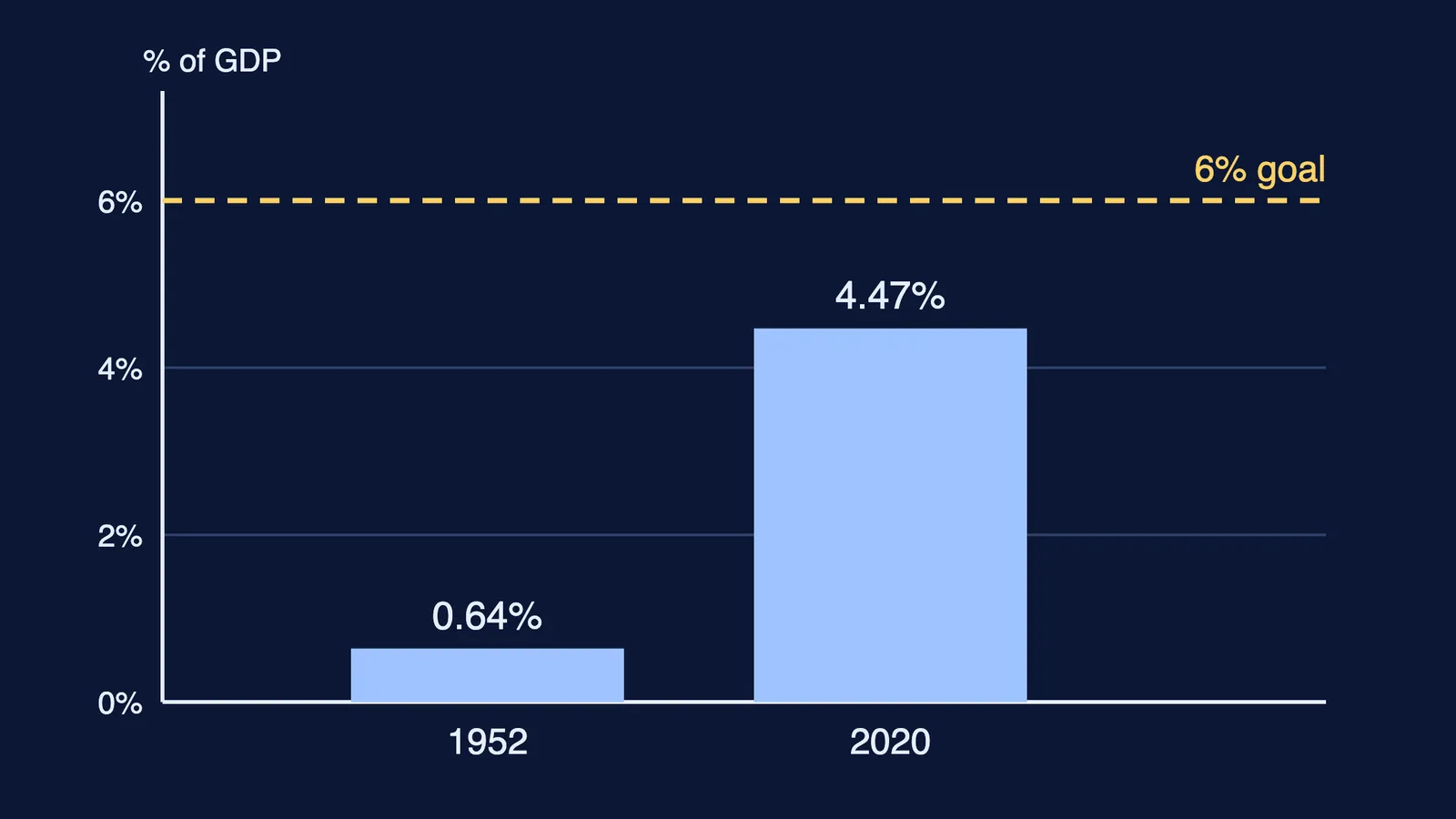
Over the same years it rose from 0.64% to 4.47% of GDP.
The Education Commission (1964-66) recommended spending at least 6% of GDP on education.
In 2020-21, per capita public spending on elementary education ranged from Rs 96,968 in Sikkim to Rs 10,710 in Bihar.
The chapter also notes the Right to Education Act of 2009, which made free education a fundamental right for children aged 6 to 14, and a 2% education cess on Union taxes earmarked for elementary education.
Gaps remain: NCERT's Table 4.2 shows the adult literacy rate for women (people aged 15 and over) rising from 37.9% in 1990 to 66% in 2017-18, against 82% for men in 2017-18.
How do you revise this chapter in one evening?
Work from the NCERT chapter itself:
Write the five sources from memory with one example each (15 minutes).
Say the human capital versus human development difference aloud in two sentences (5 minutes).
List Box 4.1's four differences from physical capital (10 minutes).
Copy the four spending figures above onto one card (5 minutes).
Answer the six exercise questions at the end of the chapter, then check against the text (30 minutes).
If you take maths alongside economics, the Fermi Problem Library has worked problems with a step-by-step solver that explains the reasoning rather than printing an answer. Still choosing a path after Class 12? Read our guide to careers after commerce, including economics.


