

On this page
Leave yeasted dough somewhere warm and it grows, though nothing new went into the bowl. The extra volume is gas made by living cells and held by a protein net: an everyday example of the anaerobic respiration in Class 10 Life Processes.
How does yeast make bread dough rise?
These steps follow a Campden BRI explainer on what makes dough rise by Gary Tucker, a fellow at the food research organisation.
Kneading folds in air. Mixing traps many tiny air bubbles in the dough, and these are the bubbles that later inflate.
Yeast uses up the oxygen. In its aerobic phase, yeast uses the oxygen in those bubbles, and carbon dioxide takes its place.
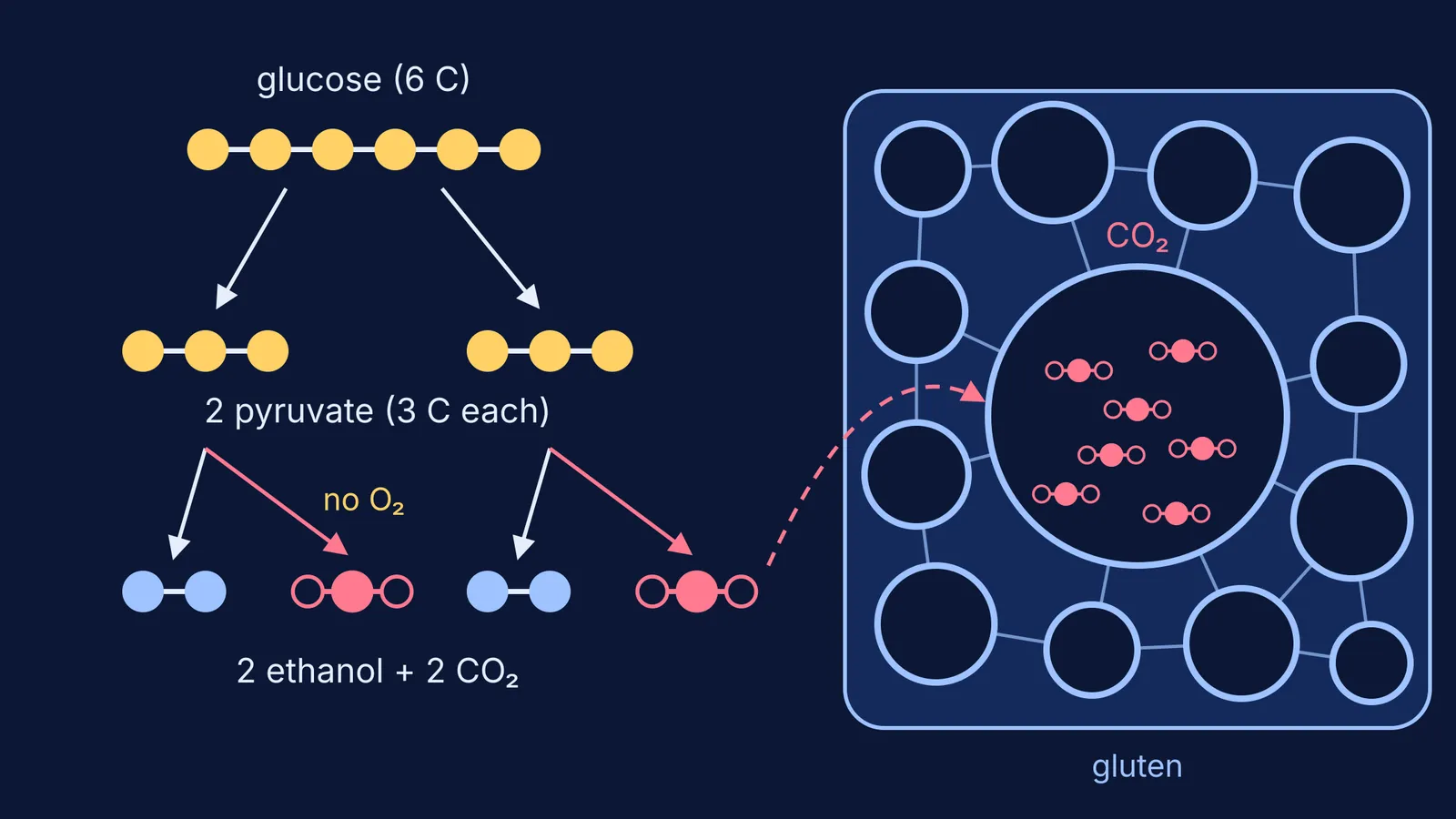
Yeast switches to fermentation. With no oxygen left, yeast breaks glucose down as C6H12O6 → 2C2H5OH + 2CO2: one glucose gives two ethanol and two carbon dioxide.
The gas dissolves first. At proving temperatures of 32-38°C, water holds only about 1.0 g of carbon dioxide per kg, and CO2 enters the bubbles only once the water is saturated.
Gluten stretches. Mixing turns flour proteins into a gluten network elastic enough to let the bubbles expand.
Is bread rising anaerobic respiration or fermentation?
Both, because in yeast they are the same thing. The NCERT Class 10 Science chapter Life Processes explains that the first step of respiration, breaking glucose (a six-carbon molecule) into a three-carbon molecule called pyruvate, happens in the cytoplasm. In yeast, pyruvate can then be converted into ethanol and carbon dioxide during fermentation, and because this happens without oxygen, it is called anaerobic respiration. When our muscle cells run short of oxygen, pyruvate becomes lactic acid instead, which our post on alcoholic vs lactic fermentation compares side by side.
Worked example: follow the carbon atoms. Counting carbons checks the pathway, as the diagram above shows.
Glucose has 6 carbon atoms.
The first step splits it into 2 pyruvate, with 3 carbons each: 3 + 3 = 6.
Each pyruvate becomes 1 ethanol (2 carbons) and 1 CO2 (1 carbon): 2 + 1 = 3.
Total: 2 ethanol (4 carbons) + 2 CO2 (2 carbons) = 6. Nothing is lost.
So one third of glucose's carbon leaves as the gas that lifts the dough.
A three-line exam answer to "Why does dough rise when yeast is added?":
Yeast respires anaerobically (fermentation) in the dough, in the cytoplasm of its cells.
Glucose is broken down to pyruvate, then to ethanol and carbon dioxide, releasing a little energy.
The carbon dioxide fills air bubbles held in the elastic gluten network, so the dough swells; the ethanol escapes during baking.
For the full chapter map, see our guide to Class 10 life processes.
Why does gluten trap the gas instead of letting it escape?
Gluten is the protein network that forms when wheat flour is mixed with water and worked. A review by Jan Delcour and colleagues in Annual Review of Food Science and Technology describes wheat's gluten-forming proteins as viscoelastic, meaning they both flow and spring back, and links them to dough properties, loaf volume and loaf structure.
A study by Thekla Alpers and colleagues in Polymers, published in December 2020, explains why that matters. A dough's ability to hold gas is strongly linked to gluten's "strain hardening": the more a gluten film is stretched, the harder it resists further stretching, which helps stop neighbouring gas cells from merging. The same study found that fermentation also wears the network down: under the microscope, the average length of continuous gluten strands in dough fermented with yeast for two hours was 37.6% shorter than in unfermented dough.
Growing bubbles in a stretchy net are easier to watch than to read about. The Fermi Simulation Lab has interactive simulations for ideas like this, and our post on a yeast fermentation temperature simulation shows what changing one variable does.
What happens to the yeast's gas and alcohol in the oven?
The same Campden BRI explainer tracks what leaves the loaf. Air is about 80% nitrogen, and yeast fermentation does not affect it, so the nitrogen left in the bubbles expands as the bread heats. Ethanol boils at 78.4°C and is likely to have left the bread soon after the loaf reaches that temperature. A 900 g piece of dough loses roughly 40-60 g during baking, much of it water that turns to steam late in the oven.
A kitchen check you can run this weekend
Make three small balls of dough: one normal, one without yeast, one with extra salt.
Put each in a clear glass and mark its height with tape.
Write a prediction for each, with a reason from the five steps above.
Check after an hour. Explain surprises using fermentation or gluten, not "lazy yeast".
If a word like pyruvate still feels shaky, the Fermi Concept Library has a lesson for every concept in biology and chemistry, each with its place in the map.
Every hole in a slice of bread was once a bubble of gas, much of it carbon dioxide from anaerobic respiration.


