

On this page
You switch the stair light on at the bottom, walk up, and switch it off at the top. These are not two ordinary switches. They are two two-way switches joined by two wires, and once you trace the current through them you will find a Class 10 series circuit doing something clever.
What is a two-way switch?
An ordinary switch has two terminals: it either joins them or it does not. A two-way switch is a single-pole double-throw (SPDT) switch, as Circuit Digest's guide to two-way switching explains. It has three terminals: one common terminal and two others. The lever always joins the common terminal to one of the other two. It never connects to nothing; it only chooses a path.
In the US the same switch is called a "three-way" switch, and the wires between the two switches are travelers (US) or strappers (UK), according to Wikipedia's article on multiway switching.
How can one light be switched from the top and bottom of the stairs?
The usual wiring, described in the multiway switching article, has four parts:
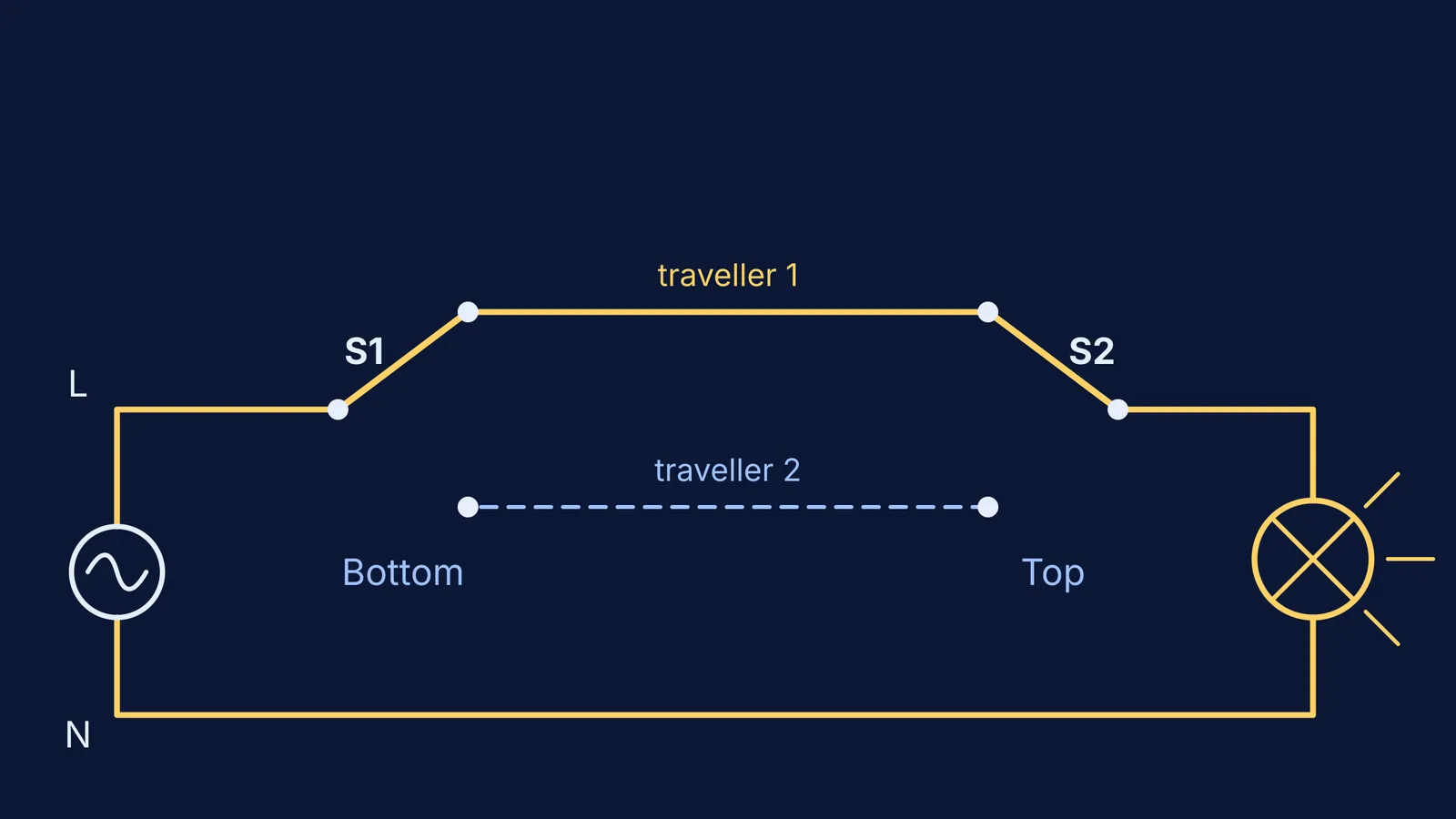
The live (phase) wire goes to the common terminal of the bottom switch, S1.
Two traveller wires join S1's other two terminals to the matching terminals of the top switch, S2.
The common terminal of S2 goes to the lamp.
The lamp's other end goes to neutral.
There are two possible roads between the switches, traveller 1 and traveller 2. Current reaches the lamp only if both switches pick the same road. If S1 sits on traveller 1 and S2 sits on traveller 2, each traveller ends at an open contact and nothing flows.
Worked example: what happens in all four positions?
Call each switch "up" when it touches traveller 1 and "down" when it touches traveller 2. Trace the path from live to neutral in every case:
S1 up, S2 up: live, S1, traveller 1, S2, lamp, neutral. Closed path. Lamp on.
S1 up, S2 down: current reaches the end of traveller 1 at S2, but S2 is connected to traveller 2. Open. Lamp off.
S1 down, S2 up: the same problem in reverse. Open. Lamp off.
S1 down, S2 down: live, S1, traveller 2, S2, lamp, neutral. Closed. Lamp on.
Now the staircase story: lamp off with S1 down, S2 up. Flip S1 and the switches match, so the lamp comes on. Upstairs, flip S2 and they no longer match, so it goes off. Every flip changes whether the switches match, which is all the lamp cares about, so it never matters who touched which switch last.
How does this connect to series circuits in Class 10?
The NCERT Class 10 Electricity chapter says "A switch makes a conducting link between the cell and the bulb", and that if the circuit is broken anywhere, "the current stops flowing and the bulb does not glow" (NCERT chapter text, reproduced on EduRev). In a series combination the same current passes through each resistor, and a break at one device stops the whole circuit (Tiwari Academy's Class 10 Electricity questions).
The staircase circuit is exactly that. When the lamp is on, the live wire, S1, one traveller, S2 and the lamp form one series loop with no side branch. Each switch is a point where the loop can be broken, and the second traveller is a spare road either switch can choose instead.
For what current does inside a series loop, read our explainer on whether current gets used up by bulbs in series. Circuits are easier to see than to read, which is what the Fermi Simulation Lab is for: interactive simulations to try after you have made your own prediction on paper.
Is a staircase switch a logic gate?
In effect, yes. Circuit Digest shows two ways to wire the pair. In one, the lamp is on when both switches are in the same position, which it matches to the Ex-NOR (XNOR) gate truth table; in the other, the lamp is on when they differ, which it matches to EX-OR (XOR) (Circuit Digest). Our labels give XNOR; the name depends only on how you label the positions. In both, changing any one input flips the output. Our guide to finding the output of any logic gate combination shows how to build tables like this one.
For three floors, electricians add an intermediate switch between the travellers. It is a double-pole double-throw switch that connects the travellers either straight through or crossed over, and with three switches there are eight possible combinations of positions, four with the light on and four with it off (Wikipedia).
Should you try wiring one at home?
Not on mains: household wiring can kill. If a stair light misbehaves, switch off at the main switch or MCB and call a licensed electrician. Our post on electrical safety at home covers the basics every student should know.
The safe way to experiment is on a table: a small battery, a torch bulb and two SPDT toggle switches from an electronics shop, with an adult nearby. Build it, predict all four positions first, then test them one by one.


