

On this page
In many South Indian homes, someone presses coffee powder into a steel cup, pours boiling water on top and walks away. Nobody pumps or stirs. Some minutes later the lower cup holds a dark, thick decoction. In between is school physics and chemistry: flow through a porous bed, dissolving and extraction.
How does a South Indian filter make decoction?
The filter is two stacked metal cups. According to the Wikipedia entry on Indian filter coffee, the upper cup has a perforated base where the grounds sit, pressed flat with a small disc, and the drink is made by "percolation brewing" of finely ground coffee, usually blended with chicory.
The same entry says the traditional blend is 80 to 90% coffee and 10 to 20% chicory. In India, packs sold as coffee-chicory mixtures must contain at least 51% coffee by mass and state both percentages on the label, as Food Safety Helpline's summary of the FSSAI rules explains.
The sequence:
Powder goes into the upper cup and is pressed with the disc.
Hot water is poured on top.
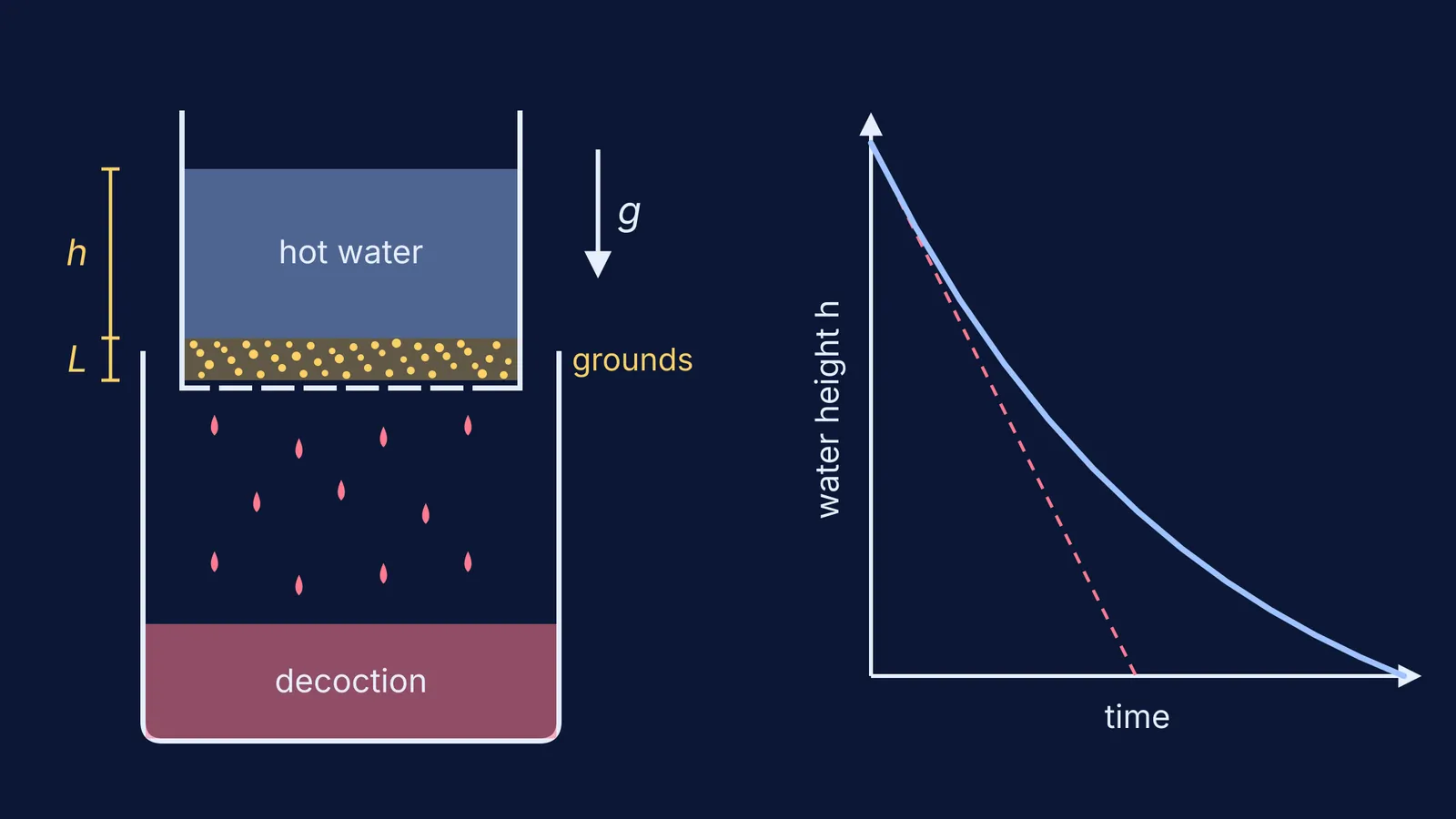
Gravity pulls the water down through the packed grounds, picking up soluble compounds on the way.
The liquid drips through the holes and collects below as decoction.
Why does filter coffee drip so slowly?
Packed coffee powder is a porous medium, like sand in a riverbed. Darcy's law says the flow through a porous material is proportional to the hydraulic gradient, the drop in water height per unit length of material, as this UC Davis geophysics text on Darcy's law sets out. The constant depends on the material; Darcy saw it change with sands of different grain sizes (more in our post on Henry Darcy and the law of groundwater flow).
What that means for your filter:
Fine powder drips slower. Smaller particles leave narrower gaps.
Hard pressing drips slower. It squeezes the gaps shut.
The drip slows as the cup empties. The push is the weight of water above the grounds, so as that column shrinks, the flow falls. In the simplest model the level drops fast at first, then creeps.
That slowness is the point: the longer water touches the grounds, the more it dissolves.
What dissolves out of the coffee powder?
A 2015 study in Chemical Engineering Science by Moroney and colleagues extracted coffee with water at 90 °C, including in a packed bed. Their model, which matched the measurements, has two stages: fast extraction from broken cells on each grain's surface, then slower extraction from intact cells inside.
Coffee researchers track two numbers, defined in a 2020 Scientific Reports study from UC Davis:
Total dissolved solids (TDS) is the mass fraction of soluble solids in the brew. It measures strength.
Percent extraction (PE) is the mass fraction of soluble solids removed from the grounds. It measures how thoroughly the coffee was used.
The classic Coffee Brewing Control Chart marks an "ideal" region for drip coffee at a TDS of 1.15 to 1.35% and a PE of 18 to 22%, the same paper notes. In that study, brewing at 87, 90 or 93 °C made no appreciable difference to taste once TDS and PE were held fixed by adjusting grind and brew time. Temperature still matters, as our post on why solubility of most solids rises with temperature explains, but it is one dial among several.
The same logic explains why several small portions of solvent beat one big one in differential extraction with a separating funnel.
Worked example: how strong is your decoction?
Use the TDS and PE definitions from the UC Davis paper. The kitchen numbers below are assumptions; weigh your own.
You use 20 g of powder and 150 g of hot water.
Wet grounds hold back some water. Suppose they keep 40 g, so about 110 g of decoction drips through.
Say you hit 20% extraction. Dissolved solids = 0.20 x 20 g = 4 g.
TDS = 4 g / 110 g, which is about 3.6%.
That is roughly three times the 1.15 to 1.35% of the chart's ideal drip cup. Decoction is a concentrate, which is why it is mixed with hot milk. One part decoction to two parts milk brings the coffee solids back to about 1.2%.
Try it: a one-variable kitchen experiment
Change one thing at a time and time the drip with a phone:
Same powder, light press vs firm press.
Same press, finer vs coarser powder.
Water straight off the boil vs after a minute of cooling.
Note when the drips slow down, and whether the last quarter takes longer than the first.
Write down the time and how much decoction you get. If the flow through the bed is hard to picture, the Fermi Simulation Lab has interactive simulations for ideas that are easier to see than to read. To revise solubility and extraction properly, each concept has its own lesson in the Fermi Concept Library.
Tomorrow morning, watch the drips and decide which dial to turn.


