On this page
As of 2025, scientists have formally described roughly 2.17 million species (Our World in Data). Yet, the natural world remains mostly undiscovered. When researchers calculate the true number of species on Earth, their estimates vary wildly, ranging from 8.7 million to a staggering 1 trillion (Locey & Lennon, 2016).
Understanding the difference between described species (those we have named and catalogued) and estimated species involves exploring mathematical modelling, ecological ratios and the vast invisible world of microbes.
How many species exist on Earth?
For decades, counting species meant extrapolating from the rate of new discoveries of plants and animals. In 2011, a study estimated that the Earth is home to about 8.7 million species, primarily consisting of animals, plants and fungi (Mora et al., 2011).
However, more recent biology has shifted its focus to the microscopic world. A 2016 study applied mathematical scaling laws to known microbial databases and predicted that the planet could harbour up to 1 trillion species, suggesting that 99.999% of life on Earth remains undiscovered (Locey & Lennon, 2016). The colossal difference between these two numbers comes down to what scientists choose to include in their counting models.
How do we estimate the number of species?
Scientists use ratio-based estimates to calculate numbers they cannot directly observe. Instead of trying to find every single insect or bacterium, they look for predictable scaling patterns in nature.
For example, a biologist might know exactly how many butterfly species live in a well-studied hectare of tropical rainforest. They then figure out the ratio of those butterflies to the known tree species in that same patch. By multiplying that ratio across all the tree species globally, they generate a worldwide estimate for butterflies.
This approach works across different ecological scales. In marine biology, researchers use the ratio of small bottom-dwelling organisms to known coral species to predict ocean biodiversity. The reliability of these estimates heavily depends on whether the observed local ratio holds true across the entire planet. If a particular rainforest has an unusually high concentration of beetles, extrapolating that ratio globally might artificially inflate the final number.
If you get stuck applying scaling laws or working out population ratios in your studies, the Fermi Problem Library has worked problems with a step-by-step solver that explains the reasoning rather than printing an answer.
Why are there so many undiscovered insects?
Even among the macroscopic species we can easily see, the discovery gap is immense. We have named roughly 1 million insect species, but experts estimate the actual baseline number is around 6.8 million, and up to 40 million when including cryptic species (Larsen et al., 2017).
Insects dominate the unknown animal kingdom for several reasons. First, many live exclusively in remote habitats, such as the unexplored canopies of rainforests. To learn more about why these areas are so rich in life, read Why do the tropics have more biodiversity? Three key hypotheses.
Second, the rise of DNA sequencing has exposed widespread cryptic diversity. This means that many insects that look completely identical are actually genetically distinct species that cannot interbreed.
Finally, extreme specialisation plays a massive role. A single species of tropical plant can host dozens of specific beetles, aphids or wasps that live nowhere else on Earth. To revise how scientists group and classify these varied organisms, you can explore the Fermi Concept Library.
Could there really be 1 trillion species?
The 1 trillion estimate is driven almost entirely by bacteria and archaea. A 2017 paper proposed a slightly more conservative but still staggering estimate that Earth holds between 1 and 6 billion species, heavily driven by host-associated microbes (Larsen et al., 2017).
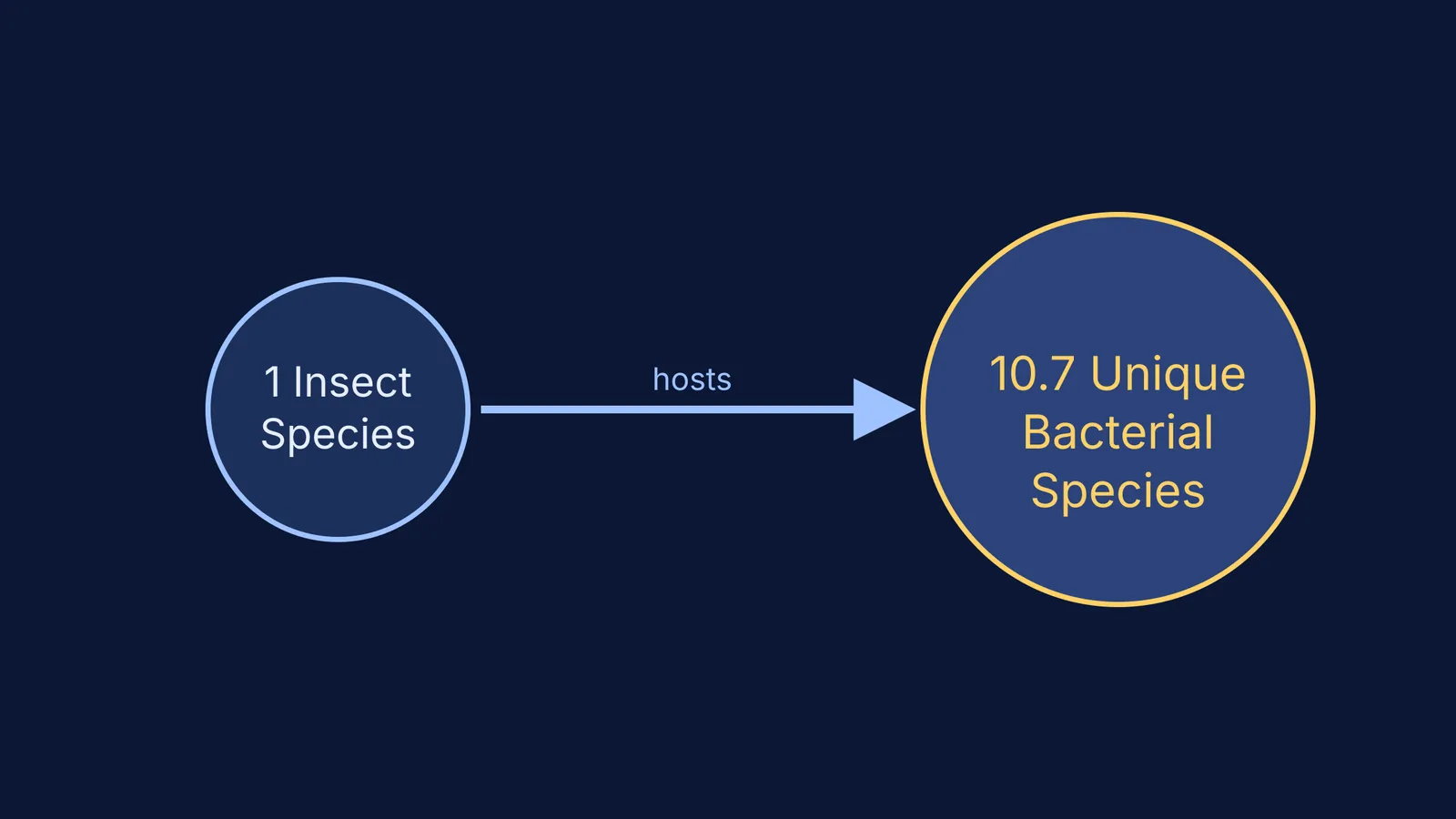
This calculation relies on a biological multiplier effect. If there are 6.8 million insect species, and each insect species hosts an average of 10.7 unique strains of bacteria in its gut or on its shell, the bacterial diversity alone would be over 70 million species (as modelled by Larsen et al., 2017). Because nearly every plant and animal acts as a host to unique microscopic life, the total number of species explodes far beyond what we can count.
Microbes are also notoriously difficult to define as species because they do not reproduce sexually. Instead of using traditional mating boundaries, microbiologists define species based on genetic similarity. Even a slight change in how much DNA difference is required to declare a new species can swing the global estimate by billions.
These vast estimates matter deeply for global conservation. If we do not know what exists, we cannot accurately track what is being lost. For a closer look at tracking known species threats, see Endemic vs endangered species: the IUCN Red List explained, or read about Why did the dodo, quagga, thylacine and Steller's sea cow go extinct? to understand our historical baselines.