

On this page
Kavach is how Indian Railways stops a missed red signal from becoming a crash. It runs on physics you already study: radio waves, position from speed, and stopping distance.
What is Kavach on Indian Railways?
Kavach is India's indigenously developed Automatic Train Protection (ATP) system, built by Indian Railways through the Research Designs & Standards Organisation (RDSO), according to a Press Information Bureau backgrounder of 6 February 2026. The same document says it protects trains against Signal Passing at Danger (SPAD), excessive speed and collisions, and is certified to Safety Integrity Level 4 (SIL-4).
Trials began in February 2016 and Kavach became the national ATP system in July 2020; by March 2026, version 4.0 was commissioned on 1,452 route kilometres of the Delhi–Mumbai and Delhi–Howrah routes, according to a Ministry of Railways release of 11 March 2026.
How does Kavach know where the train is?
The answer is a chain of RFID tags. The Ministry's March 2026 release lists "Installation of RFID Tags throughout the track length" among the key jobs in fitting Kavach.
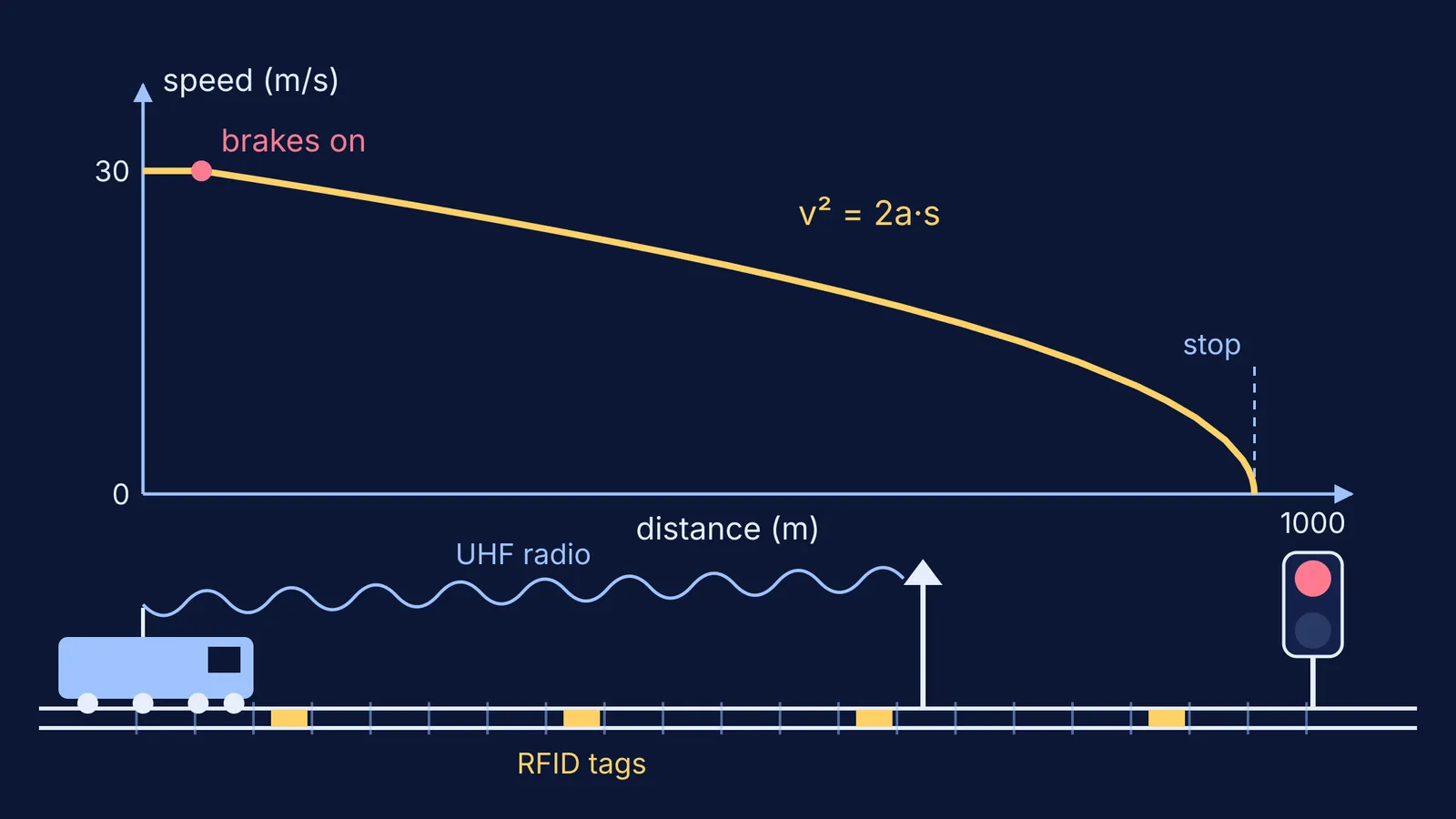
Each tag stores a fixed track identification number, and a Kavach locomotive carries two RFID readers under its underframe that read the tags as it passes, according to the Wikipedia summary of the system's design). Between tags, an odometer measures distance and resets at every tag, the same page explains.
Why reset? Small errors add up. If a wheel sensor reads 1% long, the computer is 10 m out after 1 km and 100 m out after 10 km. A tag at a known spot wipes the error back to zero.
How does the radio link work, and where do EM waves come in?
Tags give position; radio gives permission. Station units read signal aspects, points and track occupancy, calculate the Movement Authority (the safe distance the train may travel) and send it to the onboard unit over Ultra High Frequency radio, according to the PIB backgrounder.
Kavach's radio modems work between 406 and 470 MHz with a 25 kHz channel (Wikipedia: Kavach)). The UHF band runs from 300 MHz to 3 GHz (Wikipedia: Ultra high frequency). The RFID link between tag and reader is radio too: no wires, no contact.
Worked example 1: how long are Kavach's radio waves? For any electromagnetic wave, wavelength = speed of light ÷ frequency, and the speed of light is exactly 299,792,458 m/s (NIST).
At 406 MHz: λ = 299,792,458 ÷ 406,000,000 ≈ 0.74 m.
At 470 MHz: λ = 299,792,458 ÷ 470,000,000 ≈ 0.64 m.
So the message telling a train how far it may go rides on waves with crests 64 to 74 cm apart. To picture those fields, see visualising the electric and magnetic fields of an EM wave.
What happens if a loco pilot passes a red signal?
The onboard unit shows target speed and distance in the cab and "generates braking curves", says the PIB backgrounder. If the train approaches a danger signal, exceeds the permitted speed or enters a conflicting route, Kavach applies the brakes automatically; if two trains in a block section are moving toward each other, it sends both a Stop-on-Sight command.
It has been tested head-on. On 4 March 2022, on South Central Railway, two locomotives were run toward each other and Kavach halted them 380 metres apart, according to a PIB factsheet of 14 March 2022.
Worked example 2: why the brakes start so early. From v² = u² − 2as, stopping from speed u takes s = u² ÷ 2a. We assume a deceleration of 0.5 m/s² for illustration; it is not a Kavach figure.
At 54 km/h (15 m/s): s = 225 ÷ 1 = 225 m.
At 108 km/h (30 m/s): s = 900 ÷ 1 = 900 m.
At 160 km/h (44.4 m/s): s ≈ 1,975 m.
Double the speed and the stopping distance rises four times. The PIB backgrounder says speed upgrades up to 160 kmph are planned; at that speed our example train must start braking about 2 km out. Kavach brakes if the train exceeds the permitted speed and the loco pilot does not, so it needs an accurate position and the signal state well ahead. More on why doubling speed means four times the stopping distance.
How can you use Kavach to revise physics?
Kavach ties three chapters together. Try these:
EM waves (Class 12): find λ at 450 MHz, using the NIST value of c. Answer: about 0.67 m.
Kinematics (Class 11): find the stopping distance from 130 km/h at 0.6 m/s². Answer: about 1,087 m.
Errors: an odometer reads 0.5% long. How far off is it after 4 km? Answer: 20 m.
Braking curves are easier to see than to read; the Fermi Simulation Lab has interactive simulations for ideas like this, so you can predict first and then check. If a numerical goes wrong, the Fermi Problem Library has worked problems with a step-by-step solver that explains the reasoning rather than printing an answer.
Like the engineering? Read about careers in railway signalling for electronics students.


