

On this page
Walk through any bangle stall, from Firozabad to your local mela, and you see every colour at once. Much of that colour comes from small amounts of metal mixed into the glass.
Where are glass bangles made, and when is the colour added?
Firozabad in Uttar Pradesh is a hub of Indian glassmaking, with about 400 registered glass industries, according to Outlook Traveller's report on the bangle craft. Its furnaces, called bhattis, burn round the clock at 1,200 °C, melting waste glass with sand, soda, chemicals and colouring agents, the same report says. So a bangle's base colour goes into the melt, not onto the surface.
Why does a tiny amount of metal oxide colour glass?
Plain glass lets most visible light through. Add a transition metal oxide and its ions sit in the glass surrounded by oxygen. That surrounding splits the energies of the ions' d electrons, so each ion absorbs particular wavelengths of visible light. Glass scientist James Shelby lists this ionic absorption, from charge transfer and ligand field effects, as one of the sources of colour in glass in his lecture on colour in commercial glasses, part of an online glass processing course hosted at Lehigh University.
The rule to remember: the colour you see is the light the glass does not absorb. Our posts on why transition metal complexes are coloured and how our eyes see so many colours go deeper.
How does cobalt make glass blue?
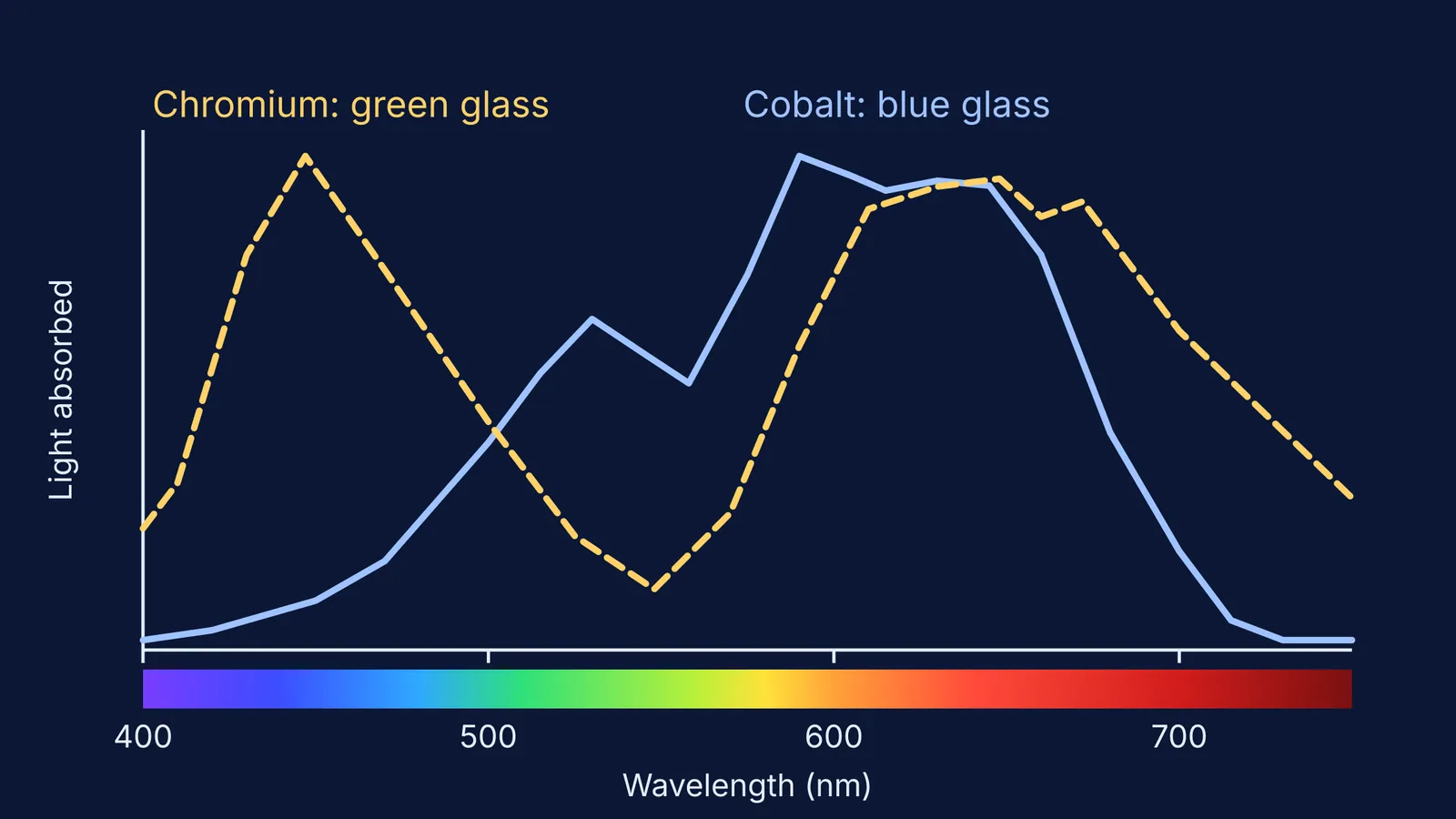
Cobalt oxide in soda-lime-silica glass absorbs strongly from about 500 nm to 700 nm, with peaks near 530 nm, 590 nm and 640 nm, and barely at all in the blue-violet, as the absorption curve in Shelby's lecture shows. Take away the yellow, orange and red, and what reaches your eye is blue.
Cobalt has the largest extinction coefficient of the ionic colorants, so glassmakers use it at low concentration or the glass turns so dark it is effectively opaque, Shelby notes. His example sample, about half an inch thick, contains less than 100 parts per million by weight of cobalt oxide and still looks blue.
Why does chromium make glass green?
Chromium(III) absorbs in two bands, one in the violet-blue near 450 nm and one in the orange-red near 650 nm, leaving a window around 550 nm, according to the chromium spectrum in the same lecture. Green is what gets through. In strongly oxidised melts some chromium becomes chromium(VI), which pulls the colour towards yellow-green, so glassmakers adjust the furnace atmosphere or add a reducing agent for a richer green.
Other metals follow the same logic in that lecture:
Manganese(III) gives purple.
Copper(II) gives blue or green, depending on the base glass.
Iron, the most common impurity in glassmaking sand, gives green, which is why window glass looks very green when you view it on edge.
Why does a bangle look darker through its edge?
The Beer-Lambert law, set out in Shelby's lecture, says absorbance A = C × E × L, where C is concentration, E is the extinction coefficient and L is the thickness the light crosses. His cobalt block looks pale blue from the flat face and deep blue through the edge, because the light travels further through the glass.
Worked example (illustrative numbers):
Say the absorbance straight through a bangle wall at 600 nm is A = 0.3.
The fraction of light transmitted is T = 10^(−A) = 10^(−0.3), about 0.50, so half the orange light gets through.
Now look through the bangle edge-on, so the light crosses four times as much glass. A becomes 4 × 0.3 = 1.2.
T = 10^(−1.2), about 0.063, so only about 6% of that orange light survives, and the blue looks much deeper.
Doubling the concentration has the same effect as doubling the thickness, which is why a strong colorant like cobalt is used at such low concentrations.
How can you test this with a bangle at home?
Try this with a parent or sibling:
Hold a blue bangle up to a tube light or a bright window. Look through the flat face, then edge-on, and compare the shade.
Stack a red and a blue bangle and look through both. Each removes light the other lets through, so the overlap looks very dark.
Put a green bangle on white paper, then on red paper. If its green comes from chromium, it looks darker on red, because red is light chromium absorbs.
Write one line per bangle: metal, light absorbed, colour seen.
For the d-block background, read why transition metal ions form so many complexes. Absorption is easier to see than to read, which is why we built the Fermi Simulation Lab of interactive simulations, and the Fermi Concept Library gives every chemistry concept its own lesson.
Next time you pick up a bangle, hold it to the light and name the metal before the colour.


