

On this page
Ask how big the sun is and you might hear "about a hundred times bigger" or "a million times bigger". Both can be right. Width, surface and volume give three different answers, and seeing why is a very useful ratio lesson.
How big is the sun compared to the Earth?
NASA's Sun fact sheet gives the sun's mean radius as 695,700 km. The Earth fact sheet gives Earth's mean radius as 6,371 km.
The sun's radius is 109.2 times Earth's radius, the ratio listed on NASA's Sun fact sheet.
You can check it yourself: 695,700 divided by 6,371 is about 109.2. The same ratio holds for diameter, because both numbers just double. NASA's Sun facts page gives the sun's diameter as about 1.4 million km and puts it about 150 million km from Earth.
How many Earths fit inside the sun?
It would take about 1.3 million Earths to fill the sun's volume, according to NASA's Sun facts page. The fact sheet lists the Sun/Earth volume ratio as 1,304,000.
One honest detail: that is a volume ratio, as if Earth were melted down and poured in. Solid round balls leave gaps between them, so fewer whole, unbroken Earths would actually pack inside. A question asking how many Earths fit usually wants the volume ratio.
Why does 109 times wider mean 1.3 million times bigger?
This is the part worth remembering, because it works for any two similar shapes.
Length scales with the ratio: k
Area scales with the square: k squared
Volume scales with the cube: k cubed
With k = 109.2, the sun's surface area is about 109.2 x 109.2, roughly 11,900 times Earth's. Its volume is about 109.2 x 109.2 x 109.2, roughly 1.3 million times Earth's. Both radii come from the NASA fact sheets above.
Mass is a different story. The sun's mass is 332,900 times Earth's, according to NASA's Sun fact sheet, which is far less than 1.3 million. That is because the sun's average density is only about a quarter of Earth's: the same sheet gives a density ratio of 0.255. Earth is rock and metal; the sun is a hot glowing ball of hydrogen and helium, as NASA describes it. If you want to see how density links to size and gravity, our post on finding a planet's density from g and its radius works through it.
How can you picture the sun and Earth to scale?
Numbers this large stop meaning anything, so shrink them. Here is a worked example using only the NASA figures.
Choose a ball for the sun. Say a football about 30 cm across.
Divide by 109.2 to get Earth: 30 cm / 109.2 is about 2.7 mm. That is a peppercorn or a small bead.
Now the distance. The sun is about 150 million km away and about 1.4 million km wide (NASA), so the gap is about 107 sun-widths.
Multiply: 107 x 30 cm is about 32 m. Put the bead roughly 32 m from the football. Pace it out in a corridor or playground and the emptiness is the lesson.
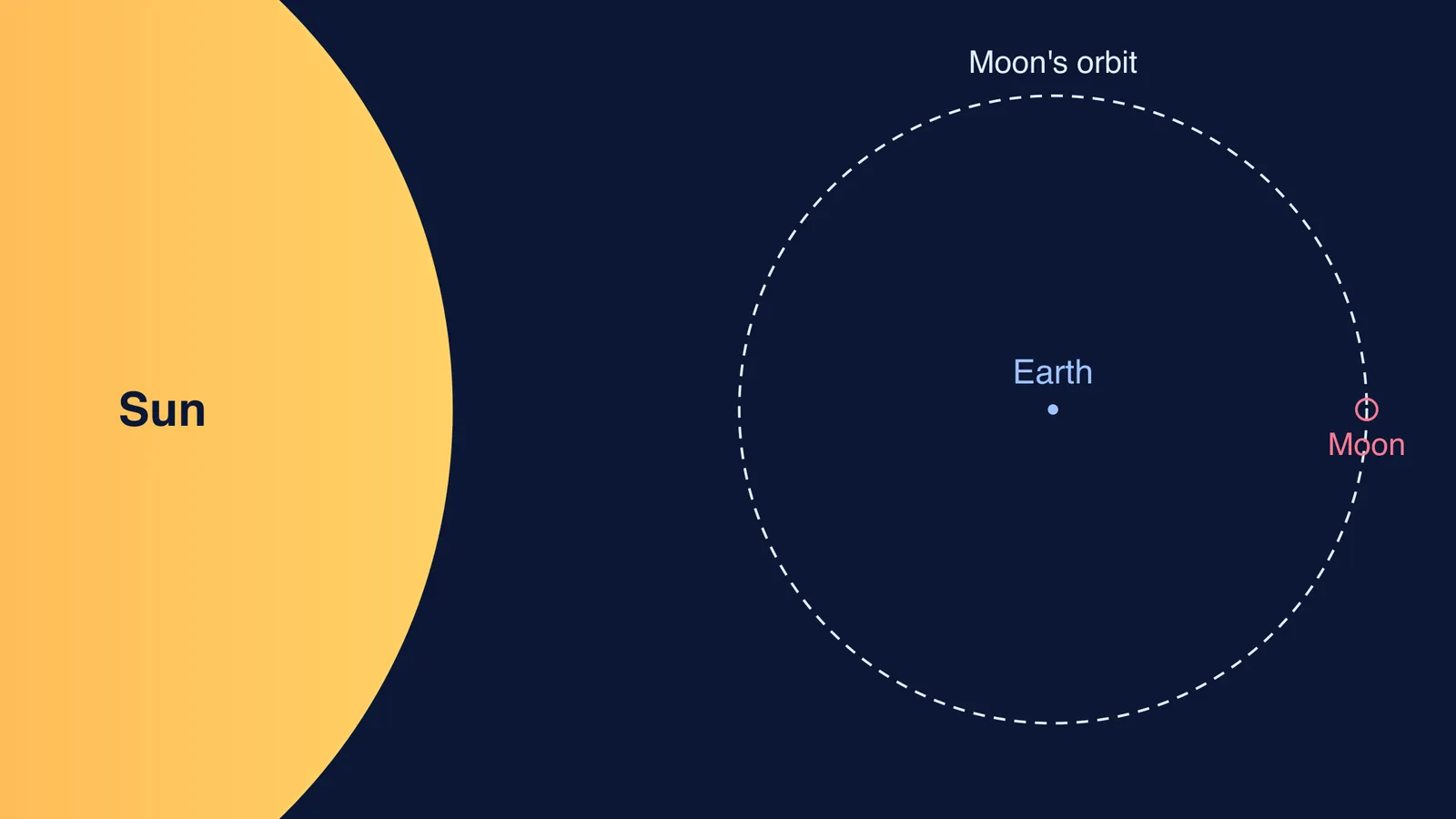
One more check that surprises most people. The Moon orbits Earth at an average distance of 384,400 km (NASA Moon fact sheet). That is only about 55% of the sun's radius. If Earth sat at the sun's centre, the Moon's whole orbit would fit inside the sun with room to spare. The diagram at the top of this post uses one scale for all three: the edge of the sun beside Earth and the Moon's orbit.
If you would rather move the pieces than imagine them, the Fermi Simulation Lab has interactive simulations for ideas that are easier to see than to read.
Where will you use this in maths and physics?
The sun-Earth comparison is really a practice set in disguise. Try these with the numbers above, all from NASA's Sun facts page and fact sheets:
Ratios: if a map or model uses 1 cm for 1,000 km, how wide is the sun? (Our guide to map scale and ratio problems sets these up step by step.)
Squares and cubes: why does a sphere twice as wide hold eight times as much water but need only four times the paint on its surface?
Units and time: divide the 150 million km by the speed of light; our explainer on how long sunlight takes to reach Earth shows the calculation.
If a scaling question keeps going wrong at the same step, the Fermi Problem Library has worked problems with a step-by-step solver that explains the reasoning rather than printing an answer.
Next time someone asks how big the sun is, ask back: wider, or bigger? The answer is 109 or 1.3 million, and now you know why.


