

On this page
Map scales tell us how the distances drawn on a page relate to the real world. A scale given as "1 cm represents 1 km" is a verbal scale, but solving geometry and geography problems often requires turning this statement into a pure ratio and understanding how it affects two-dimensional areas.
What does 1 cm represents 1 km mean as a ratio?
To write a map scale as a mathematical ratio, both sides must use the exact same unit. Since there are 1,000 metres in a kilometre and 100 centimetres in a metre, 1 km is equal to 100,000 cm (Third Space Learning).
When we replace the kilometre with its centimetre equivalent, the verbal scale "1 cm represents 1 km" becomes the unitless ratio 1:100,000. This means every single millimetre, centimetre, or inch on the map corresponds to 100,000 of those same units on the ground.
Getting comfortable with these unit leaps is essential before you tackle more complex area conversions. Understanding this foundation will make larger calculations significantly faster in an exam setting.
How do you find the real distance from the map?
When working with distances, the rule is straightforward: multiply the map distance by the linear scale factor (Wikipedia)). If you want the answer in the original large unit, you can skip the ratio and use the verbal scale directly.
Example: Finding the real-world distance Suppose you measure a path on your map and it is 4.5 cm long.
The verbal scale is 1 cm = 1 km.
Real distance = 4.5 cm × 1 km/cm.
The real distance is 4.5 km.
If you are asked to provide the answer in centimetres, use the 1:100,000 ratio:
Real distance = 4.5 cm × 100,000.
The real distance is 450,000 cm.
Working backwards is just as simple. If a real-world river is 12 km long, you divide 12 by 1 to get a 12 cm line on the map. This logic applies across all ratio methods for solving numericals. If you find yourself mixing up linear and area conversions during practice, the Fermi Problem Library breaks down exam questions step by step to catch exactly where the units went wrong, allowing you to learn from your mistakes instantly.
Why does map area scale by the square of the scale factor?
The most common trap in GCSE and CBSE maths exams is treating area the same way as distance. If a map has a linear scale factor of k, the area of a scaled object is k² times the area of the original (Wikipedia)).
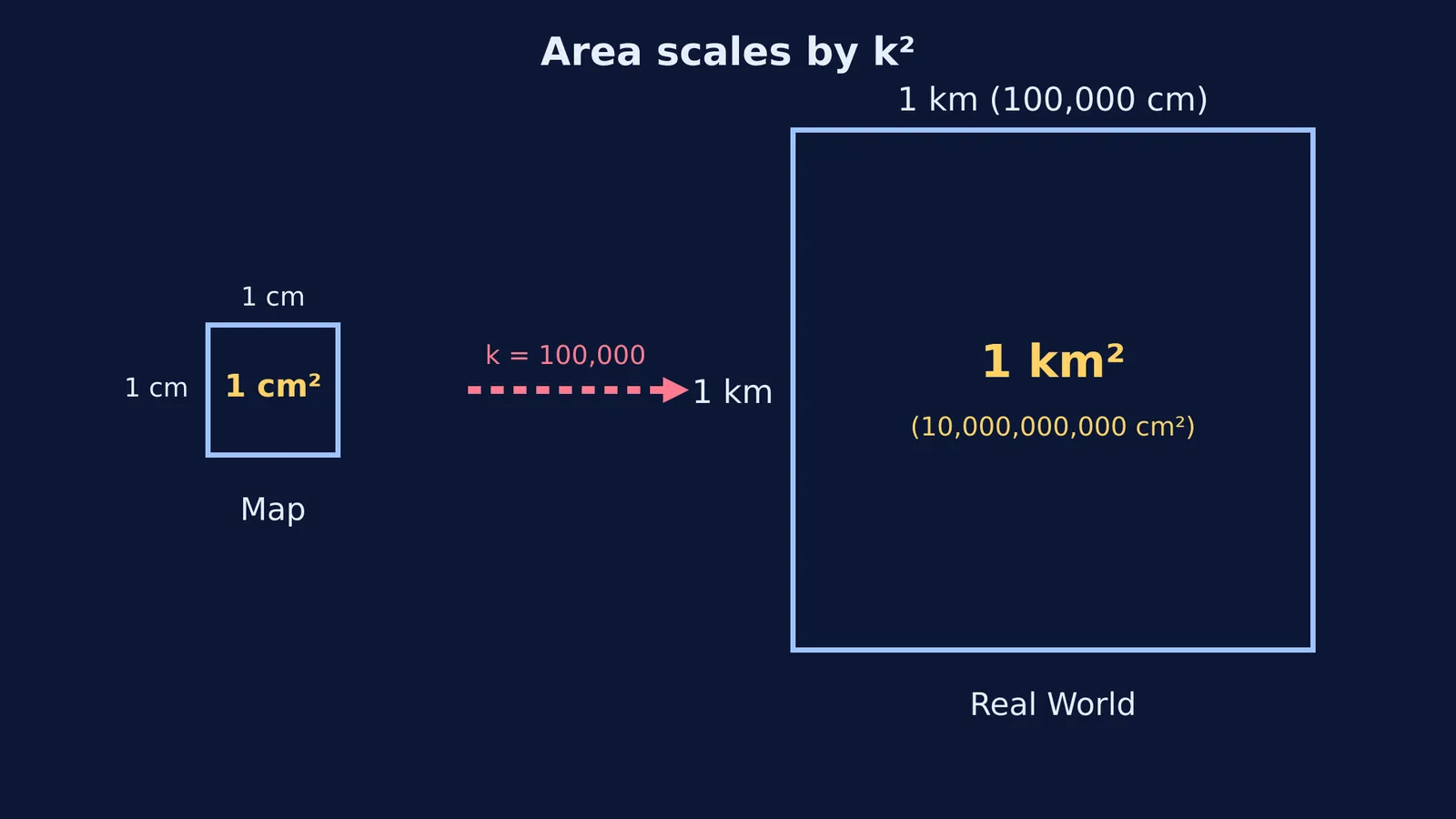
Think about a square on your map that measures 1 cm by 1 cm. Its map area is 1 cm². In the real world, both the length and the width scale up to 1 km. The real-world area is 1 km × 1 km = 1 km². So, a map area of 1 cm² represents a real area of 1 km².
Notice what happens if we use centimetres. The real length is 100,000 cm and the real width is 100,000 cm. The real area is 100,000 × 100,000 = 10,000,000,000 cm². This proves that the area scale factor is the square of the linear scale factor (100,000²). Sometimes seeing this grid expand helps the idea click; Fermi's AI tutor can draw out these squares during a session to show exactly why a 2 cm by 2 cm box covers 4 square kilometres, giving you a visual foundation rather than just a formula to memorise.
How do you solve a map area problem?
When a question asks you to find the real area of a forest or lake from a map, the safest method is to convert the linear dimensions first (Third Space Learning). This prevents you from forgetting to square the scale factor.
Example: Calculating real area A forest covers 6 cm² on a map with a scale of 1 cm to 1 km (1:100,000). What is the real area in square kilometres?
Find the area value of a single unit: 1 cm² on the map = (1 km)² = 1 km² in reality.
Multiply the map area by this value: 6 × 1 km² = 6 km².
The real area is 6 km².
If the map had a different scale, such as 1:50,000, the process relies on the exact same logic. At 1:50,000, 1 cm represents 0.5 km. The area of 1 cm² on that map would be (0.5 km)², which is 0.25 km². For more complex unit chains, applying dimensional analysis keeps your working rigorous; you can see this in action by using dimensions to check your physics answers.
A checklist for exam questions
When you sit down to a scale ratio problem, run through this quick checklist to ensure you do not miss a squared unit. Examiners intentionally design distractors around this common oversight:
Check the final units: Underline whether the examiner wants the answer in cm, m, or km.
Find the linear scale: Write it down clearly as 1 : n.
Check the dimension: Are you finding a length (perimeter, distance) or an area (surface, region)?
Square for area: If you are finding an area, you must square the linear scale before you multiply.
Keeping distance and area conversions distinct is the single most important habit for map problems. Once the difference between k and k² becomes second nature, no map question will throw you off course, giving you confidence in both geometry and geography papers.


