

On this page
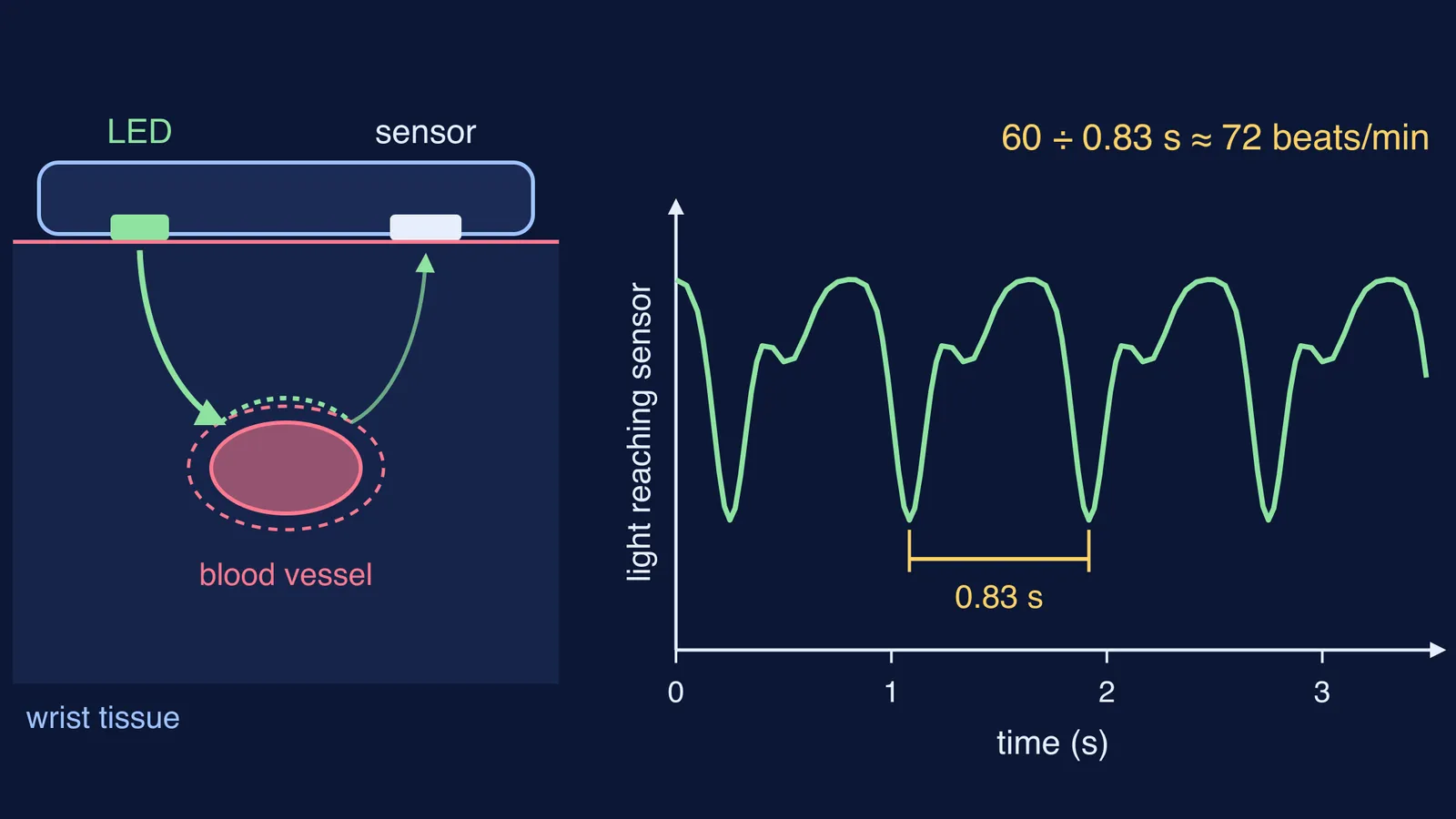
Turn your smartwatch over and you will see small lights on the back. When it reads your heart rate, it shines light into your skin and measures how much comes back. The trick joins two chapters you study separately: absorption of light and the circulatory system.
How does a smartwatch measure heart rate?
The method is called photoplethysmography, or PPG. In a 2007 review, John Allen describes PPG as "a simple and low-cost optical technique that can be used to detect blood volume changes in the microvascular bed of tissue" (Allen, Physiological Measurement, 2007).
Here is the chain of events:
Green LEDs on the back of the watch shine into your wrist.
The light scatters through skin and tissue; some is absorbed and some comes back out.
A light-sensitive photodiode next to the LEDs measures how much returns.
Each heartbeat pushes a surge of blood into the small vessels under the watch. More blood absorbs more light, so less reaches the sensor.
The watch counts these dips and turns them into beats per minute.
Apple's support page describes this setup for the Apple Watch: it uses "green LED lights paired with light-sensitive photodiodes" and flashes them "hundreds of times per second" to calculate heart rate (Apple Support).
Step 4 is the biology half. Your heart pumps blood in pulses, which is why you can feel one at your wrist; our explainer on double circulation in humans covers the two loops blood travels. Allen's review explains that the PPG signal has a pulsing "AC" part that rises and falls with each heartbeat, sitting on a slowly varying "DC" baseline linked to breathing, sympathetic nervous system activity and temperature control.
Why do smartwatches use green light?
Apple's page puts the first reason in one line: "Blood is red because it reflects red light and absorbs green light" (Apple Support).
It is a similar idea to Beer's law in chemistry: the more absorbing material light passes through, the less gets out. Skin also scatters light, so the match is only rough. See our post on why absorbance rises in a straight line with concentration.
Maeda, Sekine and Tamura compared reflected green light (525 nm) with transmitted infrared light (880 nm) on young healthy volunteers in cold (10°C), hot (45°C) and normal rooms (Journal of Medical Systems, 2011). Pulse rates from green light were strongly correlated with the beat-to-beat intervals on an ECG in all three conditions, while infrared showed a weaker correlation in the cold. The authors concluded that reflected green light can be useful for pulse rate monitoring because it is "less influenced by the tissue and vein region".
Infrared still has a place. Apple says its sensor can also use infrared light, depending on factors such as the watch model, your activity level and whether you are sleeping. A pulse oximeter uses light in a related way to estimate how much oxygen your blood carries.
How do you turn light dips into beats per minute?
From the gap between beats: suppose the dips in the light signal are 0.83 seconds apart, as in the diagram above. Heart rate = 60 ÷ 0.83 ≈ 72 beats per minute.
From a count: suppose you see 10 dips in 8 seconds. Heart rate = 10 ÷ 8 × 60 = 75 beats per minute.
From your own pulse: 18 beats in 15 seconds is 18 × 4 = 72 beats per minute.
Counting several beats gives a steadier answer than timing one gap, because a single gap can be thrown off by one wobble in the signal.
If light scattering through tissue is hard to picture, the Fermi Simulation Lab has interactive simulations for ideas that are easier to see than to read.
When are smartwatch heart-rate readings less accurate?
Bent and colleagues tested consumer and research-grade wearables at rest and during activity (npj Digital Medicine, 2020). They found no statistically significant difference in accuracy across skin tones, but they did find differences between devices and between activity types. Absolute error during activity was, on average, 30% higher than at rest.
The physics explains why. When your wrist moves, the watch shifts on your skin and the returning light changes for reasons unrelated to your heart, so the sensor must separate heartbeat dips from movement wobbles.
Try it: check your watch against your own pulse
Sit still for two minutes with the watch on.
Place two fingers on the thumb side of your other wrist and count your pulse for 30 seconds. Double it.
Note the watch reading at the same moment.
Walk up and down the stairs for a minute, then repeat steps 2 and 3.
Compare the pairs. Did the watch agree more closely at rest or after moving?
A watch reading is a gadget's estimate, not a diagnosis. If a reading worries you, or you feel faint, breathless or have chest pain, speak to a doctor.
To revise the biology behind your pulse, the Fermi Concept Library has a lesson for every concept in physics, chemistry, biology, mathematics and computing.


