

On this page
A sharp crack, a tiny flash, and one mosquito fewer. The bat runs on a small battery, yet its mesh sits at a potential difference far higher than the battery's. Here is how, why it waits for the mosquito, and the Class 12 physics behind each step.
How does an electric mosquito bat kill mosquitoes?
A patent for an electronic insect-killing swatter, US 5,519,963 by Tsao-i Shih, describes a battery-powered high-voltage circuit "composed of a vibrator, a transformer, and a plurality of voltage doublers", with an output of "1000 volts or more" wired to two separate sets of electrodes.
An explainer from Electrical Technology traces the same chain in a typical racket:
A 3 V rechargeable battery supplies direct current.
A transistor oscillator turns it into low-voltage AC. A transformer cannot step up DC, so this step is essential.
A step-up transformer raises that AC to about 200 V.
A voltage multiplier, a ladder of diodes and capacitors, raises it to 2,000 to 3,000 V.
A capacitor at the output stores the charge. The inner mesh is sandwiched between two outer meshes, with the inner mesh on one terminal and both outer meshes on the other. When a mosquito flies between an inner and an outer mesh, it completes the circuit and the capacitor discharges through it as an arc.
What does "thousands of volts" actually mean?
Potential difference is energy per charge: OpenStax College Physics states that 1 V = 1 J/C.
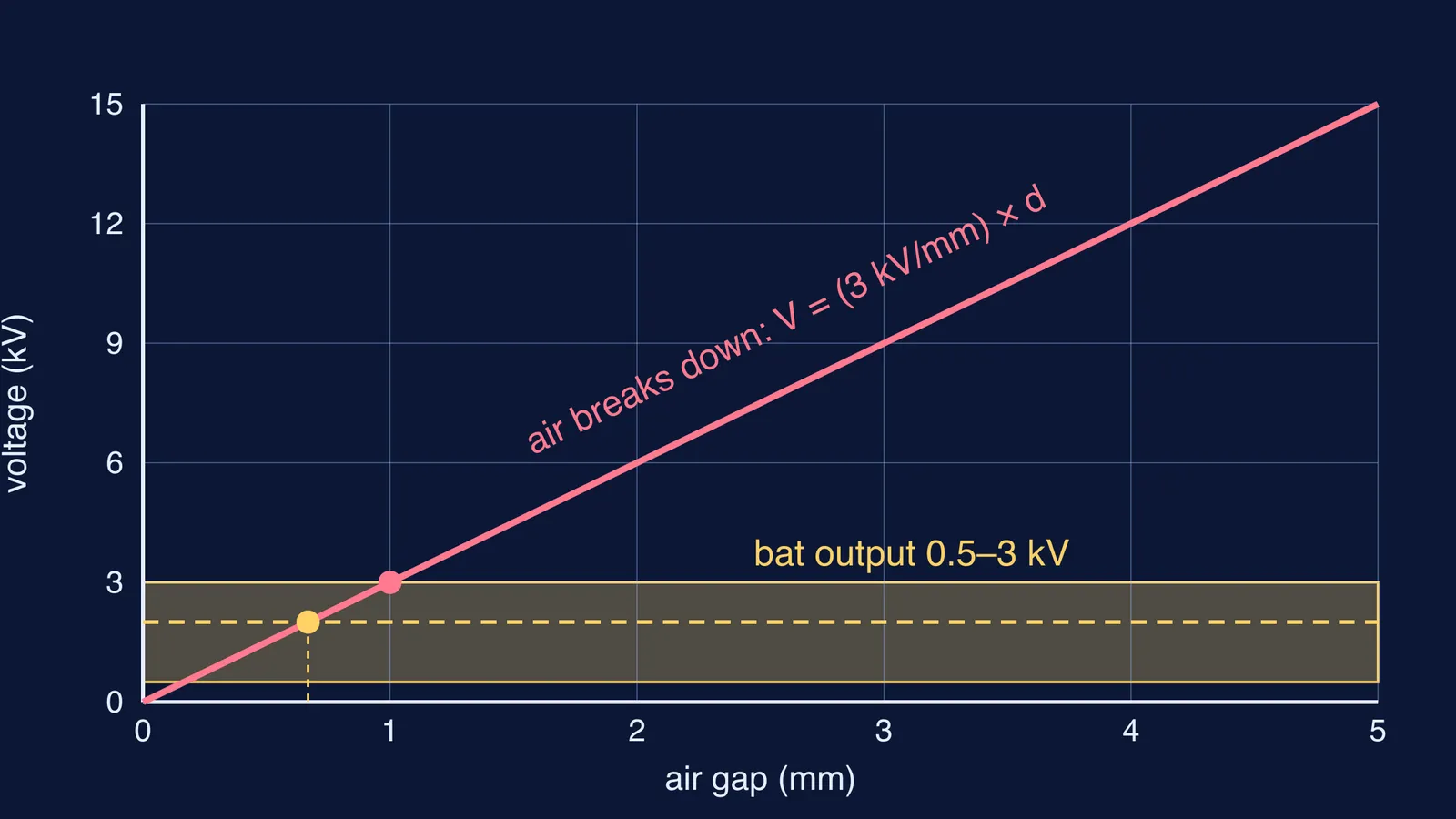
The output of an electric bat is usually between 500 and 3,000 volts, according to Electrical Technology. So at 2,000 V every coulomb that crossed the mesh would carry 2,000 joules, but very little charge is ever waiting there. Voltage tells you how hard charge is pushed, not how much there is.
Touching only one mesh does little: with no second point at a different potential, no current flows, for the same reason birds sitting on a power line don't get a shock.
Why doesn't the bat spark on its own?
Air is an insulator until the electric field gets too strong. The dielectric strength of air is 3 × 10^6 V/m, according to OpenStax College Physics, which defines dielectric strength as the field above which an insulator "begins to break down and conduct". That works out to about 3,000 V per millimetre.
A worked example: take a uniform field, E = V/d, and assume a 3 mm gap between the layers (a teaching value, not a measurement; real breakdown at tiny gaps only roughly follows this rule).
To spark across 3 mm of clean air you need about 3,000 V/mm × 3 mm = 9,000 V. A bat giving 2,000 V falls well short, so the air holds.
At 2,000 V the widest air gap that breaks down is about 2,000 ÷ 3,000,000 m, which is roughly 0.7 mm.
Now suppose a mosquito, which conducts far better than air, fills 2.5 mm of that 3 mm gap. Only 0.5 mm of air is left, so the field there is about 2,000 V ÷ 0.5 mm = 4,000 V/mm. That is above 3,000 V/mm, so the air breaks down and charge flows through the insect.
For the same limit elsewhere, see how much charge a sphere can hold before air breaks down.
Where does the capacitor come in?
The bat keeps its charge ready in the output capacitor. OpenStax defines capacitance as charge stored per volt, C = Q/V. The energy stored is E = ½CV², from OpenStax section 19.7.
Illustrative numbers (not taken from any datasheet): a 10 nF capacitor at 2,000 V holds Q = CV = 20 µC and E = ½ × 10 × 10⁻⁹ × 2,000² = 0.02 J. That is very little energy, but released almost at once into a tiny insect, it is enough; the crack is that sudden release. For where the ½ comes from, see our post on deriving the energy stored in a capacitor.
The Shih patent says that sandwiching one electrode set between insulating grids reduces the chance of a child touching both sets at once, so the swatter "has greatly reduced the chance of electric shock to a user". It is still a high-voltage device: keep it from small children, never touch the mesh while pressing the button, and treat it as live after you let go, since a capacitor can stay charged.
How can you check you really understand it?
Try these without notes:
Why does the circuit need an oscillator before the transformer? (Transformers need changing current.)
Why does the spark appear only when an insect arrives? (Breakdown field, E = V/d.)
How can such a high voltage carry so little energy? (Small Q and small ½CV².)
The Fermi Simulation Lab has interactive simulations for ideas that are easier to see than to read, so fields and capacitors become something you can watch. Next time the bat crackles, you'll know what the mosquito just did.


