

On this page
Many Class 12 students learn U = ½CV² as a formula to recall. The derivation is one short integral of the work done while charging, and once you see it, the half stops being a mystery.
How do you derive the energy stored in a capacitor?
The NCERT Class 12 Physics textbook, Chapter 2, section 2.15 builds the capacitor up one tiny bit of charge at a time. Start with two uncharged conductors and move positive charge from one to the other until they hold +Q and −Q.
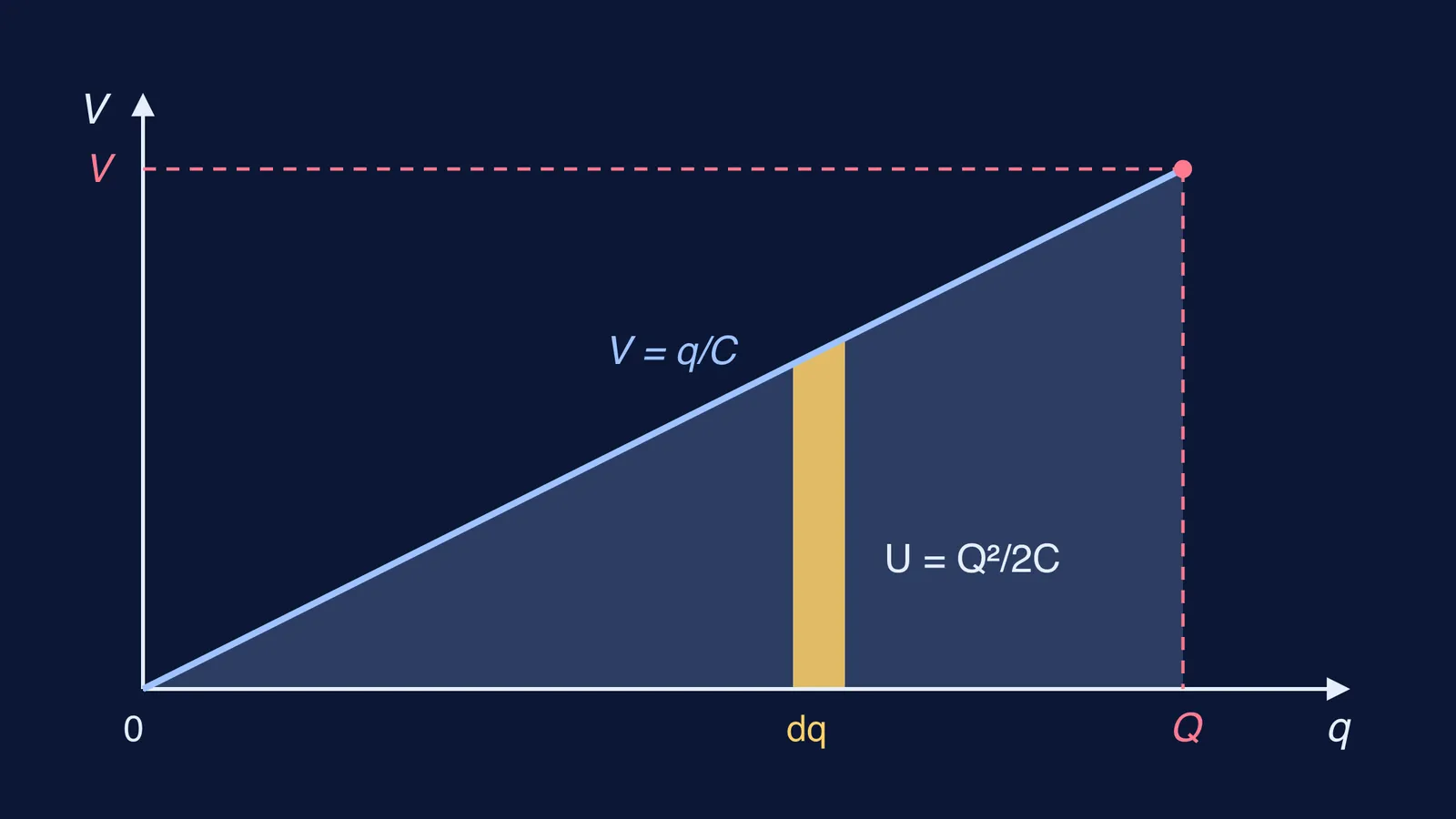
Take a moment in the middle of charging, when the plates hold +q and −q. The potential difference between them is V = q/C.
Move one more tiny charge dq across. Because the voltage barely changes during that step, the work needed is dW = V dq = (q/C) dq.
Add up every step from q = 0 to q = Q: W = ∫ (q/C) dq from 0 to Q.
C is constant, so it comes out of the integral: W = (1/C) × [q²/2] from 0 to Q = Q²/2C.
The electrostatic force is conservative, so this work is stored as potential energy: U = Q²/2C.
Using Q = CV, the same result can be written three ways, U = Q²/2C = ½CV² = ½QV, as NCERT's equation 2.69 shows. OpenStax University Physics Volume 2, section 8.3 gives the same derivation.
Why is there a half in ½CV²?
The first bit of charge crosses for free, because there is no voltage yet. The last bit crosses against the full voltage V. On average, each bit of charge is pushed against V/2, so the total work is Q × V/2.
This is not the same as the energy the battery supplies. A battery pushes all of Q through its full voltage, so it does QV of work. Half goes into the capacitor and the other half is dissipated, mostly as heat in the circuit's resistance; our post on why half the energy is lost when charging a capacitor works through that second half.
How does the integral work on a real example?
NCERT's Example 2.10 charges a 900 pF capacitor with a 100 V battery. The charge is Q = CV = 9 × 10⁻⁸ C, and the stored energy is ½QV = 4.5 × 10⁻⁶ J (NCERT Chapter 2).
Now check that the integral really means "add up the steps". Pretend you charge the capacitor in four equal chunks of Q/4 instead of infinitely many tiny ones. Using these numbers, QV is 9 × 10⁻⁶ J.
If you price each chunk at the voltage at its start (0, V/4, V/2, 3V/4), the total is (0 + 1 + 2 + 3)/16 of QV, which is 3/8 of QV, or about 3.4 × 10⁻⁶ J. That is too little.
If you price each chunk at the voltage at its end (V/4, V/2, 3V/4, V), the total is (1 + 2 + 3 + 4)/16 of QV, which is 5/8 of QV, or about 5.6 × 10⁻⁶ J. That is too much.
With N chunks the two sums become (N − 1)/2N and (N + 1)/2N of QV. As N grows, both close in on ½QV = 4.5 × 10⁻⁶ J.
That squeeze is exactly what the integral does. For a typical exam twist, see what happens to capacitor energy when plate separation is doubled.
Where is the energy actually stored?
NCERT goes one step further for a parallel plate capacitor. Write Q = σA and C = ε₀A/d, and use E = σ/ε₀. The energy becomes U = ½ε₀E² × Ad, and Ad is the volume between the plates. So the energy density of an electric field is u = ½ε₀E², and NCERT notes after equation 2.73 that this holds for the field of any arrangement of charges, not just this one. This means you can view the stored energy as sitting in the field between the plates. If that step from plates to fields feels shaky, the Fermi Concept Library gives each concept, including capacitance and electrostatic potential energy, its own lesson.
What mistakes cost marks in this derivation?
Writing dW = V dq with V held at its final value. That gives QV, which is the battery's work, not the stored energy. Use V = q/C, with q the charge at that moment.
Forgetting the limits. State that charge goes from 0 to Q.
Skipping the reason. Work equals stored energy because the electrostatic force is conservative; say so.
Picking an awkward form. All three forms are equal, but when C changes, use the one built on what stays fixed: ½CV² if the battery stays connected (V fixed), Q²/2C if it is disconnected (Q fixed).
If you keep picking the wrong method in capacitor numericals, the Fermi Problem Library has worked problems with a step-by-step solver that explains the reasoning rather than printing an answer. To watch charge build up over time, try our RC circuit charging simulation.


