

On this page
You have probably watched a fly land on a plate, sit still and seem to dab at the food. A housefly has no jaws to bite with, so it turns food into liquid and mops it up. The same habit makes it good at moving germs from a drain to your dinner.
How does a housefly eat if it cannot chew?
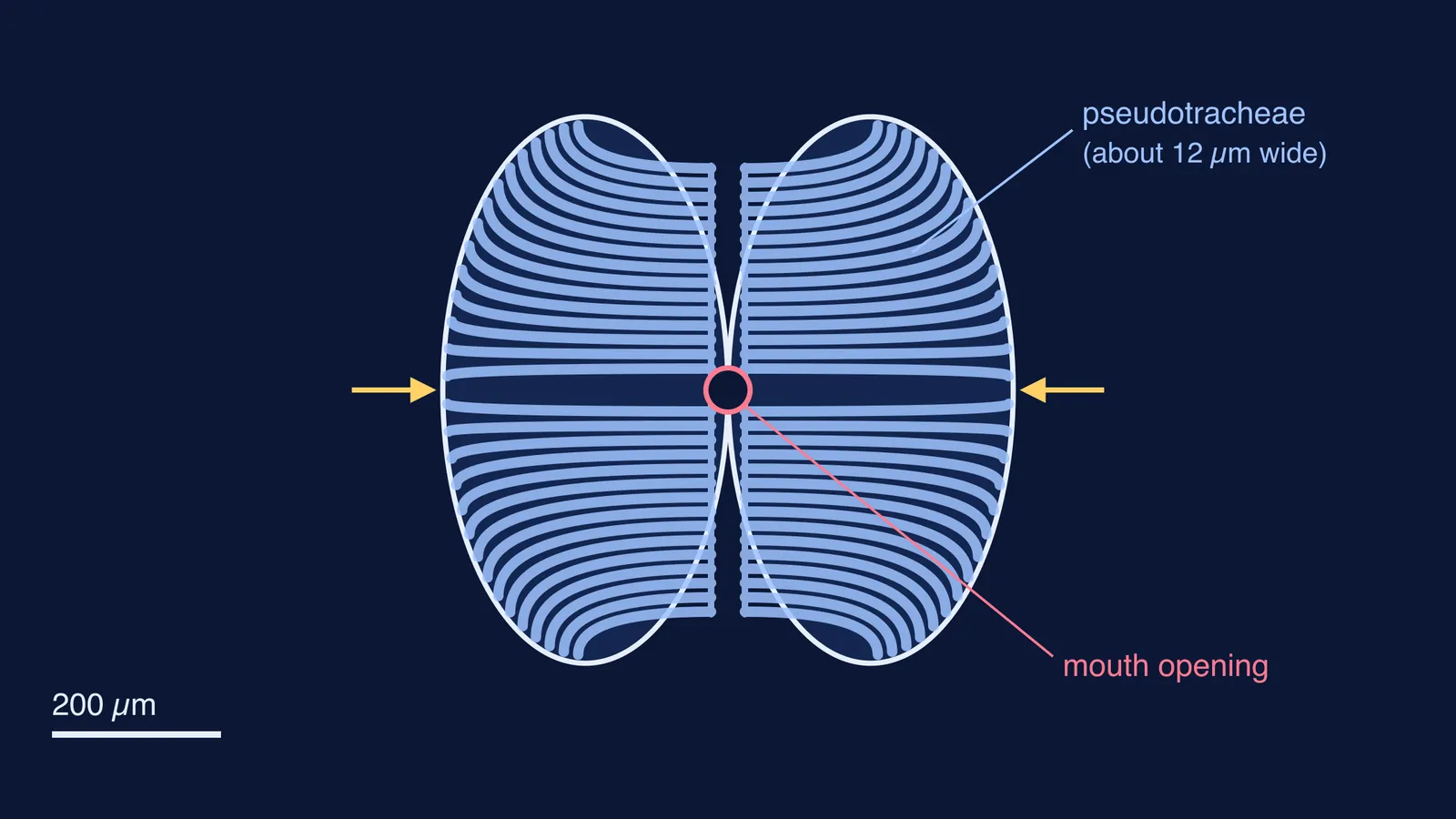
A housefly's mouthparts are built for sponging and sucking: a proboscis with three parts, the rostrum, the haustellum and, at the tip, a soft pad called the labellum, as described in a 2022 study of fly mouthparts in the journal Insects. The labellum has two lobes that open and close. When they open, a set of fine grooves called pseudotracheae is exposed, and these grooves draw liquid by capillary action toward an oral opening in the middle.
Under a scanning electron microscope, each house fly labellar lobe was about 647 micrometres long and 337 micrometres wide and carried about 30 pseudotracheae (Lehnert and colleagues, 2022).
Each pseudotrachea of a house fly is about 12 micrometres across, and the food canal near the mouth opening is about 96 micrometres, according to a 2017 study in Proceedings of the Royal Society B. Liquid gathers in the grooves first, then moves to the mouth, where a sucking pump draws it in. Think of a sponge with built-in straws.
Why do flies vomit on their food?
Liquid is easy. Solid food, like a sugar grain or a dry crust, is the problem, so the fly brings its own liquid.
"Upon landing on a solid substrate, the house fly can deposit its saliva which assists in the breakdown and liquefaction of its food source," write the authors of a 2025 study of house fly saliva in Scientific Reports. That saliva carries enzymes for different nutrients. A 2025 farm study in the Journal of Insect Science says house flies take up liquid food with a sponging labellum and can eat dry food "by first dissolving the food with wet regurgitate".
So the "vomit" is saliva plus fluid brought back up from the crop, the sac where the fly stores what it has swallowed.
How does this help flies carry germs?
In a 2022 review in Insects, John Stoffolano Jr. of the University of Massachusetts Amherst explains that these flies feed on fluids from wounds, saliva, mucus or tears, as well as on faeces, and that infective fluids are stored in the crop. From there they can be regurgitated onto the next food, groomed over the body, or passed on to the midgut. In one experiment the review describes, Chlamydia trachomatis, the bacterium behind the eye disease trachoma, stayed alive in the house fly crop for 24 hours.
A systematic review of 99 studies in BMC Public Health identified over 130 pathogens from house flies, mostly bacteria, along with fungi, parasites and viruses. Our explainer on how houseflies carry amoebiasis follows one of them, a gut parasite, from faeces to food.
Worked example: trace one fly's meal
A fly that has just been at an open drain lands on an uncovered tray of jalebis and samosas.
Jalebi syrup is already liquid. The labellum opens, the pseudotracheae fill by capillary action, and the fly sucks the syrup in. No saliva is needed.
The samosa crust is dry. The fly wets a patch with saliva and regurgitated crop fluid, waits for it to dissolve, then sponges the mix back up.
The crop fluid came from the drain. Any germs it held can end up on the crust, and some can stay behind when the fly leaves.
The exam version fits in one line: the housefly has sponging mouthparts; the labellum's pseudotracheae draw up liquid food by capillary action; solid food is first dissolved with saliva or regurgitated fluid; this makes the fly a mechanical carrier of germs.
If the types of insect mouthparts blur together before a test, the Fermi Concept Library covers every concept in biology, each with its own lesson and its place in the map.
What can you do about it at home?
You cannot change how a fly feeds, but you can keep it off your food. The first of the World Health Organization's Five Keys to Safer Food is "keep clean".
Cover cooked food, sweets and cut fruit that sit out, even for a few minutes.
Wipe up sugar, syrup and milk spills; dry food on a counter is still a meal for a fly.
Keep bin lids shut and drains covered, since that is where a fly fills its crop.
Wash your hands before eating; here is how long handwashing takes to remove germs.
Next time a fly starts to dab at your plate, you will know what it is doing, and why the plate is worth covering.


