

On this page
Tilt a hologram and the object inside shifts like a real one: a part at the front slides across a part at the back. A photograph never does that. A camera records how bright the light is at each point; a hologram also records how the light waves line up, and that is where depth lives.
What does an ordinary photograph actually record?
A light wave has an amplitude (how strong it is) and a phase (where in its cycle it is when it arrives). Film and camera sensors respond only to intensity. The presentation speech for the 1971 Physics prize, given by Erik Ingelstam of the Royal Swedish Academy of Sciences, puts it plainly: a photographic image reproduces only intensity, so phase is lost, “and thereby the three dimensional geometry”. Phase depends on which direction the wave comes from and how far it has travelled from the object, the speech explains.
How does a hologram work?
Dennis Gabor described the idea in a 1948 Nature paper, A New Microscopic Principle, and won the 1971 Nobel Prize in Physics “for his invention and development of the holographic method”. It has two steps.
Record: laser light is split in two. The object beam scatters off the object towards the film; the reference beam goes straight to the film. Where the two waves arrive in step they make a bright fringe; out of step, a dark one.
Replay: light the developed film with the reference beam alone. The fringes diffract it into a copy of the light that once came from the object, so you see the object, in depth, behind the film.
HyperPhysics at Georgia State University calls holography “lensless photography”: the film holds an interference pattern, not a focused image. Each fringe depends on the phase difference between the beams, so the phase a photograph throws away is written into the film as brightness. The pattern looks nothing like the object; HyperPhysics compares it to ripples on a pond after pebbles are thrown in. For a refresher on when waves add or cancel, see our post on conditions for constructive and destructive interference.
Where exactly is the depth stored?
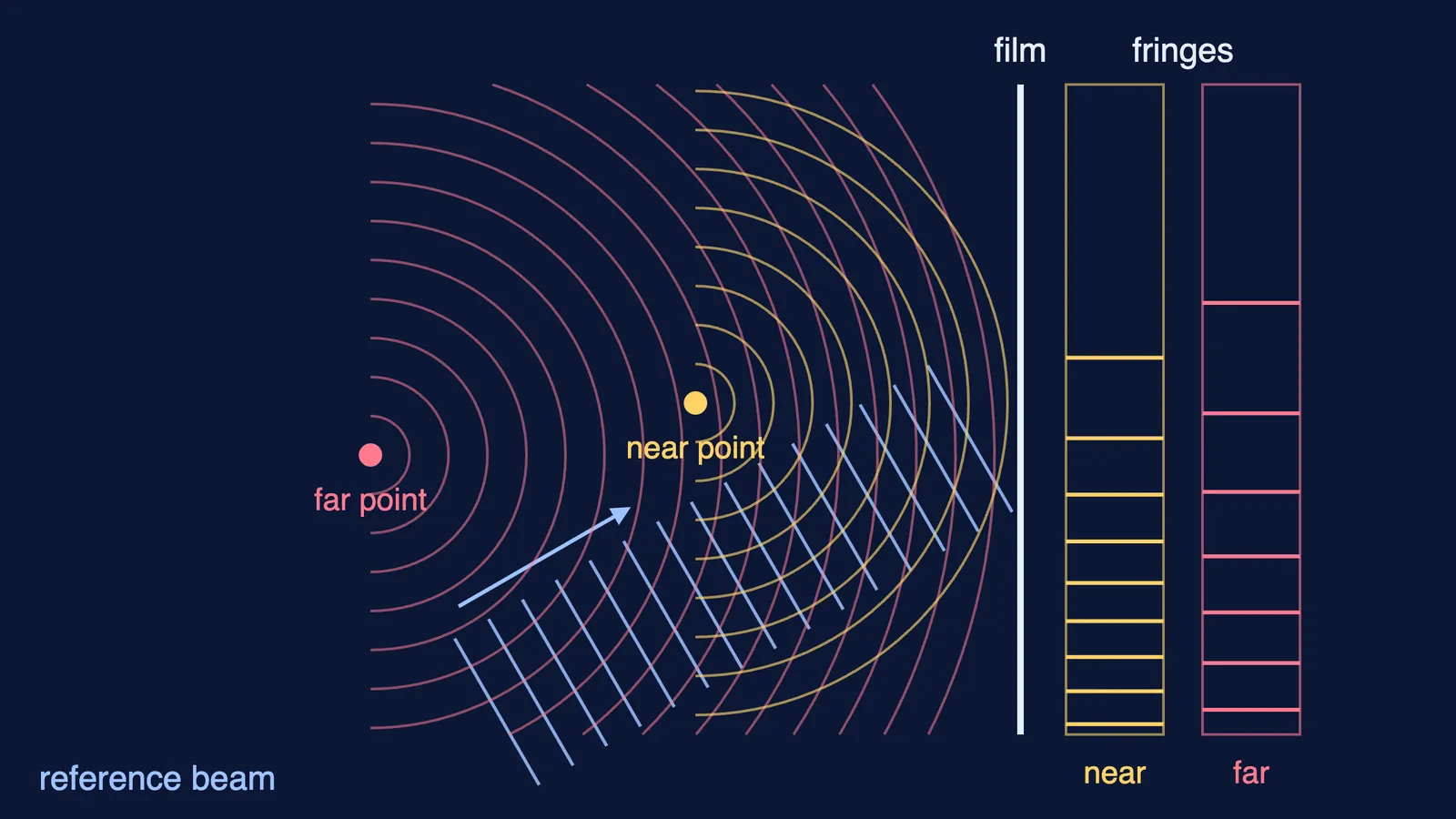
HyperPhysics notes that the common red helium-neon laser usually runs at 632.8 nm. Suppose the reference beam hits the film at 30° to the normal and light from a point on the object arrives at angle α, tilted the same way. Slide a distance x along the film and the path difference between the two beams changes by x(sin 30° − sin α). A new bright fringe appears each time that change equals one wavelength, so the fringe spacing is d = λ / (sin 30° − sin α).
Light arriving straight on (α = 0): d = 632.8 nm / 0.5 = 1.27 µm, about 790 fringes per millimetre.
A point 10 cm in front of the film, seen from a spot 1 cm to one side: its light arrives at α = 5.7°, so d = 1.58 µm.
A point 20 cm in front of the film, seen from the same spot: α = 2.9°, so d = 1.41 µm.
So one spot on the film records a different fringe spacing for the near point and the far point. Across the film, light from a near point changes direction quickly, so its spacing changes quickly; light from a far point changes slowly. That rate of change is the distance, stored in a pattern about a micrometre fine. It is also why, as HyperPhysics shows, a corner cut off a hologram still shows the whole object from one viewpoint: every patch of film received light from every point.
Why does a hologram need a laser?
Fringes only form if the two beams keep a steady phase relationship, even though the object beam travels further. The Nobel presentation speech says holography broke through after the first laser was built in 1960, because its coherent wave-trains are long enough to reconstruct depth, and that a University of Michigan group led by Emmett Leith led the way in removing the disturbing double images. HyperPhysics credits Leith and Upatnieks with the off-axis reference beam method, the tilted beam in our example.
How do you explain a hologram in an exam answer?
Name the two beams, object and reference, from one laser.
Say the film records their interference pattern, not an image.
State the contrast: a photograph records intensity only; a hologram records intensity and phase.
Explain replay: the reference beam diffracts off the fringes and recreates the object's light.
Give evidence: parallax, or any piece showing the whole object.
For numbers, use d = λ / (sin θ₁ − sin θ₂).
The same path-difference rule sets the fringes in our post on fringe width in Young's double slit experiment. If interference is hard to picture, the Fermi Simulation Lab has interactive simulations for ideas easier to see than to read. If you are unsure where wave optics stands in your preparation, Fermi's AI tutor works out what you already know and builds a plan for the session.


