

On this page
You start with a six-carbon nitrile and need a five-carbon amine. That missing carbon is the whole puzzle. Hexanenitrile is C₆H₁₁N and 1-aminopentane, whose IUPAC name is pentan-1-amine, is C₅H₁₃N, according to PubChem's records for hexanenitrile and pentan-1-amine. Whatever route you pick, one carbon has to leave the chain and the nitrogen has to end up on the carbon next to it.
What is the route from hexanenitrile to 1-aminopentane?
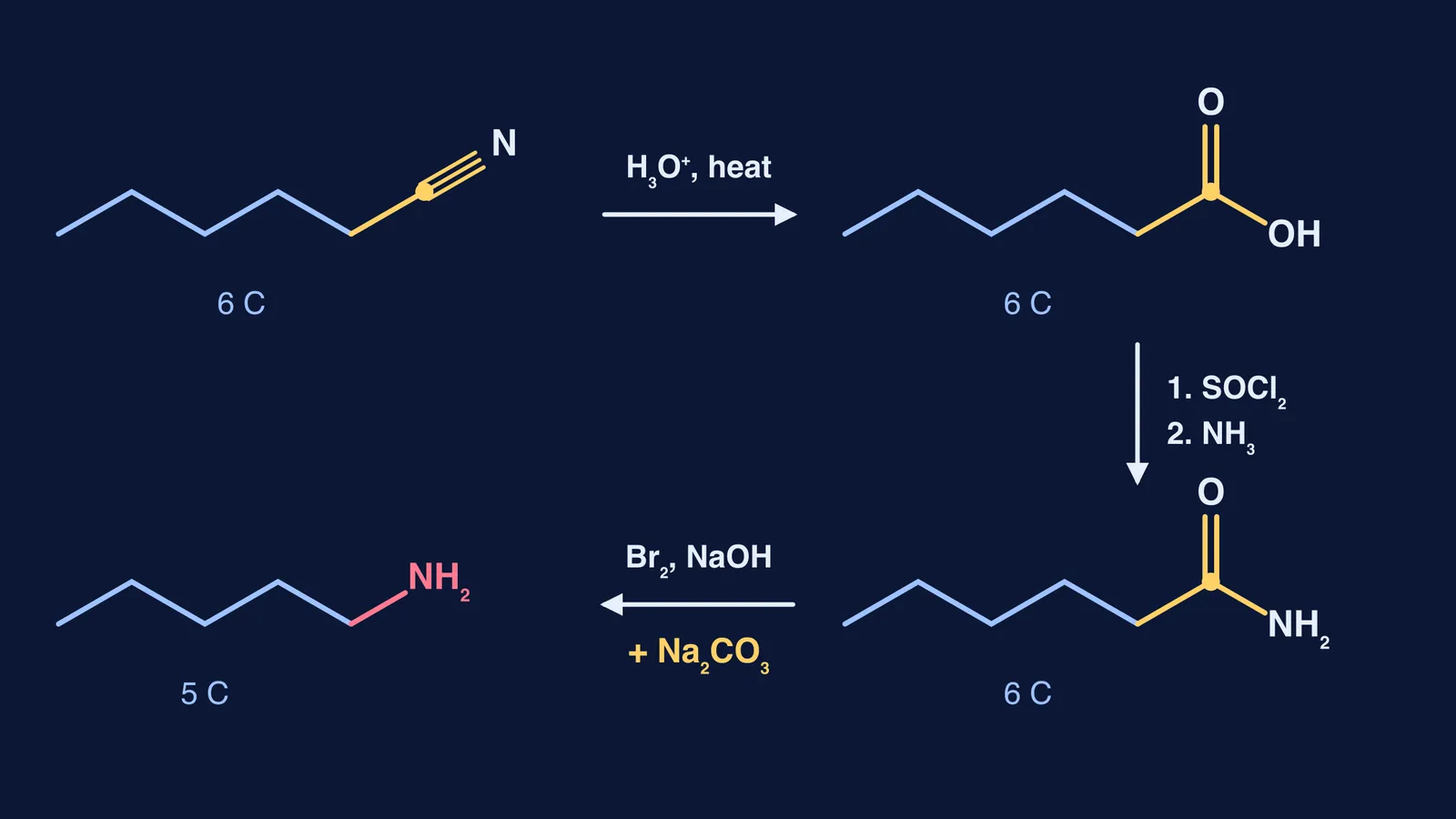
It takes three steps, and you already know each reaction from Class 12:
Hydrolyse hexanenitrile to hexanoic acid with dilute acid and heat.
Turn hexanoic acid into hexanamide: thionyl chloride gives the acid chloride, then ammonia gives the amide.
Treat hexanamide with bromine and sodium hydroxide (Hofmann bromamide degradation) to get pentan-1-amine.
Step 3 is the one that removes the carbon. Steps 1 and 2 are only there to build the amide it needs.
Why can't you just reduce the nitrile?
This is the tempting shortcut, and it fails. According to NCERT's Class 12 chapter on amines, reducing a nitrile with LiAlH₄ or catalytic hydrogenation gives a primary amine, and the reaction is used for the "ascent of amine series", which makes amines with one carbon atom more (NCERT Chemistry Part II, Unit 9 Amines, p. 263). Reduce hexanenitrile and all six carbons stay, so you get hexan-1-amine instead of pentan-1-amine.
One page later, the same chapter gives the opposite tool. NCERT describes Hoffmann bromamide degradation as treating an amide with bromine in an aqueous or ethanolic solution of sodium hydroxide, and says the amine formed "contains one carbon less than that present in the amide" (NCERT, Unit 9, p. 264). That is exactly the carbon count you need.
How does each step work?
Step 1 turns hexanenitrile into hexanoic acid. Nitriles hydrolyse to carboxylic acids in acidic or basic aqueous solution, and an amide forms on the way but "usually is not isolated" (Chemistry LibreTexts, Chemistry of Nitriles/20%3A_Carboxylic_Acids_and_Nitriles/20.07%3A_Chemistry_of_Nitriles)). In acid, the nitrogen leaves as ammonium ion.
CH₃(CH₂)₄C≡N + 2H₂O + H⁺ → CH₃(CH₂)₄COOH + NH₄⁺
That amide intermediate explains the shape of the route. You might hope to stop at hexanamide, but in ordinary hydrolysis the amide keeps reacting. The reliable answer is to go all the way to the acid and then build the amide again under control.
Step 2 turns hexanoic acid into hexanamide. Carboxylic acids react with thionyl chloride (SOCl₂) to form acid chlorides, and acid chlorides react with ammonia to give amides, releasing HCl (Chemistry LibreTexts, Chemistry of Acid Halides/21%3A_Carboxylic_Acid_Derivatives-_Nucleophilic_Acyl_Substitution_Reactions/21.04%3A_Chemistry_of_Acid_Halides)). Use excess ammonia so it also takes up that HCl.
CH₃(CH₂)₄COOH + SOCl₂ → CH₃(CH₂)₄COCl + SO₂ + HCl
CH₃(CH₂)₄COCl + 2NH₃ → CH₃(CH₂)₄CONH₂ + NH₄Cl
Step 3 turns hexanamide into pentan-1-amine. NCERT gives the general equation RCONH₂ + Br₂ + 4NaOH → RNH₂ + Na₂CO₃ + 2NaBr + 2H₂O (NCERT, Unit 9, p. 264). Put R = CH₃(CH₂)₄ and you get:
CH₃(CH₂)₄CONH₂ + Br₂ + 4NaOH → CH₃(CH₂)₄NH₂ + Na₂CO₃ + 2NaBr + 2H₂O
The carbonyl carbon is the one that leaves, as carbonate. The pentyl group moves from that carbon to nitrogen through an isocyanate intermediate, which is hydrolysed and gives off CO₂ to leave the amine (Hofmann rearrangement, Wikipedia). The reaction is named after its discoverer, August Wilhelm von Hofmann, according to the same source. For the mechanism arrow by arrow, read our step-by-step guide to Hofmann bromamide degradation.
How do you write this conversion in a board or JEE exam?
Use this checklist for a conversion question:
Write both ends with formulae and carbon counts: a C6 nitrile and a C5 amine.
Say in one line that one carbon is lost, so the last step must be Hofmann.
Draw three arrows with reagents above them: H₃O⁺ and heat; SOCl₂ then NH₃; Br₂ and NaOH.
Name every intermediate: hexanoic acid, hexanoyl chloride, hexanamide.
Check the product: the NH₂ sits on the carbon that was C2 of the nitrile.
That callout comes from the same NCERT page that lists amide reduction among the ways to prepare amines (NCERT, Unit 9, p. 263).
Two related posts are useful practice. Our acetic acid to methylamine step-down uses the same last two steps on a two-carbon acid. Our guide to dehydrating amides to nitriles with P₄O₁₀ runs part of this route backwards.
If you keep picking the wrong last step in conversion questions, the Fermi Problem Library has worked problems with a step-by-step solver that explains the reasoning rather than printing an answer. If the gap is the idea of stepping up or down a series, each concept in the Fermi Concept Library has its own lesson and its place in the map.


