

On this page
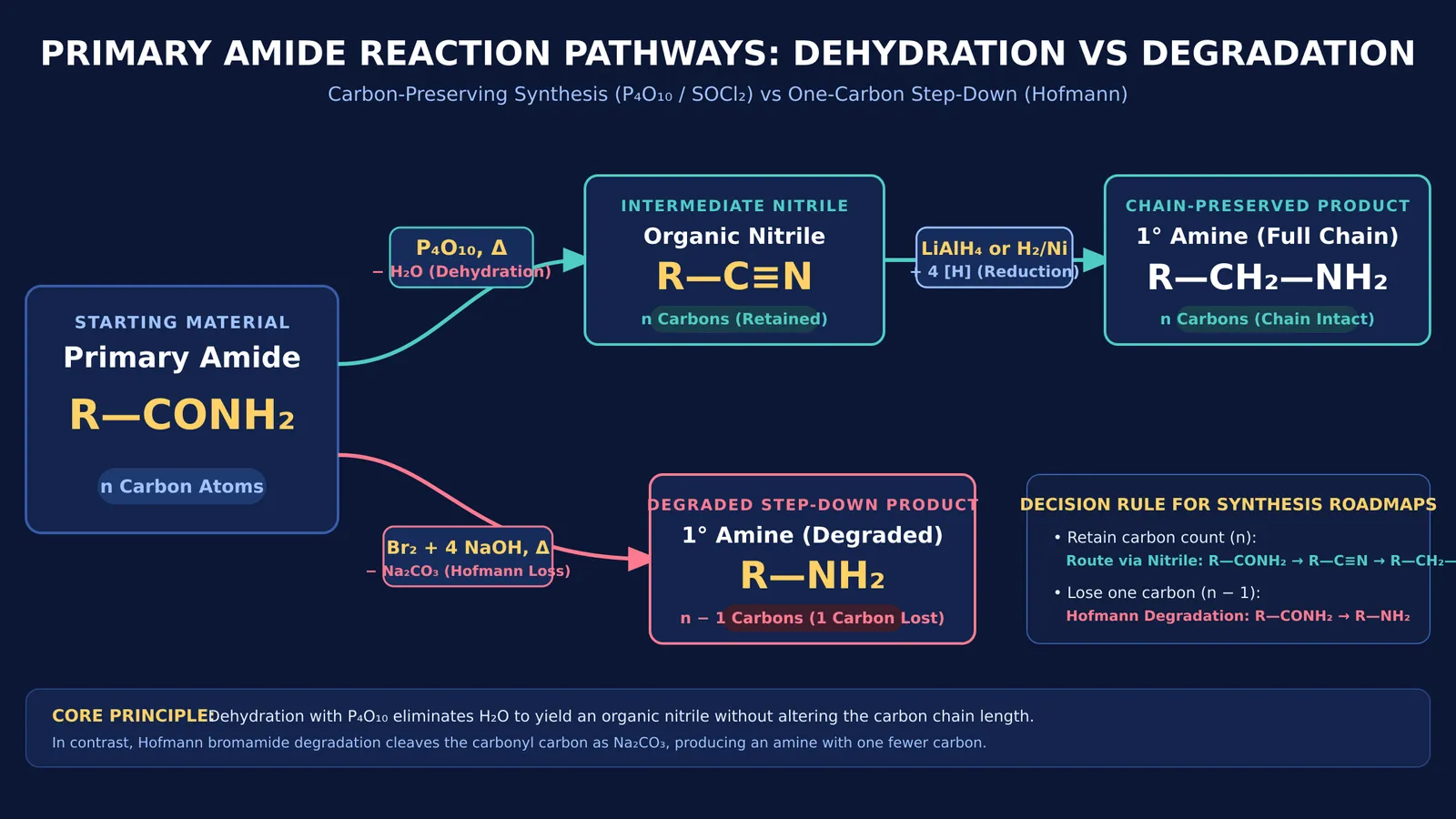
Converting a carboxylic acid into an amine is a staple transformation in CBSE Class 12, JEE Main, and NEET-UG organic chemistry. When you heat an unsubstituted primary amide with a strong dehydrating agent like phosphorus pentoxide (tetraphosphorus decaoxide, P₄O₁₀) or thionyl chloride (SOCl₂), the amide loses water (H₂O) to yield an organic nitrile (R—C≡N). Because this dehydration preserves the intact carbon framework of the starting acid derivative, it acts as a reliable bridge in synthetic roadmaps where you must keep the original chain length while transforming functional groups.
How does P₄O₁₀ dehydrate a primary amide to a nitrile?
The conversion of a primary amide to a nitrile relies on electrophilic activation at the carbonyl oxygen. Because resonance delocalizes the nitrogen lone pair onto the carbonyl oxygen, the oxygen is the most nucleophilic atom in the amide group. When heated with tetraphosphorus decaoxide (P₄O₁₀), the carbonyl oxygen attacks an electrophilic phosphorus atom in P₄O₁₀ to generate an imidoyl phosphate intermediate.
Subsequent proton transfer from the nitrogen followed by elimination allows the nitrogen lone pair to establish a carbon-nitrogen triple bond, expelling the phosphorus leaving group. The reaction is driven by the formation of exceptionally stable phosphorus-oxygen bonds in polymeric metaphosphoric acid. As reviewed by Muthupandian Ganesan and Paramathevar Nagaraaj in Organic Chemistry Frontiers, 2020, P₄O₁₀ provides high functional reliability for this transformation. In preparative organic chemistry, such as the dehydration of isobutyramide to isobutyronitrile documented in Organic Syntheses, 1945, heating with phosphorus pentoxide delivers isolated yields between 67% and 86%.
Why is SOCl₂ preferred for cleaner laboratory workups?
Although phosphorus pentoxide is a potent desiccant, it generates a viscous residue of polyphosphoric acids that can complicate product isolation. Thionyl chloride (SOCl₂) offers an efficient, cleaner benchtop alternative.
The amide oxygen attacks the sulfur atom of SOCl₂, releasing chloride to form a chlorosulfite intermediate: R—C(=N⁺H₂)—O—S(=O)Cl. A base like pyridine removes a proton from the nitrogen. The intermediate then collapses as the nitrogen lone pair forms the C≡N triple bond, releasing sulfur dioxide (SO₂) and hydrogen chloride (HCl).
As David T. Mowry detailed in Chemical Reviews, 1948, thionyl chloride drives nitrile formation because both by-products evolve as gases, shifting the equilibrium forward under Le Chatelier's principle. In Vilsmeier-type conditions developed by Thomas M. Bargar and C. M. Riley in Synthetic Communications, 1980, primary amides dehydrate to nitriles within minutes at 0 °C with isolated yields between 81% and 94%.
How does dehydration differ from Hofmann degradation in carbon count?
Students frequently confuse two reactions that begin with primary amides: dehydration versus the Hofmann bromamide degradation. Tracking your carbon budget resolves the confusion immediately:
Dehydration (P₄O₁₀ or SOCl₂): Retains the carbon count. An n-carbon amide yields an n-carbon nitrile (R—CONH₂ → R—C≡N). Reducing this nitrile with LiAlH₄ or H₂/Ni gives a primary amine (R—CH₂—NH₂) with the same number of carbons as the starting material.
Hofmann degradation (Br₂ + NaOH): Steps down the carbon count. The carbonyl carbon is lost as sodium carbonate (Na₂CO₃), yielding a primary amine (R—NH₂) with n − 1 carbons.
When navigating multi-step cascades across carboxylic acids and their derivatives, the Fermi Concept Library covers every concept in physics, chemistry, biology, mathematics and computing, each with its own lesson and its place in the map, showing how functional groups interconvert.
How do you step from a carboxylic acid to a chain-preserved amine?
Consider synthesizing ethanamine (CH₃CH₂NH₂, two carbons) from ethanoic acid (CH₃COOH, two carbons). Treating ethanamide directly with Br₂ and NaOH would eliminate a carbon to yield methanamine (CH₃NH₂). To preserve both carbons, route through the nitrile:
Amidation: React ethanoic acid with ammonia and heat to form ethanamide:
CH₃COOH + NH₃ → CH₃COONH₄ (heat) → CH₃CONH₂ + H₂O
Dehydration: Heat ethanamide with P₄O₁₀ (or reflux with SOCl₂ and pyridine) to yield ethanenitrile:
CH₃CONH₂ + P₄O₁₀ (heat) → CH₃C≡N + H₂O
Reduction: Reduce ethanenitrile with LiAlH₄ or H₂/Ni to obtain ethanamine:
CH₃C≡N + 4 [H] → CH₃CH₂NH₂
This sequence preserves the original two-carbon chain and pairs effectively with methods like the Gabriel phthalimide synthesis for preparing clean primary amines. If you get stuck choosing reagents during a multi-step conversion problem, the Fermi Problem Library offers worked problems with a step-by-step solver that explains the reasoning rather than printing an answer.
The 3-step decision checklist for exam roadmaps
Tally the carbon atoms: Compare the carbon counts of your starting material and final product.
Select retention or degradation: If carbons match, use amidation followed by P₄O₁₀ dehydration and reduction; if you must lose one carbon, use Hofmann bromamide degradation.
Choose the workup reagent: Use P₄O₁₀ for standard academic questions, or SOCl₂ when clean gaseous by-products are preferred.


