On this page
Textbooks often give you hcp and ccp as two facts to memorise. They are really one decision, made at the third layer. Build the layers yourself and the difference becomes a picture you can redraw in an exam.
How do layers A and B form?
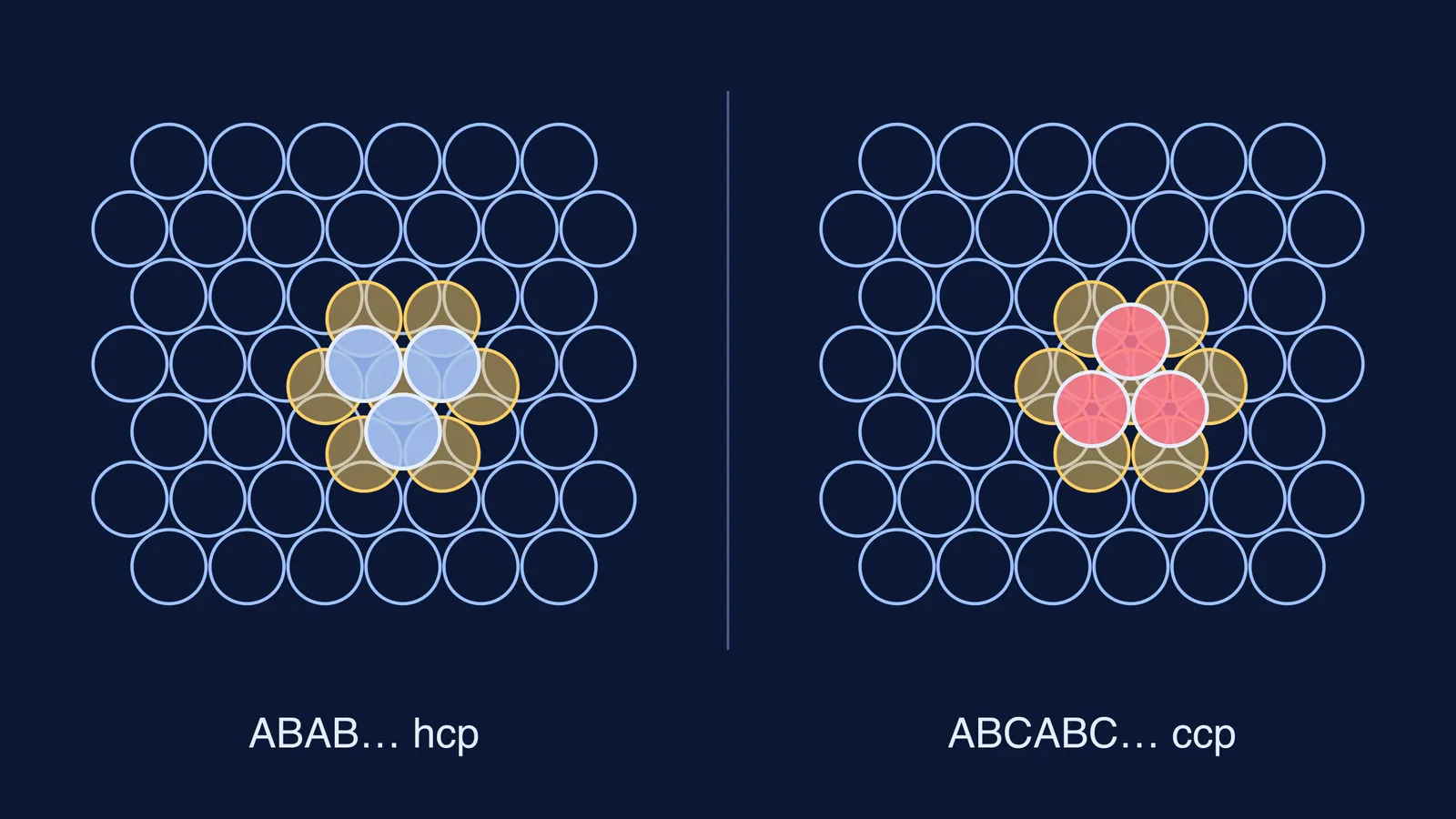
The tightest flat layer of identical spheres is hexagonal: each sphere touches six neighbours, with a small triangular hollow between every three. Call this layer A.
Layer B sits in A's hollows. The detail that matters later: B spheres are as big as A spheres, so they can only cover every other hollow. Half of A's hollows end up under B; the other half stay open. Up to here there is no choice: hcp and ccp look identical for two layers.
Where does the third layer go in hcp and ccp?
The third layer sits in B's hollows, which come in two kinds.
Some hollows of B lie directly above spheres of A. Put the third layer there and it repeats A exactly. The sequence is ABAB..., which is hexagonal close packing (hcp).
The other hollows of B lie above the hollows of A that B left open. Put the third layer there and you get a new position, C, which matches neither A nor B. The fourth layer then lines up with A again, so the sequence is ABCABC..., which is cubic close packing (ccp), the same structure as face-centred cubic (fcc).
Purdue University's chemistry review describes the same two choices: the third plane packs directly above the first (ABAB), or above the holes in the first plane not used by the second (ABCABC).
Why do hcp and ccp have the same coordination number and packing efficiency?
Because each sphere's neighbourhood is built the same way. In both, a sphere touches six spheres in its own layer, three in the layer above and three in the layer below, according to Purdue's review. That is 6 + 3 + 3 = 12, so the coordination number of both hcp and ccp is 12.
The same source states that 74% of the space in hcp is filled and that ccp is just as efficient. LibreTexts/Physical_Properties_of_Matter/States_of_Matter/Properties_of_Solids/Crystal_Lattice/Closest_Pack_Structures) gives the same 74% for both, notes that 26% of hcp is empty space, and lists the fcc (ccp) value more precisely as 74.04%.
You can check the number yourself. Here is the calculation for both unit cells, with sphere radius r:
ccp (fcc) cell: spheres touch along the face diagonal, so 4r = a times root 2, and the edge is a = 2 root 2 r. The cell holds 4 spheres.
ccp fraction: 4 times (4/3) pi r cubed, divided by a cubed = 16 root 2 r cubed, gives pi divided by (3 root 2), about 0.7405.
hcp cell: 6 spheres. The base is a hexagon of side 2r, area 6 root 3 r squared, and the height between repeating A layers is 4r times root (2/3). The volume is 24 root 2 r cubed.
hcp fraction: 6 times (4/3) pi r cubed is 8 pi r cubed; divide by 24 root 2 r cubed and you get pi divided by (3 root 2) again.
Same answer, because both are made from identical close-packed layers. Can equal spheres do better? No. The Kepler conjecture states that the density of a packing of equal spheres in three dimensions is never greater than pi divided by root 18, about 0.74048, the same number. Thomas Hales completed its proof in a series of papers, and the peer-reviewed version appeared in Annals of Mathematics in 2005.
What is actually different between hcp and ccp?
Stacking: ABAB... for hcp, ABCABC... for ccp.
Unit cell: hcp has 6 atoms per unit cell; ccp (fcc) has 4 (LibreTexts/Physical_Properties_of_Matter/States_of_Matter/Properties_of_Solids/Crystal_Lattice/Closest_Pack_Structures)).
Symmetry: ccp has a cubic unit cell; hcp has a hexagonal one.
Examples: Purdue lists Be, Mg and Zn among hcp metals, and Ag, Al, Au, Cu, Ni, Pb and Pt among ccp metals.
If you follow the reasoning but still pick the wrong unit cell under time pressure, practise with the Fermi Problem Library, where a step-by-step solver explains the reasoning rather than printing an answer.
How do you avoid mixing up hcp and ccp in an exam?
Use this short check before you write anything down:
Write the layer sequence first: AB, then decide the third letter.
Third letter A means hcp; third letter C means ccp, which is fcc.
Coordination number 12 and 74% packing apply to both (Purdue), so they never decide the answer.
Atoms per unit cell separate them: 6 for hcp, 4 for ccp.
Asked for a calculation? Start from where the spheres touch: the face diagonal in fcc.
To revise close packing alongside unit cells and voids, the Fermi Concept Library gives each chemistry concept its own lesson and its place in the map.