

On this page
HCF × LCM = a × b is a handy shortcut for two numbers. Try it on three and it gives a wrong answer. Here is the method and why the shortcut breaks.
How do you find the HCF and LCM of three numbers by prime factorisation?
Every composite number has exactly one prime factorisation, apart from the order of the factors. NCERT's Class 10 textbook calls this the Fundamental Theorem of Arithmetic (NCERT Class 10 Mathematics, Chapter 1: Real Numbers). Because it is unique, the same chapter reads the HCF and LCM straight off it:
HCF = product of the smallest power of each common prime factor.
LCM = product of the greatest power of each prime factor involved in the numbers.
For three numbers:
Write each number as a product of prime powers, for example 72 = 2³ × 3².
For the HCF, keep only the primes found in all three numbers, each at its lowest power.
For the LCM, keep every prime that appears, each at its highest power.
Check: the HCF must divide all three numbers, and all three must divide the LCM.
Slow at factorising? Compare factor trees and the division method.
Worked example: what are the HCF and LCM of 6, 72 and 120?
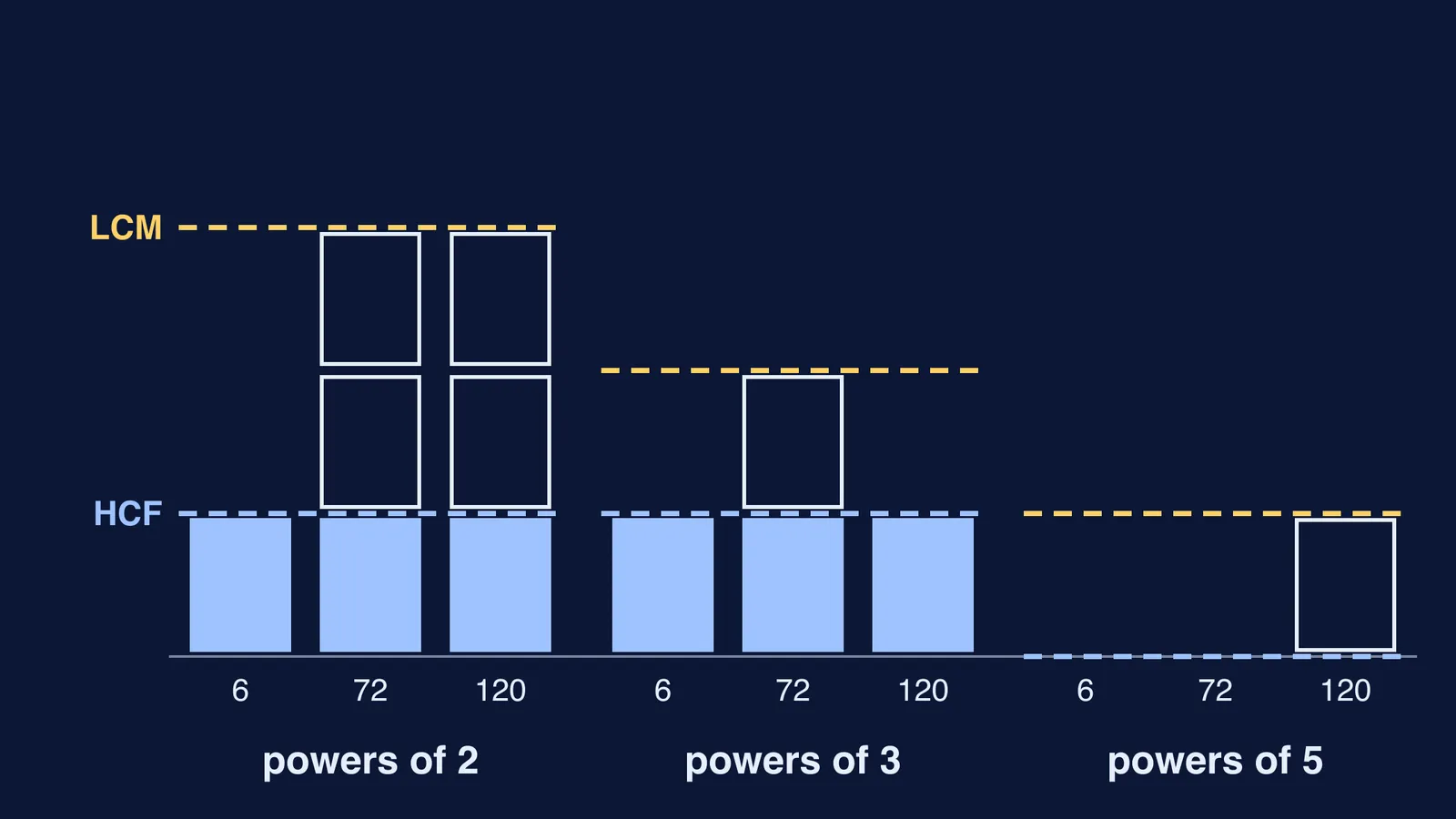
This is Example 4 in the NCERT Real Numbers chapter. 6 = 2 × 3, 72 = 2³ × 3² and 120 = 2³ × 3 × 5. Take one prime at a time, with its power in 6, 72 and 120:
Prime 2: powers 1, 3, 3. Lowest 1, highest 3.
Prime 3: powers 1, 2, 1. Lowest 1, highest 2.
Prime 5: powers 0, 0, 1. Lowest 0, highest 1.
A power of 0 means the prime is missing from that number, so 5 drops out of the HCF.
HCF(6, 72, 120) = 2¹ × 3¹ = 6.
LCM(6, 72, 120) = 2³ × 3² × 5 = 360.
Check: 6 divides all three numbers, and 360 ÷ 6 = 60, 360 ÷ 72 = 5 and 360 ÷ 120 = 3.
Why doesn't HCF × LCM equal the product for three numbers?
NCERT states that HCF(a, b) × LCM(a, b) = a × b for any two positive integers (NCERT Class 10 Mathematics, Chapter 1). Straight after the three-number example, the same textbook remarks that 6 × 72 × 120 ≠ HCF(6, 72, 120) × LCM(6, 72, 120).
6 × 72 × 120 = 51,840, but 6 × 360 = 2,160, so the product is 24 times bigger.
Look at one prime at a time. Multiplying numbers adds their powers of it. The HCF holds the lowest power and the LCM the highest, so HCF × LCM holds lowest + highest.
With two numbers, lowest + highest is simply both powers, so HCF × LCM equals the product.
With three numbers, HCF × LCM leaves out the middle power.
So the product equals HCF × LCM × (each prime raised to its middle power). For 6, 72 and 120 the middle powers are 3 for prime 2 (from 1, 3, 3), 1 for prime 3 (from 1, 1, 2) and 0 for prime 5 (from 0, 0, 1). That gives 2³ × 3 = 24, exactly the gap above.
When does the shortcut work for three numbers?
It works only when every middle power is 0: no prime divides two or more of the numbers, so they are pairwise coprime. Question 3 of NCERT's Exercise 1.1 has sets that show both cases (NCERT Class 10 Mathematics, Chapter 1):
17, 23 and 29 are primes: HCF 1, and LCM 17 × 23 × 29 = 11,339, which is also the product.
8 = 2³, 9 = 3² and 25 = 5² share no prime: HCF 1, and LCM 1,800, the product again.
12 = 2² × 3, 15 = 3 × 5 and 21 = 3 × 7 all contain 3: HCF 3 and LCM 2² × 3 × 5 × 7 = 420. The product is 3,780, three times 3 × 420 = 1,260.
Watch the word pairwise. 6, 10 and 15 have HCF 1, yet every pair shares a prime. Their LCM is 30 and their product is 900, so HCF × LCM is 30 times too small.
What should you check before writing the answer?
Does the HCF divide every number?
Does every number divide the LCM?
Did you use the product shortcut only for two numbers?
For the rest of the chapter, see our guide to real numbers in Class 10. If your answer disagrees with the book, the Fermi Problem Library has worked problems with a step-by-step solver that explains the reasoning rather than printing an answer, so you can spot the line where a power went wrong.
Next, practise choosing between them with when to use HCF or LCM in word problems.


