On this page
A hay infusion lets you grow single-celled life in a jar from dry grass and water. Over the following days a cloudy, smelly film forms on top, and a drop of it under a school microscope can hold swimming protozoa.
What is a hay infusion?
A hay infusion is water in which hay or dry grass has soaked, so that bacteria get a meal and protozoa get a supply of bacteria to eat. The idea is old: Antonie van Leeuwenhoek described "little animals" in spice infusions in a letter dated 9 October 1676, and an extract appeared in the Royal Society's Philosophical Transactions in 1677, according to the Lens on Leeuwenhoek archive.
Bacteria come first, feeding on what leaks out of the hay; protozoa such as Paramecium then feed on the bacteria.
How do you make a hay infusion step by step?
This method follows the Carolina Biological hay infusion guide and the Microbehunter guide to hay infusions. You need a handful of unsprayed dry grass or hay, a clean jar or beaker, about 0.5 to 1 litre of pond water or springwater, a dropper, slides, coverslips and a microscope.
Put the hay in the jar and fill it with the water. Pond water brings its own protozoa; if you use springwater, stir in a spoon or two of pond water to seed it.
Rest a lid or paper loosely on top, so air gets in but dust does not.
Keep it in a well-lit place at room temperature, out of direct sunlight.
Wait. Carolina says to leave it undisturbed for at least a week, notes that most organisms can be seen at 200x magnification, and suggests bubbling air in once a day with a pipette, because protozoa need oxygen.
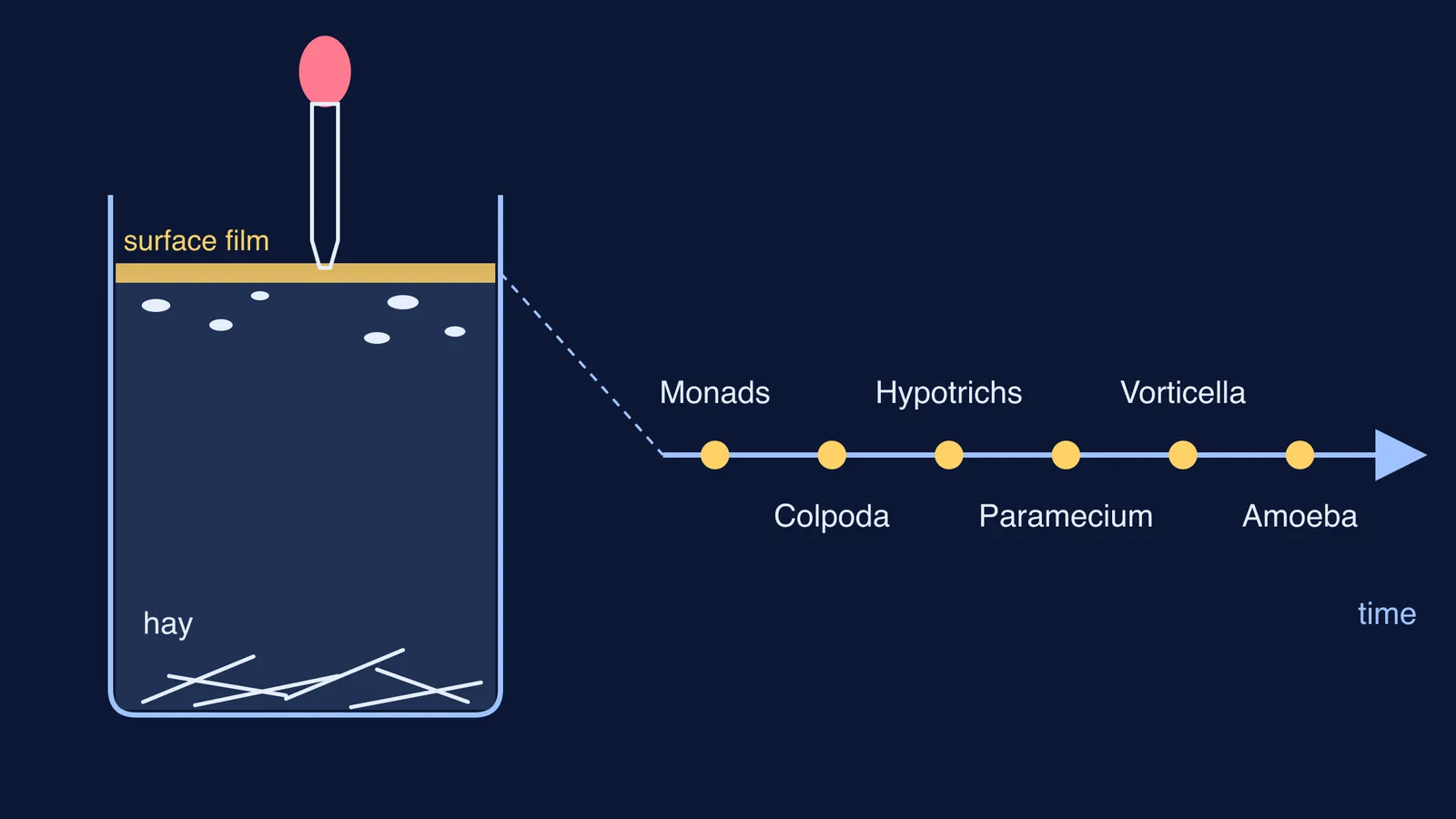
Sample from the top. Touch the dropper to the surface film, where the oxygen is, as Microbehunter advises, and put one drop on a slide under a coverslip.
Some recipes boil the hay first. Neither guide does, and boiling would not sterilise the jar: Ferdinand Cohn observed that spores of Bacillus subtilis survive periods of boiling, as a Microbial Cell review describes. If you boil, let an adult handle the pan.
In what order do protozoa appear in a hay infusion?
In 1912, Lorande Loss Woodruff at Yale seeded hay infusions with protozoa and reported a definite sequence of dominant types at the surface: first monads, then Colpoda, then hypotrichs, then Paramecium, then Vorticella and finally Amoeba. Every form except Amoeba lived chiefly at the surface, and once a form had passed its surface peak, that peak was seldom approached again. Woodruff put the sequence down to how the organisms affect each other, through food and the waste products each one releases.
Your jar will not keep to a timetable, but you can test Woodruff's order with this two-week log.
Days 0 to 3: daily, note colour, smell and whether a film has formed.
Days 4 to 7: sample the film and count organisms in five fields of view at one magnification. Record the average.
Days 8 to 14: count every second day and note the commonest shape: tiny specks, kidney-shaped Colpoda, slipper-shaped Paramecium or stalked, bell-shaped Vorticella.
After day 14: also sample the bottom. Woodruff often found cysts collecting there just after a form's surface peak.
A worked example: on day 9 your five fields show 4, 6, 3, 5 and 7 Paramecium, so the mean is 25 ÷ 5 = 5 per field. If day 11 gives 9 and day 13 gives 4, Paramecium peaked around day 11. Plot mean per field against day for each organism to get your own succession graph.
To name what you find, read our guides to the four groups of protozoans and how the contractile vacuole works in Amoeba and Paramecium, and our explainer on ecological succession.
Is a hay infusion safe to do at home?
Yes, if you treat it as a jar of unknown microbes; Microbehunter warns it may contain potentially harmful bacteria. The ASM Guidelines for Biosafety in Teaching Laboratories list basic practices that carry over to a kitchen table:
Wash your hands with soap after touching the jar, dropper or slides.
Do not eat or drink while you work, and keep the jar away from food.
Never draw liquid up with your mouth; use the dropper's bulb.
Wipe the table with disinfectant before and after.
Wear closed shoes, and gloves if you have cuts on your hands.
Make the culture safe before you throw it away. Carolina's guide says to dispose of cultures according to your district's procedures, so ask your biology teacher how they do it.
Microbehunter notes that a foul smell is normal, but bubbles rising in the water suggest methane is forming because oxygen has run out, so aerate it more. Keep the jar away from small children and pets.
For the theory behind your log, such as ecological succession and how protists feed, the Fermi Concept Library gives each biology concept its own lesson and its place in the map.