

On this page
Protozoans are fascinating single-celled organisms that exhibit a wide variety of shapes and survival strategies. In the broad scheme of biological classification, as outlined in the official NCERT Class 11 Biology chapter on Biological Classification, they fall under the Kingdom Protista. Unlike some other members of this kingdom that can photosynthesize, all protozoans are heterotrophs. This means they cannot make their own food; instead, they live either as predators hunting for microscopic prey or as parasites feeding off a host organism. Biologists believe that protozoans are the primitive relatives of animals.
Just as understanding the three algae classes compared relies heavily on identifying their major pigments and stored food types, mastering the classification of protozoans depends almost entirely on one functional trait: how they move. This functional grouping is a common theme in biology, much like how animals are categorised by their primary waste products into ammonotelic, ureotelic and uricotelic animals.
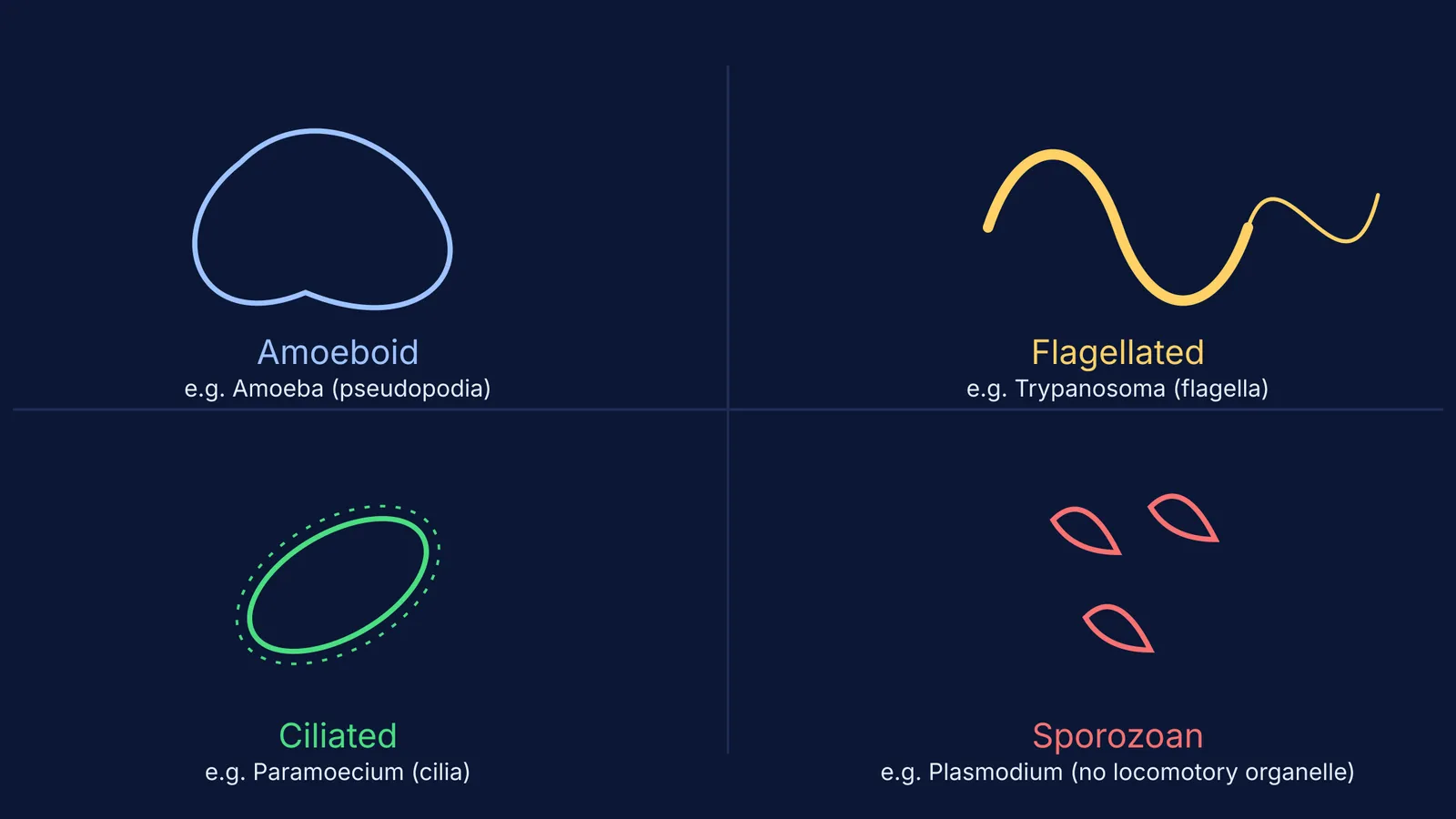
Based on their locomotory organelles, protozoans are divided into four major groups.
What are amoeboid and flagellated protozoans?
The first two groups are defined by very distinct, observable structures used for moving and feeding.
Amoeboid protozoans are found in diverse habitats, including fresh water, sea water, and moist soil. They move and capture their prey by extending pseudopodia, which literally translates to "false feet." As the cell pushes its cytoplasm in a specific direction, the pseudopodium extends, allowing the organism to crawl forward and engulf food particles. *Amoeba* is the most famous free-living example of this group. Interestingly, marine forms of amoeboid protozoans have protective silica shells on their surface. Not all of them are harmless pond-dwellers, however; some, like *Entamoeba*, are parasites that cause diseases such as amoebic dysentery in humans.
Flagellated protozoans, as their name explicitly states, possess flagella for movement. A flagellum is a long, whip-like structure that propels the cell through its fluid environment. Members of this group can be either free-living or parasitic. The parasitic forms are of significant medical importance because they can cause severe diseases. A classic example is *Trypanosoma*, the infectious agent responsible for sleeping sickness, a serious disease transmitted by the tsetse fly.
How do ciliated and sporozoan protozoans differ?
The remaining two groups contrast sharply in their level of mobility.
Ciliated protozoans are primarily aquatic and are known for being extremely active. Their high mobility is due to the presence of many tiny, hair-like structures called cilia covering their cell surface. These cilia beat in a highly coordinated, wave-like manner. Beyond just moving the organism, the cilia play a crucial role in feeding. Ciliated protozoans have a specific cavity called a gullet that opens to the outside of the cell. The synchronized movement of the rows of cilia creates a current that steers water, laden with bacteria and other food particles, directly into the gullet. *Paramoecium* is the standard textbook example of a ciliated protozoan.
Sporozoans stand out from the other three groups because they lack specific locomotory organs altogether. Instead of being defined by how they move, they are defined by a phase in their life cycle. This group includes diverse organisms that all have an infectious, spore-like stage. Because they do not have structures like pseudopodia, flagella, or cilia to propel themselves to find food, they are exclusively parasitic, relying entirely on their hosts for survival and transmission. The most notorious sporozoan is *Plasmodium*, the malarial parasite. Malaria is a disease that continues to have a staggering and devastating effect on the human population globally.
How can you actively learn protozoan classification?
Memorising the characteristics and examples of biological classifications can sometimes feel overwhelming. A highly effective active learning strategy is to teach the concepts to someone else—or even to an imaginary student—using a structured framework.
Here is a simple checklist to guide your self-explanation:
State the name of the group.
Identify the locomotory organelle (or the lack thereof).
Provide the classic NCERT example.
Mention one unique feature or disease associated with it.
For instance, you might say: "The first group is the amoeboid protozoans. They move using pseudopodia. An example is *Amoeba*, and a parasitic example is *Entamoeba*." Repeating this process for flagellated (*Trypanosoma*), ciliated (*Paramoecium*), and sporozoans (*Plasmodium*) will cement these associations in your memory.
If you are revising biological classification and finding it difficult to keep track of all the defining features across different kingdoms, the Fermi Concept Library covers every concept in physics, chemistry, biology, mathematics and computing, each with its own lesson and its place in the map. Instead of just reading a list, you can explore protozoans in their proper place, making it easier to see how they fit into the Kingdom Protista and connect visually to their characteristics.


