On this page
You have probably met this in a limits chapter: a huge power like x¹⁰⁰ on top, a plain eˣ underneath. The power looks unbeatable. The limit is still zero. Once you know one short ordering of functions, questions like this take a line instead of a page.
Which grows faster, x power n or e power x?
eˣ, for every fixed n. The free textbook OpenStax Calculus Volume 1 defines it this way: g grows more rapidly than f as x → ∞ if f(x)/g(x) → 0.
Using that definition, the same section works through x² against eˣ and ln x against x², then states that eˣ grows more rapidly than xᵖ for any p > 0, and that xᵖ grows more rapidly than ln x for any p > 0. Its own practice question pits x¹⁰⁰ against 2ˣ, and the exponential wins there too.
Put together, that gives a ladder, slowest at the bottom:
ln x, and any power of ln x
xᵖ for any p > 0, from x^0.01 and √x up to x² and x¹⁰⁰
eˣ, and aˣ for any base a > 1
Each rung beats everything below it, however big the constants or powers on the lower rung.
Small values can fool you. In the OpenStax table in that section, at x = 5 you get x⁴ = 625 while eˣ is only about 148. By x = 20, x⁴ is 160,000 and eˣ is about 485 million.
Why does eˣ beat x¹⁰⁰ in the end?
With L'Hôpital's rule. x¹⁰⁰/eˣ is of the form ∞/∞. Differentiate top and bottom: you get 100x⁹⁹/eˣ, still ∞/∞. Repeat. Each round knocks the power down by one, while eˣ stays eˣ. After 100 rounds you are left with 100!/eˣ, which goes to 0. OpenStax does exactly this for x²/eˣ in two rounds.
With logs. Take the log of the ratio: ln(x¹⁰⁰/eˣ) = 100 ln x − x. Since x is a higher rung than ln x, the −x term wins, the log heads to −∞, and the ratio heads to 0.
If you want the rule itself, with the cases where it fails, read our guide to when L'Hôpital's rule works and when it does not.
When does eˣ actually overtake x¹⁰⁰?
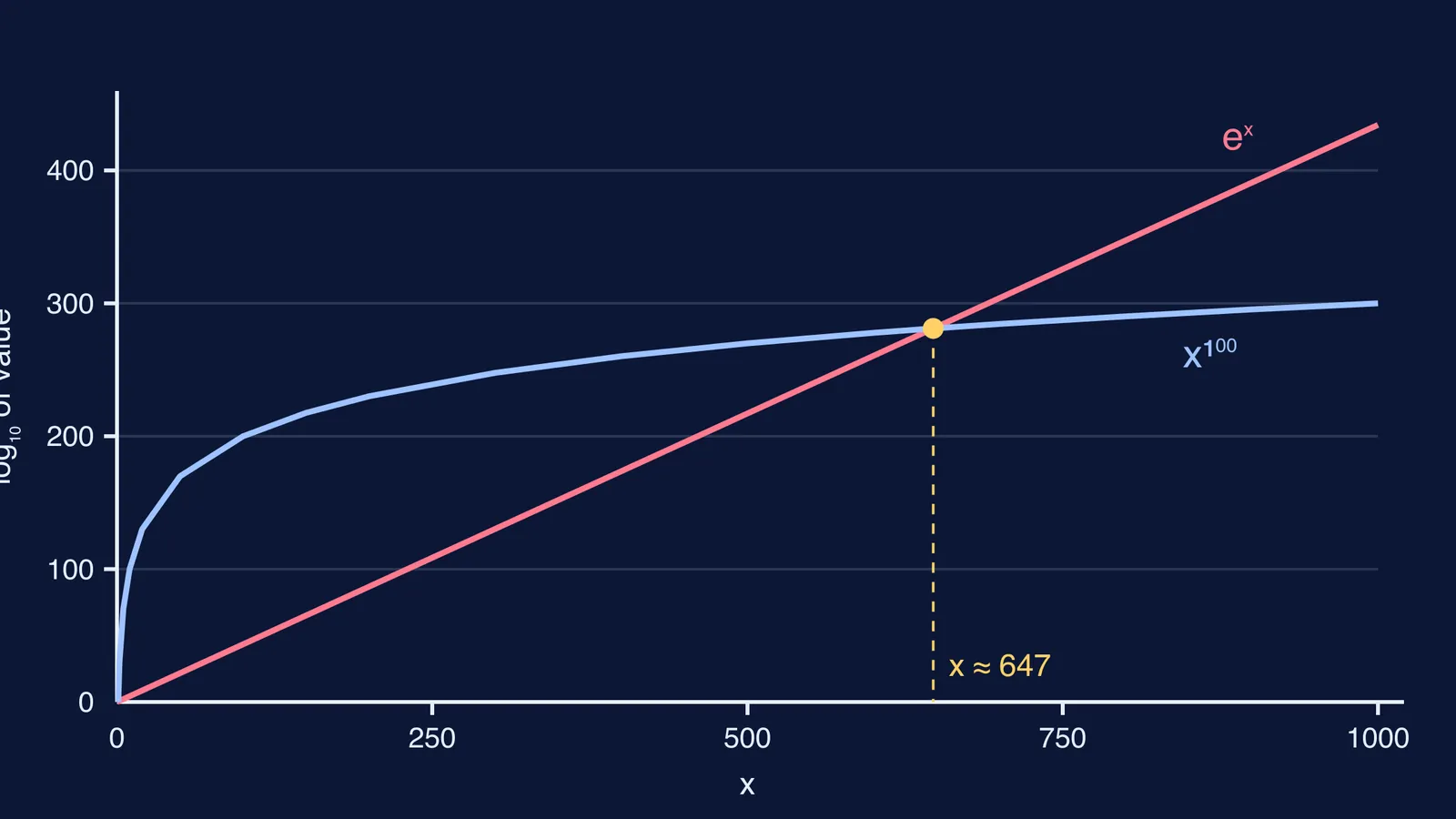
Later than most students guess. OpenStax's graphs already show that eˣ takes over from x⁴ further to the right than from x³. For x¹⁰⁰, set x¹⁰⁰ = eˣ and take logs: x = 100 ln x. Try x = 647 on a calculator: 100 ln 647 is about 647.2. So the two curves cross near x ≈ 647, and eˣ stays ahead after that.
Compare with logs to base 10 to feel the gap. At x = 100, x¹⁰⁰ is 10²⁰⁰ while eˣ is only about 10⁴³. At x = 1000, x¹⁰⁰ is 10³⁰⁰ and eˣ is about 10⁴³⁴. The lesson for exams: a limit is about what happens eventually, so never decide it by plugging in x = 10.
The bottom rung is just as slow to show itself. Solve x^0.1 = ln x the same way and you find x^0.1 pulls ahead for good only after x passes about 3.4 × 10¹⁵. For more on how a slow start hides a fast finish, see exponential versus linear growth, visualised.
How do you use the ladder in a limits question?
A three-step routine for any limit as x → ∞:
Find the fastest-growing term in the whole expression, using the ladder.
Divide numerator and denominator by that term.
Every leftover ratio of a slower term over a faster one goes to 0. Read off what remains.
Four worked examples:
lim (eˣ + x¹⁰⁰)/(2eˣ − ln x). Divide by eˣ: (1 + x¹⁰⁰/eˣ)/(2 − ln x/eˣ) → (1 + 0)/(2 − 0) = 1/2.
lim (ln x)⁵⁰/x^0.01. Put x = eᵗ: this becomes t⁵⁰/e^(0.01t), a power over an exponential, so it goes to 0. A big power of ln x still loses to a tiny power of x.
lim x¹⁰⁰/(1.01)ˣ. Write (1.01)ˣ = e^(x ln 1.01). The exponent grows like a multiple of x, so this is still an exponential and the limit is 0.
lim x ln x as x → 0⁺. This is 0 × (−∞). Put x = 1/t with t → ∞: you get −(ln t)/t, a log over a power, so the limit is 0.
Expansions handle the other end, when x → 0; our post on limits using series expansions of sin x, eˣ and ln(1 + x) covers that.
If these limits keep going wrong at the method step, the Fermi Problem Library has worked problems with a step-by-step solver that explains the reasoning rather than printing an answer. If ln x and eˣ themselves feel shaky, the Fermi Concept Library gives each concept in mathematics its own lesson.
Next time you see x¹⁰⁰/eˣ, place both on the ladder first; the answer usually follows in one line.