

On this page
Barium, strontium and calcium all give white carbonates in Group 5, so the trick is the order of tests: each reagent picks out one ion, and you read each result only once the ion tested before it has been ruled out.
Everything below follows Unit 7 of the NCERT Class 11 laboratory manual, Systematic Qualitative Analysis. For the whole flow from preliminary tests to Group 6, see our guide to the systematic approach to salt analysis.
How do you separate barium, strontium and calcium in Group 5?
The NCERT manual gives this sequence once Group 4 is absent:
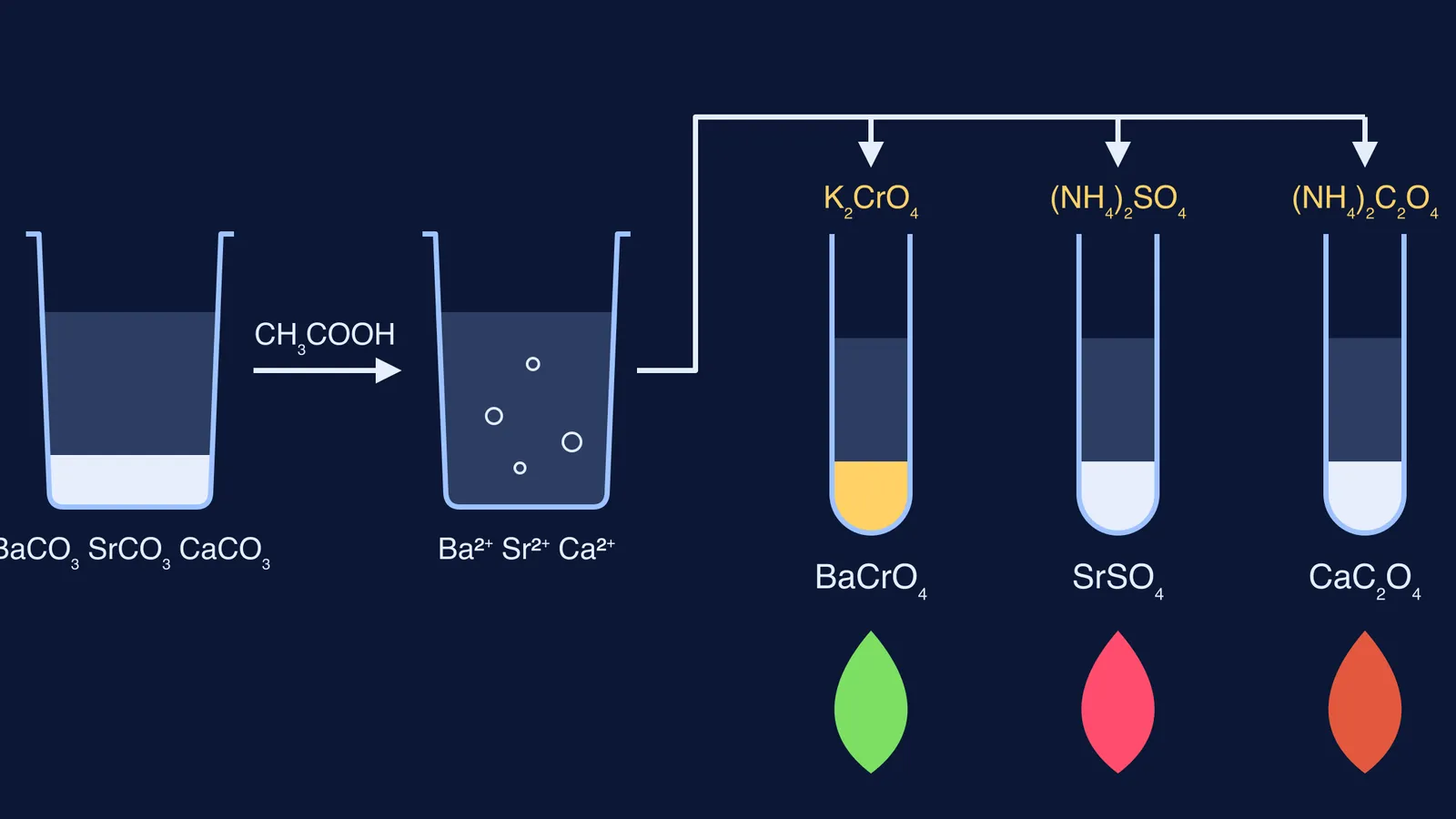
Take the original solution. Add a little solid NH₄Cl, an excess of NH₄OH, then solid ammonium carbonate. A white precipitate means Group 5 is present.
Keep a small amount of the precipitate aside for the flame test.
Dissolve the rest by boiling with dilute acetic acid, and divide the solution into three parts.
Part 1: add potassium chromate. A yellow precipitate of barium chromate shows Ba²⁺.
Part 2, if barium is absent: add ammonium sulphate, heat, scratch the inside of the tube with a glass rod and cool. A white precipitate of strontium sulphate shows Sr²⁺.
Part 3, if barium and strontium are absent: add ammonium oxalate and shake. A white precipitate of calcium oxalate shows Ca²⁺.
Flame test on the saved precipitate: grassy green for barium, crimson red for strontium, brick red for calcium, which looks greenish-yellow through blue glass.
In step 3 each carbonate becomes its acetate: BaCO₃ + 2CH₃COOH → (CH₃COO)₂Ba + H₂O + CO₂. For the physics of step 7, see why flame test colours differ.
Why is NH₄Cl added with ammonium carbonate?
Ammonium ions push the equilibrium NH₄⁺ + CO₃²⁻ ⇌ NH₃ + HCO₃⁻ to the right, which keeps the carbonate ion concentration low. The NCERT manual uses this to explain why Mg²⁺ stays in solution for Group 6. The Group 5 carbonates still precipitate: at 25 °C their solubility products are 2.58 × 10⁻⁹ for BaCO₃, 5.60 × 10⁻¹⁰ for SrCO₃ and 3.36 × 10⁻⁹ for CaCO₃, according to the LibreTexts table of solubility constants.
Why is barium tested first with potassium chromate?
Barium chromate has a solubility product of 1.17 × 10⁻¹⁰ at 25 °C (LibreTexts). Calcium chromate dissolves to about 2.25 g per 100 mL of water at 20 °C, against 2.775 × 10⁻⁴ g for barium chromate (Wikipedia solubility table). Strontium chromate sits in between, at about 0.12 g per 100 mL at 15 °C, and is soluble in dilute acids (Wikipedia).
This is why the acetic acid matters. In acid, part of the chromate turns into dichromate, which lowers the chromate ion concentration; see how pH shifts the chromate and dichromate equilibrium. Under these conditions barium chromate is the one that precipitates, so a yellow solid points to Ba²⁺.
Why ammonium sulphate for strontium and ammonium oxalate for calcium?
The sulphates follow the same pattern. At 25 °C the solubility products are 1.08 × 10⁻¹⁰ for BaSO₄, 3.44 × 10⁻⁷ for SrSO₄ and 4.93 × 10⁻⁵ for CaSO₄ (LibreTexts). Barium sulphate is the least soluble, so barium would also give a white precipitate with ammonium sulphate. That is why you look for strontium only after barium has been ruled out. Calcium sulphate has a Ksp over a hundred times larger than strontium sulphate, so calcium mostly stays in solution.
Calcium oxalate dissolves to only about 6.7 × 10⁻⁴ g per 100 mL of water at 20 °C (Wikipedia solubility table). Barium oxalate dihydrate is also sparingly soluble, at about 0.003 g per 100 mL at 20 °C in the same table, so a white oxalate precipitate means calcium only once barium and strontium are ruled out.
Worked example: reading your observations
Your salt gives a white precipitate with NH₄Cl, NH₄OH and ammonium carbonate. A clean record reads:
Part 1 + potassium chromate: no yellow precipitate. Ba²⁺ absent.
Part 2 + ammonium sulphate, heated, scratched, cooled: no precipitate. Sr²⁺ absent.
Part 3 + ammonium oxalate: white precipitate. Ca²⁺ likely.
Flame test: brick red, greenish-yellow through blue glass. Ca²⁺ confirmed.
Three slips to avoid:
Calling a white precipitate in Part 2 strontium before ruling out barium.
Judging Part 2 before you have heated, scratched and cooled the tube, as the manual asks.
A dirty wire: the manual says dip the platinum wire in concentrated HCl and heat until it colours the flame no more.
If the Ksp reasoning still feels shaky, the Fermi Concept Library gives every chemistry concept its own lesson, so you can revisit solubility product and the common ion effect, and the Fermi Problem Library has worked problems with a step-by-step solver that explains the reasoning.
Before your practical, write the three test equations from memory and check them against the manual's chemistry of the Group 5 confirmatory tests.


