

On this page
Dip a clean wire loop in a salt, hold it in a Bunsen flame, and the flame changes colour. In the chemistry practical, that colour is often your first clue to the metal ion. Here is what each colour is, why it appears, and how a piece of blue glass stops sodium from hiding potassium.
What happens to electrons in a flame test?
The heat of the flame promotes electrons to higher energy levels, and as they fall back to lower levels the energy is released as light, as Chemistry LibreTexts explains in its page on flame tests/Descriptive_Chemistry/Elements_Organized_by_Block/1_s-Block_Elements/Group__1%3A_The_Alkali_Metals/2Reactions_of_the_Group_1_Elements/Flame_Tests). Each fall releases a fixed amount of energy, and each amount matches one wavelength of light. Every element has its own ladder of energy levels, so every element gives its own set of wavelengths, and your eye blends them into one colour.
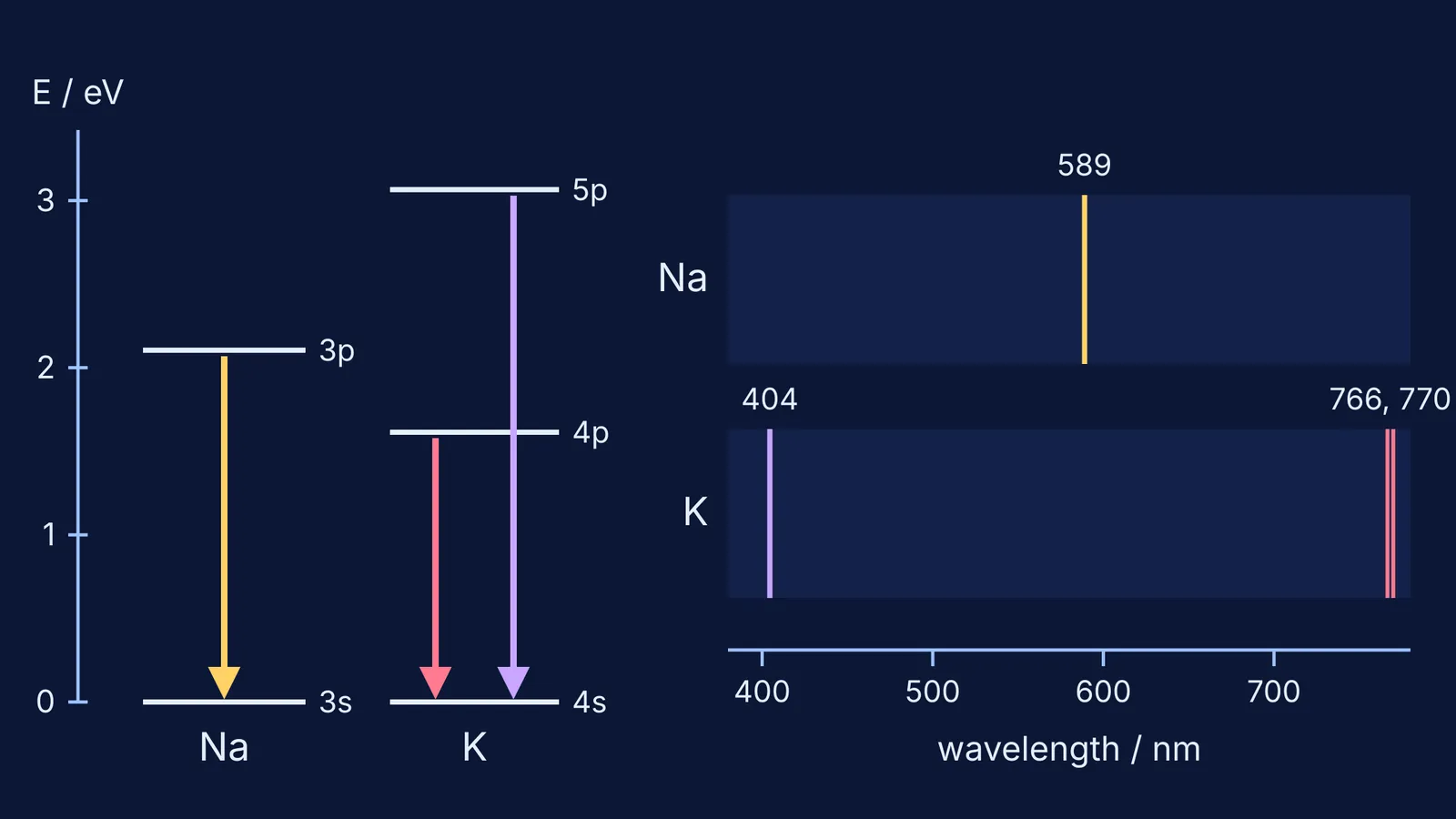
For sodium, the same LibreTexts page says the orange-yellow comes from electrons falling from the 3p level back to the 3s level. The NIST Handbook of Basic Atomic Spectroscopic Data lists the two strong sodium lines at 588.995 nm and 589.592 nm.
These colours have a history too. Wikipedia's flame test article records that in 1860 Bunsen and Gustav Kirchhoff saw an unexpected sky-blue and dark red in spectral emissions, which led to the discovery of caesium and rubidium. Our post on Robert Bunsen, his burner and the discovery of caesium tells that story.
What colour does each metal ion give in a flame test?
The Royal Society of Chemistry's flame test sheet gives these colours:
Sodium: bright yellow
Potassium: pale lilac
Calcium: orange-red
Strontium: red
Barium: pale green
Copper: green with streaks of blue
You will see other names for the same colours. The chart in the Wikipedia flame test article gives golden for sodium, brick or orange red for calcium, crimson to scarlet for strontium, light apple green for barium and green or blue-green for copper. Use the words in your own lab manual, because those are the words your examiner will look for.
Do strontium and barium colours come only from atoms?
Not entirely. In a 1956 paper in the Proceedings of the Physical Society, Monique Charton and A. G. Gaydon attributed several bands in the red part of the strontium spectrum to SrOH, and bands of barium in the green to BaOH (DOI: 10.1088/0370-1298/69/7/303). These are small molecules formed in the flame. The energy-level idea still holds, but for these metals some of the levels belong to molecules rather than lone atoms.
How does cobalt blue glass help you see potassium?
Sodium is everywhere. The Science Olympiad flame test guide warns that sodium compounds colour the flame yellow even in trace amounts, that sweat from your hands can contaminate a splint, and that potassium's violet is masked by sodium. Its fix: look through cobalt blue glass, which absorbs the yellow so the other flame can be seen. With sodium present, the same guide describes potassium through cobalt glass as purple-red.
The spectra show why this works. The NIST table for potassium lists its strongest lines at 766.490 nm and 769.896 nm in the deep red, with another pair at 404.414 nm and 404.721 nm in the violet. Sodium's light sits in a narrow band near 589 nm, so glass that removes yellow can leave potassium's red and violet. That mix of red and violet also helps explain why potassium looks lilac to the naked eye.
Worked example: from flame colour to energy gap
Use E (in eV) = 1240 / λ (in nm), which our post on the quick photon-energy formula E = 1240/λ derives. Take the NIST wavelengths above.
Sodium, 589 nm: E = 1240 / 589 = 2.1 eV. This is the gap between the 3p and 3s levels.
Potassium red, 766.5 nm: E = 1240 / 766.5 = 1.62 eV.
Potassium violet, 404.4 nm: E = 1240 / 404.4 = 3.07 eV.
Potassium's violet photon carries almost twice the energy of its red one, because the electron falls from a higher level: a bigger fall, a shorter wavelength.
That last point matters. The RSC sheet pairs flame tests with sodium hydroxide tests: calcium ions, for example, give a white precipitate of Ca(OH)2 that remains when more sodium hydroxide is added. Our guide to a systematic approach to salt analysis in the chemistry practical walks through the group reagent and precipitate tests that do that confirming.
If the jump from colour to energy level still feels shaky, the Fermi Concept Library has a lesson for every concept in chemistry and physics, each with its place in the map. For numericals on wavelengths and energy gaps, the Fermi Problem Library has worked problems with a step-by-step solver that explains the reasoning rather than printing an answer.


