On this page
A chemistry question gives you four colloids and four gold numbers and asks you to rank their protective power. The whole trick fits in one line: the smaller the gold number, the stronger the protection. Here is where the number comes from, why gelatin wins, and a quick method for ranking any list.
What is the gold number of a protective colloid?
Gold number is the minimum mass, in milligrams, of a protective colloid that stops 10 mL of a standard gold sol from coagulating when 1 mL of 10% sodium chloride solution is added (Wikipedia: Gold number).
The test comes from Richard Zsigmondy, who published it in 1901. His 1909 book Colloids and the Ultramicroscope, translated by Jerome Alexander, describes it this way: bright red colloidal gold turns violet when salt is added, and the "gold figure" is the number of milligrams of colloid that is just not enough to prevent that change (Zsigmondy, 1909, on archive.org). Today's textbooks say "minimum amount that prevents it". Both describe the same boundary, so use the textbook wording in your answer.
Why does salt matter? A gold sol is lyophobic: its particles stay apart because each carries the same charge. Sodium chloride disturbs that charged layer, the particles clump, and the colour shifts from red to blue or purple (Wikipedia: Gold number). A lyophilic colloid such as gelatin forms a layer around the gold particles that prevents direct collisions, so they cannot clump (Wikipedia: Protective colloid).
Why is a lower gold number better?
The gold number measures how much protector you need. If a hundredth of a milligram of gelatin does the job and potato starch needs about 25 mg for the same job, gelatin is the stronger protector. Zsigmondy suggested flipping the number: "The protective action may be better expressed by the reciprocal of the gold figures," which gives gelatin a protective action of 100 to 200 (Zsigmondy, 1909).
Why does gelatin protect better than starch?
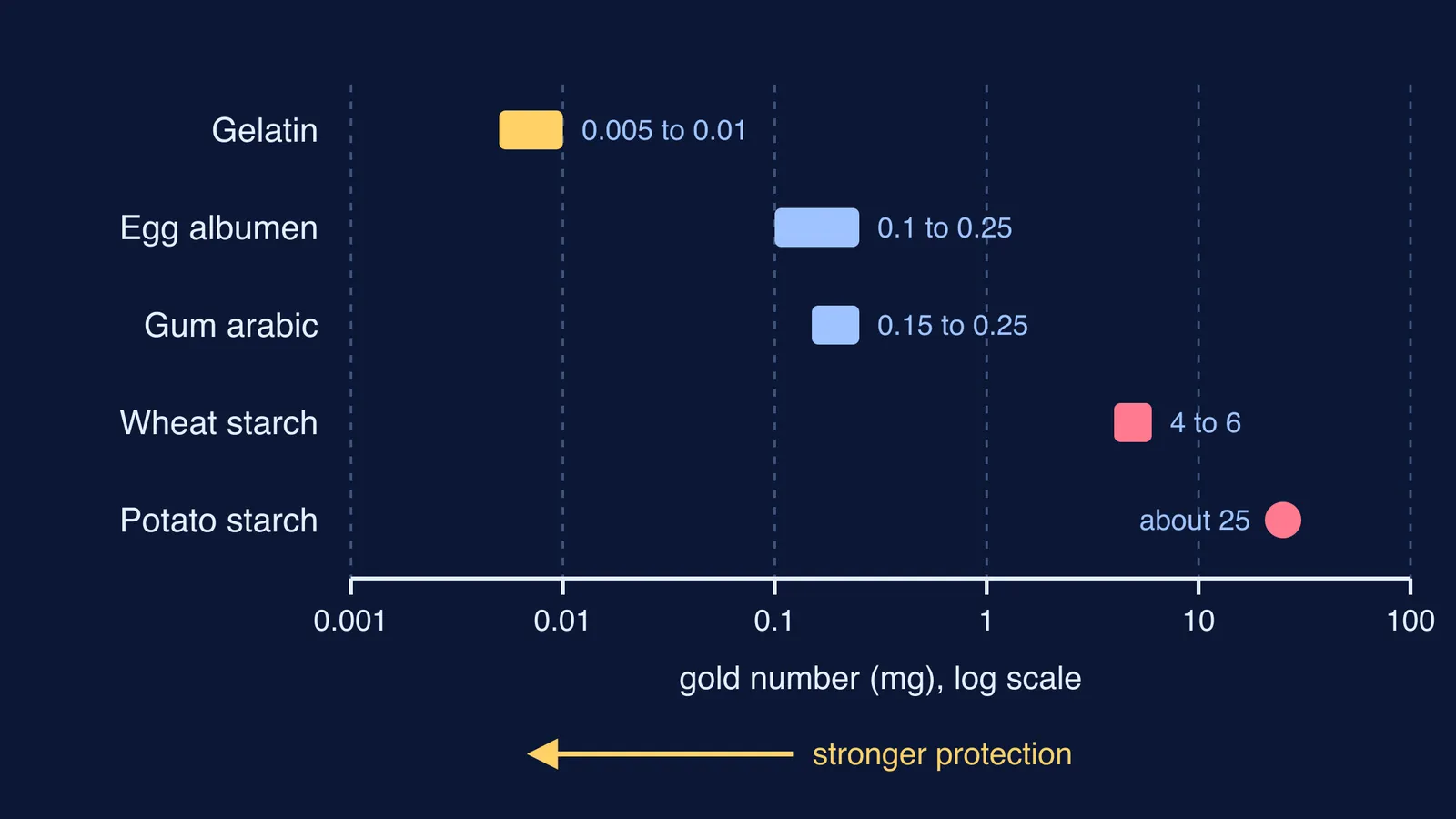
Zsigmondy's table of commercial colloids gives these gold numbers, in milligrams (Zsigmondy, 1909):
Gelatin: 0.005 to 0.01
Egg albumen: 0.1 to 0.2 and 0.15 to 0.25 (two commercial samples)
Gum arabic: 0.15 to 0.25 for one commercial sample; his other samples ranged from 0.1 to 4
Sodium oleate: 0.4 to 1
Wheat starch: about 4 to 6
Potato starch: about 25
Two ideas explain the gap. First, it is not about making the liquid thicker. Zsigmondy found that as little as 0.0001 per cent of gelatin can protect a gold sol, far too little to change its viscosity; what gelatin prevents is the clumping itself, not the settling (Zsigmondy, 1909).
Second, gelatin is a protein with reactive side groups. A 2010 study in Nanoscale Research Letters by Ying Liu, Xiaoheng Liu and Xin Wang lists amine (-NH2), thiol (-SH) and carboxyl (-COOH) groups in the gelatin chain, and found that the absorption peak of gelatin-stabilised gold nanoparticles stayed stable even at higher sodium chloride concentrations (Liu, Liu and Wang, 2010). Starch is a chain of glucose units without those groups. A reasonable exam-level picture is that it holds on to the gold less firmly, so you need far more of it to protect the particles. Zsigmondy's table records the difference, not its cause, and the full surface chemistry is more complicated.
How do you rank protective colloids from given gold numbers?
Exam questions often give single values, either made up or close to the ones in Zsigmondy's table (Zsigmondy, 1909). Try this one: A = 0.01, B = 2.5, C = 0.15, D = 25 (all in mg).
Check the units match. If one value is in grams or micrograms, convert it to milligrams first.
Sort the gold numbers from smallest to largest: A (0.01), C (0.15), B (2.5), D (25).
That list is already the order of decreasing protective power: A > C > B > D.
If the question asks how many times stronger, divide: 25 / 0.01 = 2,500, so A is 2,500 times as protective as D.
Read the question's wording twice. "Increasing order of gold number" and "increasing order of protective power" are opposite lists.
Check yourself with Zsigmondy's values: gelatin (0.005 to 0.01) > egg albumen (0.1 to 0.25) > wheat starch (about 4 to 6) > potato starch (about 25).
If ranking questions still trip you up, the Fermi Problem Library has worked problems with a step-by-step solver that explains the reasoning rather than printing an answer. For the ideas underneath, such as lyophilic and lyophobic sols and coagulation, each concept has its own lesson in the Fermi Concept Library.
Next time you see a gold number question, sort smallest to largest and you have your answer.