On this page
Pour glycerol from a bottle and it moves like honey. Heat it and it barely steams until it is far hotter than boiling water. Both facts have one cause: three OH groups on a small molecule. Once you see how that works, you can answer a whole family of board and JEE Main questions about boiling points and viscosity with the same few steps.
What makes glycerol different from propanol?
Glycerol is propane-1,2,3-triol: a three-carbon chain with an OH group on every carbon. Its molar mass is 92.09 g/mol and it has 3 hydrogen-bond donors, according to PubChem's glycerol record.
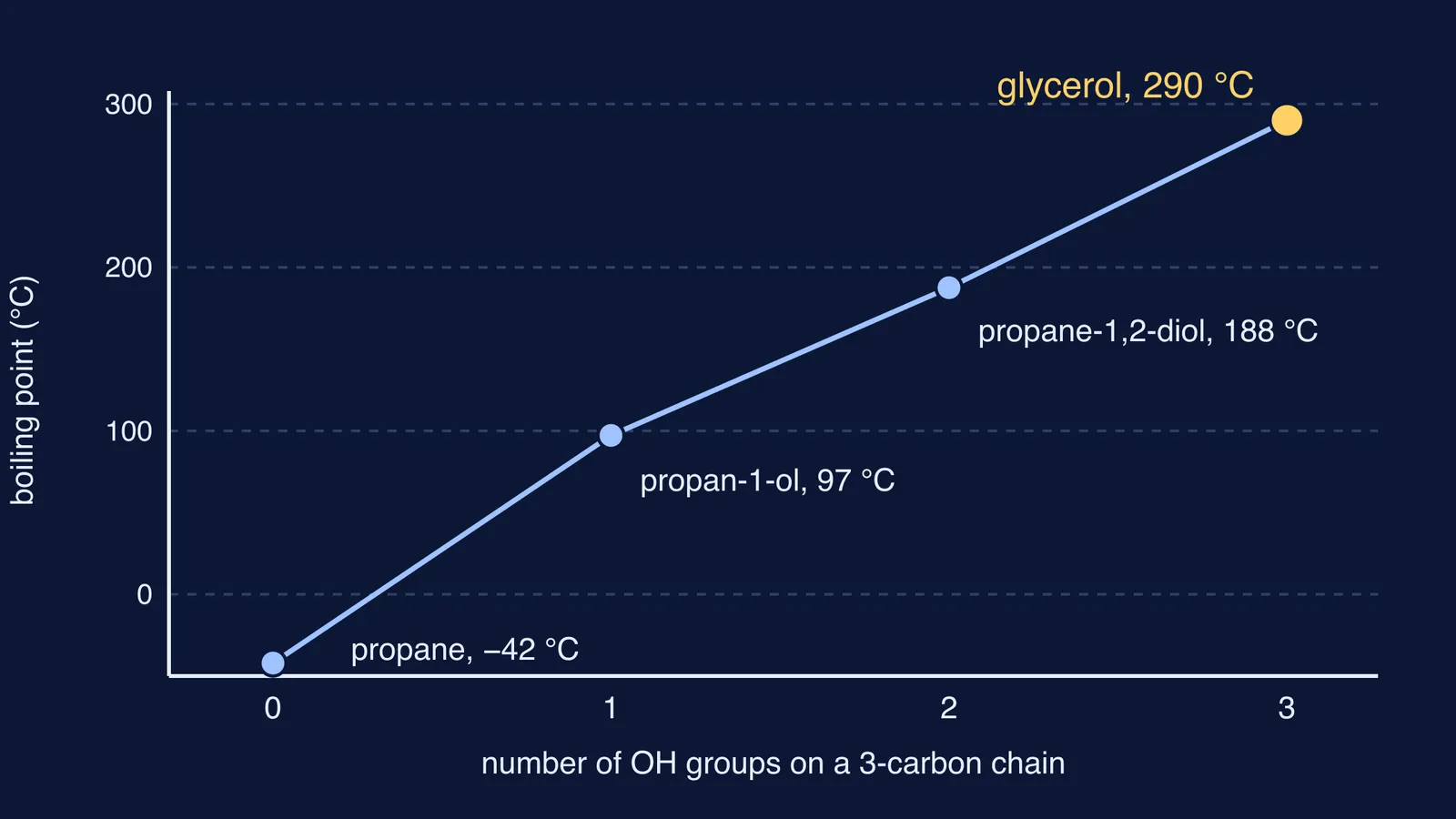
The neat way to see what those OH groups do is to keep the three-carbon chain and add them one at a time. All the numbers below are from PubChem: propane, propan-1-ol, propane-1,2-diol and glycerol.
Propane, no OH: 44.10 g/mol, boils at −42 °C.
Propan-1-ol, one OH: 60.10 g/mol, boils at 97 °C.
Propane-1,2-diol, two OH: 76.09 g/mol, boils at 188 °C.
Glycerol, three OH: 92.09 g/mol, boils at 290 °C.
The molar mass only roughly doubles across the series, while the boiling point climbs by more than 330 degrees. Something other than size is doing most of the work.
Why does glycerol have such a high boiling point?
Every OH group can do two jobs. Its hydrogen can bond to an oxygen on a neighbouring molecule, and its oxygen can accept a hydrogen from another neighbour. With three OH groups, one glycerol molecule can be tied to several others at once, and they are tied to others in turn. The result is not a set of pairs but a network running through the liquid.
Experiments support this picture. In a 2011 study, Towey, Soper and Dougan used neutron diffraction data on liquid glycerol at 298 K to build a three-dimensional model of the liquid. They found that the number of hydrogen bonds per molecule is larger than had previously been suggested, and found no evidence for hydrogen bonds within a single molecule (abstract on PubMed; DOI 10.1039/c0cp02136a). That second point matters: the OH groups spend their bonding on neighbours, which is what builds the network.
To boil, a molecule must break free of its neighbours and escape into the gas. In glycerol that means breaking several hydrogen bonds per molecule, so you need a much higher temperature before the vapour pressure reaches 1 atmosphere. PubChem lists glycerol's normal boiling point as 290 °C and notes that it decomposes there (PubChem). The same record gives lower boiling points at reduced pressure, for example 182.2 °C at 20 mm Hg. Lowering the pressure lets glycerol boil well below the temperature where it breaks down; see distillation under reduced pressure and why glycerol needs it.
Why is glycerol so viscous?
Viscosity is a liquid's resistance to flow. For a liquid to flow, molecules must keep sliding past one another, which means constantly breaking and remaking contacts with neighbours. In glycerol those contacts are hydrogen bonds in a network, so every step of flow is slow.
PubChem lists glycerol's viscosity as 954 centipoise at 25 °C, against 2.256 centipoise at 20 °C for propan-1-ol (glycerol, propan-1-ol). That is a factor of about 420, even though the propanol figure was taken at a cooler temperature; liquids get runnier as they warm, so at the same temperature the gap would be wider still. The same glycerol record gives just 17 centipoise for a 70% solution in water, so diluting glycerol thins it sharply.
One centipoise is one millipascal second; if the units trip you up, see our guide to the SI unit of viscosity and how to convert poise.
How do you answer a "which boils higher" question?
Here is a worked example. Arrange in increasing order of boiling point: propan-1-ol, glycerol, propane, propane-1,2-diol.
Check for hydrogen bonding. Propane has no OH or NH, so it has only weak dispersion forces. It comes first.
Count the OH groups in the rest: one, two, three. More OH groups means more hydrogen bonds per molecule.
Check that size does not overturn the order. Here the molecules with more OH groups are also heavier, so both effects point the same way.
Write the answer: propane < propan-1-ol < propane-1,2-diol < glycerol. The data above (−42, 97, 188, 290 °C) confirm it.
Use the same three checks for viscosity questions: hydrogen bonding first, then the number of groups that can form it, then size and shape.
If intermolecular forces still feel shaky, the Fermi Concept Library gives hydrogen bonding its own lesson and its place in the map of chemistry concepts. When you want to practise ranking questions, the Fermi Problem Library has worked problems with a step-by-step solver that explains the reasoning rather than printing an answer.